


For years, organic visibility was measured using familiar indicators such as rankings, impressions, and click-through rates. However, with AI answer engines now synthesizing responses directly, these traditional metrics may no longer fully capture performance, prompting marketers to reconsider how they evaluate success.
AI-powered answer engines are transforming how information is delivered and consumed by acting as intermediaries that synthesize responses directly, shifting the focus from website traffic to content influence.
Visibility Without Clicks Is Becoming the Norm
The expansion of AI summaries, featured snippets, and conversational search interfaces has accelerated a long-running trend toward zero-click behavior. Users are receiving answers immediately, often without ever viewing the underlying source pages.
The Reality of “Zero-Click” Search
According to data from SparkToro and Similarweb, a majority of Google searches (nearly 60%) now end without a click.
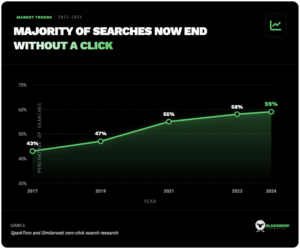
Visibility without clicks is becoming the norm, emphasizing that content influence now matters more than traditional metrics, helping marketers feel valued for their true impact.
In this environment, content can influence outcomes without generating visits. Recognizing this influence helps marketers feel valued for the actual impact of their content, even if the originating page never receives traffic.
Why Rankings No Longer Tell the Full Story
Rankings were designed for an era when search engines primarily listed links. Their relevance diminishes as AI systems collapse discovery and delivery into a single step. A page can rank well and still be excluded from AI-generated responses if it lacks clarity or structural suitability.
Recent analysis of the limitations of ranking-centric optimization highlights that answer engines favor content that directly resolves intent over content optimized primarily for competitive positioning. One such breakdown is outlined in a detailed examination of why traditional SEO frameworks struggle in AI-driven search environments.
This shift reframes the purpose of optimization, empowering marketers to be confident that their content’s value now lies in influence, not just rankings.
Answer Engines Evaluate Content Differently
AI-driven systems rely on different signals than conventional search algorithms, such as semantic clarity, consistent terminology, and alignment with recognized entities. To optimize content, content strategists should clearly define concepts and maintain consistency across related materials, making their content more likely to be extracted and reused by search engines.
Language models are trained to identify patterns across large datasets. Content that defines concepts clearly and consistently across contexts is easier to extract and reuse. By contrast, content that prioritizes persuasion, novelty, or brand voice over explanation is often ignored.
A recent Pew Research Center study found that users increasingly trust AI-generated answers to informational queries. As confidence in these systems grows, the importance of being represented within answers rises accordingly.
New Metrics for an Answer-First Landscape
If rankings and traffic no longer capture visibility, marketers must identify alternative indicators. These metrics are less standardized, but they are becoming increasingly important.
Emerging visibility signals include:
- Whether an entity’s concepts appear consistently across AI-generated answers
- How frequently are definitions or frameworks paraphrased in responses
- Whether the terminology introduced by a source becomes normalized in AI outputs
- The presence of content within summaries, snippets, and conversational interfaces
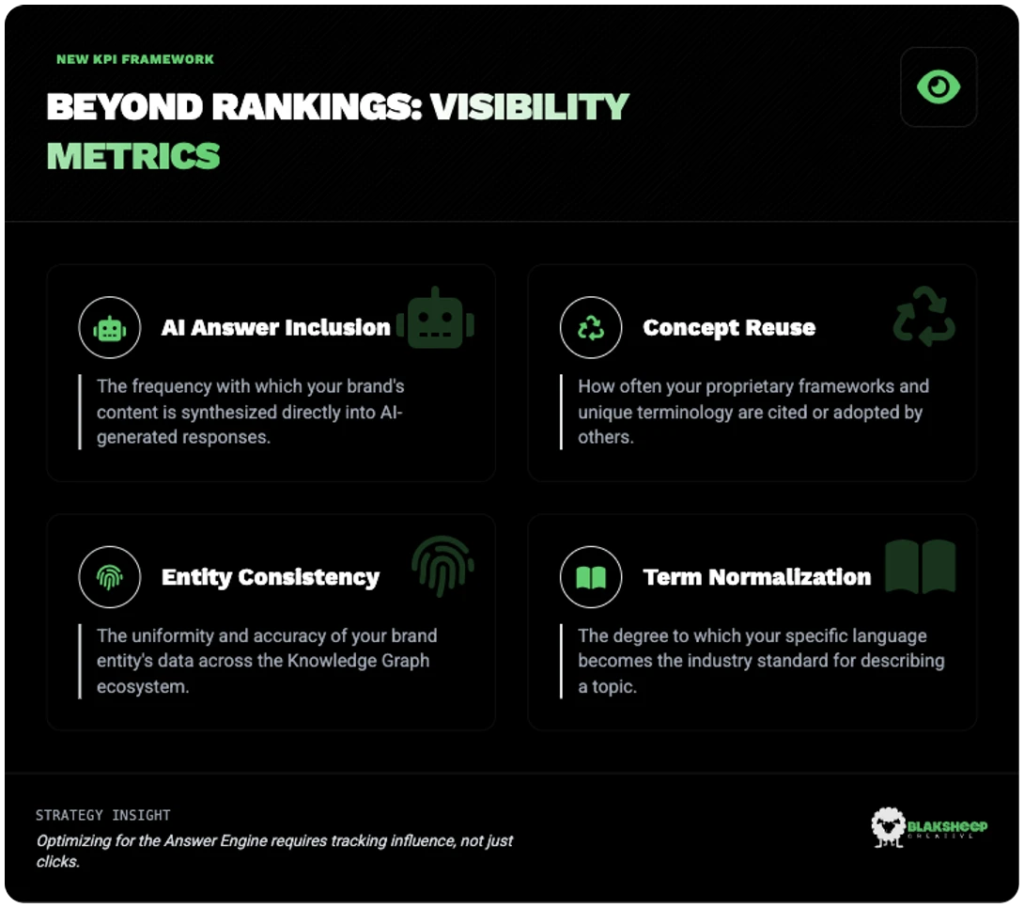
These signals reflect influence rather than engagement. They measure whether content shapes the information users receive, not whether users click through to a page.
Authority Is Reinforced Through Consistency
AI systems compare explanations across sources, so reinforcing authority through consistent, clear messaging across related content helps marketers feel assured about their credibility.
This means authority is no longer established solely through backlinks or brand recognition. It is reinforced through repetition, clarity, and alignment across related content. Entities that articulate ideas clearly and consistently are more likely to be reflected in generated answers.
Research on large language models shows that fragmented messaging reduces the likelihood of reuse. Content strategies that emphasize cohesion across articles, definitions, and explanations perform better in answer-driven systems.
The Strategic Implications for Marketers
The rise of AI-powered answer engines does not eliminate the need for SEO fundamentals. Instead, it expands the scope of optimization. Technical health and discoverability remain prerequisites, but they are no longer differentiators.
Visibility now depends on whether content can be understood, trusted, and reused by machines. This requires closer collaboration between subject-matter experts, editors, and technical teams. It also requires patience, as influence in answer engines compounds gradually.
As AI-mediated search continues to mature, organizations that rely exclusively on traditional performance metrics risk underestimating their exposure. Conversely, those that adapt measurement frameworks to include answer-based visibility may gain a clearer picture of their actual influence.
Organic Visibility Is Being Redefined
The evolution of search toward AI-generated answers represents a structural shift rather than a temporary trend. Visibility is no longer defined solely by where content appears, but by whether it shapes the responses users receive.
In this environment, optimization becomes an exercise in clarity and consistency. Rankings still matter, but understanding matters more. As answer engines continue to redefine discovery, influence will belong to those whose content is built to be reused, not just ranked.