






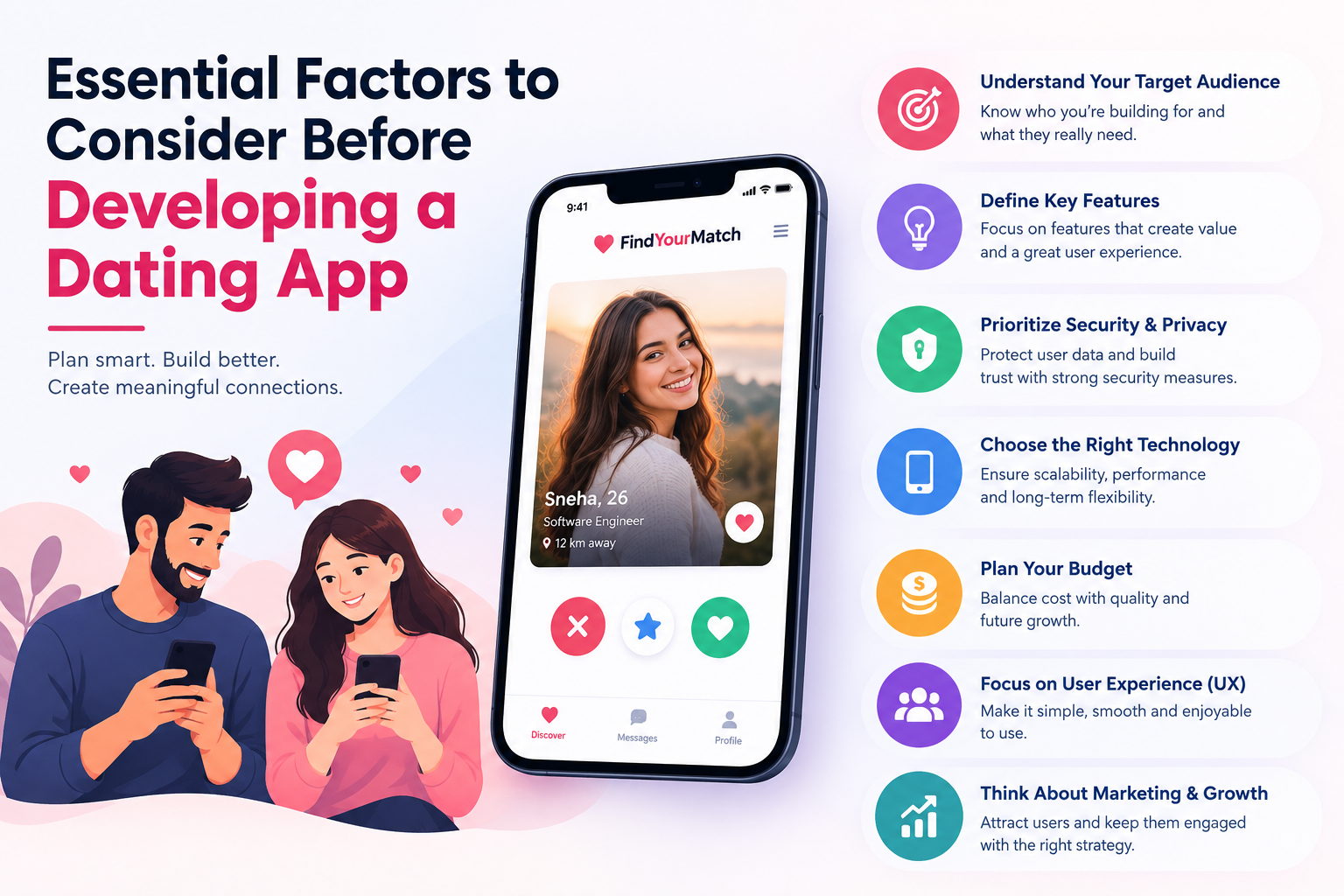
Online dating has changed the way people discover relationships, communicate with potential partners, and build meaningful connections. Instead of relying entirely on traditional introductions or social gatherings, users can now explore compatible people through mobile applications. This shift has created opportunities for businesses to introduce dating platforms that serve different audiences, relationship goals, and social preferences.
However, launching a successful dating application requires much more than creating user profiles and adding a matching feature. The platform must offer a comfortable user experience, protect personal information, encourage genuine interactions, and provide enough value to keep people returning. It also needs a clear business model and a reliable technical foundation that can support future growth.
For entrepreneurs planning to enter this competitive market, understanding the essential considerations before development begins can prevent expensive mistakes. From identifying the right audience to selecting suitable technologies, every decision influences the application’s performance and long-term potential.
1. Identify Your Target Audience and Market Demand
The first step in developing a dating application is understanding who will use it and what they expect from the experience. Creating a platform for everyone might appear attractive, but a broad audience can make it difficult to establish a recognizable identity in a crowded marketplace.
Consider whether the application will serve people looking for long-term relationships, casual dating, shared interests, professional communities, or connections within a particular age group. If you plan to make an app like Tinder, identifying your target audience and understanding its dating preferences can help you create a more engaging platform with relevant features and personalized matching options.
Once the intended audience is defined, research its existing challenges. Some users may feel overwhelmed by too many matches, while others might struggle to identify genuine profiles or find people with compatible interests.
Market research can include surveys, interviews, competitor analysis, and reviews of existing dating applications. Pay attention to complaints about fake accounts, irrelevant recommendations, complicated registration, and poor communication experiences.
The objective is to discover a genuine user need rather than simply reproduce an existing product. A clearly defined audience helps shape the application’s features, branding, marketing strategy, and overall development priorities.
2. Create a Clear Value Proposition
A dating app needs a convincing reason for people to choose it over established alternatives. Without a distinct value proposition, even a technically advanced platform may struggle to attract consistent users.
Your value proposition should explain what makes the application useful and different. For example, the platform might prioritize compatibility over appearance, provide better profile verification, support interest-based introductions, or create a more accessible experience for users with different needs.
Think about the complete experience rather than relying on one unusual feature. A dating application could stand out through transparent matching preferences, thoughtful conversation prompts, better privacy controls, or tools that help users communicate comfortably.
Avoid adding features merely because competing platforms offer them. Each feature should support the product’s central purpose and solve a recognizable problem.
Before development starts, summarize the application’s primary benefit in one or two sentences. This statement will guide product decisions and help designers, developers, and marketers work toward the same objective.
3. Study Competitors and Identify Market Gaps
Competitor research helps businesses understand the current dating app landscape and identify opportunities for differentiation. Popular platforms can provide useful examples of successful onboarding, profile design, matching systems, and subscription options.
However, copying a competitor’s interface or feature set is unlikely to produce a sustainable advantage. Instead, examine how existing applications serve their users and where their experiences could improve.
Evaluate factors such as registration requirements, profile quality, search filters, communication options, pricing, safety features, and customer support. Public reviews can reveal recurring frustrations that are not immediately visible when testing an application.
For instance, users might complain about receiving irrelevant recommendations or finding it difficult to control who can view their profiles. Such observations can inspire practical product improvements.
Create a comparison document that records competitor strengths, weaknesses, pricing structures, and underserved audiences. Use the findings to identify opportunities that align with your own resources and business objectives.
The purpose of competitor analysis is not to imitate market leaders. It is to understand user expectations and develop a more focused, valuable alternative.
4. Select the Right Features for the First Version
Feature planning has a direct impact on development time, project cost, and product complexity. Adding too many capabilities to the initial release can delay launch and make it harder to determine which features actually matter to users.
A minimum viable product, or MVP, allows a business to introduce a functional version of the application with its most important capabilities. Feedback from real users can then guide future improvements.
Common features to consider include:
- User registration: Provide straightforward sign-up through supported methods such as email, phone number, or third-party authentication.
- Profile creation: Allow users to add photographs, biographies, interests, and relevant relationship preferences.
- Matching functionality: Recommend profiles using selected preferences, location settings, interests, and other relevant signals.
- Discovery and filters: Help users explore potential connections without overwhelming them with unnecessary options.
- Messaging: Support conversations between eligible users and provide controls for managing unwanted interactions.
- Notifications: Inform users about relevant activity while allowing them to control notification frequency.
- Reporting and blocking: Make it easy to report suspicious behavior and prevent further contact from unwanted accounts.
- Account settings: Give users control over privacy preferences, subscriptions, and account deletion.
Additional features, such as video calls, advanced recommendation systems, paid boosts, and event-based matching, can be introduced when user feedback justifies them.
A well-planned initial release should deliver a complete and trustworthy core experience rather than a long list of unfinished capabilities.
5. Prioritize User Experience and Interface Design
Dating applications depend heavily on how users feel while navigating the platform. If registration is confusing, profiles are difficult to understand, or important controls are hidden, users may leave before discovering the application’s value.
The interface should make common actions easy to understand. Users need to create profiles, explore recommendations, manage preferences, and communicate with minimal friction.
Visual design also influences the atmosphere of a dating platform. Typography, colors, photography, spacing, and animation should support the intended audience rather than distract from the primary experience.
For example, a relationship-focused application may benefit from a calm, welcoming interface, while a community-oriented dating platform might emphasize shared activities and interests.
Accessibility deserves equal attention. Readable text, sufficient color contrast, clear error messages, and appropriately sized touch targets help people interact with the application more comfortably.
Before launch, conduct usability testing with people who resemble the intended audience. Observe where they hesitate, misunderstand instructions, or abandon tasks. These findings can reveal problems that internal teams might overlook.
Good design is not simply about making an application attractive. It is about helping people use it confidently and comfortably.
6. Build Privacy and Security Into the Product
Dating applications can handle particularly personal information, including photographs, location preferences, conversations, relationship interests, and identity details. A privacy or security failure can damage user trust and create serious legal and operational consequences.
Security should therefore be considered during the earliest stages of product planning rather than added after development is complete.
Use secure authentication, appropriate access controls, encrypted network connections, and carefully designed data storage. Sensitive information should only be collected when necessary, and access should be restricted to authorized systems and personnel.
Location data requires special care. Users should understand when location information is being used and have meaningful control over location-related features. Avoid exposing precise locations or creating interfaces that make it easy to infer someone’s private movements.
The application should also provide clear privacy settings, transparent consent mechanisms, and practical options for downloading or deleting personal information where applicable.
Businesses must evaluate the privacy laws and consumer protection requirements relevant to the countries where the application will operate. Depending on the audience and jurisdiction, these may include requirements concerning consent, children’s access, data retention, and users’ rights over personal information.
Regular security testing, dependency updates, vulnerability assessments, and an incident response plan can further reduce risk.
Trust is a fundamental part of the dating experience. Protecting personal information is both a technical responsibility and a key component of the product’s reputation.
7. Develop Reliable Profile Verification and Safety Systems
Fake profiles, impersonation, scams, harassment, and unwanted messages can undermine even a well-designed dating application. Users need confidence that the platform takes inappropriate behavior seriously.
Profile verification can involve verified email addresses, phone confirmation, optional identity checks, or other proportionate methods. The appropriate approach depends on the platform’s audience, risk level, privacy obligations, and available resources.
Verification should not be treated as a guarantee that a person is honest or safe. Instead, it should form one part of a broader trust and safety strategy.
Consider providing visible reporting tools, blocking controls, moderation workflows, and clear community guidelines. Reports should be reviewed according to defined procedures, with appropriate action taken against abusive or fraudulent accounts.
Automated systems may help identify suspicious behavior, repeated spam, or unusual account activity. However, automated decisions can produce mistakes, so sensitive cases may require human review and an appeal process.
Safety education can also help users recognize common scams and understand how to protect themselves when interacting with people online.
The goal is to create an environment where people can connect while retaining control over their interactions. Effective safety measures protect individual users and strengthen the long-term health of the platform.
8. Choose an Appropriate Technology Stack
The technology stack determines how the application is built, maintained, secured, and expanded. Selecting technologies solely because they are popular can lead to unnecessary complexity or higher maintenance costs.
Start by defining the product’s requirements. Consider the expected number of users, real-time messaging needs, matching complexity, media storage, third-party integrations, and the experience required across different devices.
For mobile development, businesses may choose native development for individual platforms or cross-platform frameworks that support Android and iOS through a shared codebase. The best option depends on performance requirements, available expertise, budget, and long-term product plans.
The backend must support account management, matching logic, messaging, notifications, subscriptions, and moderation tools. A well-designed database structure and reliable application programming interfaces can make these functions easier to maintain.
Cloud infrastructure can provide flexibility as demand grows, but it should be configured carefully to manage costs, reliability, security, and performance.
It is also important to plan for testing, monitoring, backups, and deployment procedures from the beginning.
When exploring how to build a dating app like Tinder, businesses should focus on understanding the architecture and functionality behind the user experience instead of assuming that a particular framework will automatically guarantee success.
The right technology is the one that supports the product’s actual requirements without making future improvements unnecessarily difficult.
9. Design a Matching System That Supports Meaningful Connections
Matching is one of the most important components of a dating application because it influences the relevance of recommendations and the quality of user interactions.
A basic matching system might use preferences such as age range, distance, interests, and relationship goals. More advanced systems can consider profile completeness, stated compatibility preferences, interaction patterns, and feedback about previous recommendations.
Artificial intelligence and machine learning may help identify patterns in user preferences, but they should be introduced only when sufficient data and a clear use case justify the additional complexity.
Recommendation systems require careful evaluation. A high number of profile views or matches does not necessarily indicate meaningful connections. Businesses should consider measures such as relevant conversations, user satisfaction, repeat engagement, and reports of poor recommendations.
Fairness is another important consideration. Poorly designed ranking systems can systematically limit visibility for certain groups or reinforce unwanted patterns.
Users should have reasonable control over their preferences and understand the main factors influencing their recommendations. Testing the matching system with different user groups can help identify quality issues and unintended outcomes.
An effective matching system should help users discover relevant people while respecting their preferences, privacy, and ability to make their own decisions.
10. Select a Sustainable Revenue Model
A dating application needs a financial strategy that supports operating expenses without making the user experience frustrating.
Several monetization approaches are available, and each offers different advantages.
Freemium subscriptions: Core features remain free, while paid memberships unlock additional filters, enhanced discovery, or other optional benefits.
Premium memberships: Users pay a recurring fee for a broader set of advanced features or an enhanced experience.
One-time purchases: Optional profile boosts or limited-use discovery features can generate revenue without requiring a subscription.
Advertising: Carefully selected advertisements can support a free product, although excessive advertising may interrupt conversations and reduce trust.
The appropriate model depends on the audience, competitive landscape, and value delivered by the paid features. Businesses should validate pricing assumptions through market research and controlled experiments rather than relying entirely on competitor prices.
Be transparent about billing periods, renewal terms, cancellation procedures, and the difference between free and paid functionality. Subscription management should be straightforward, and paid features must comply with applicable consumer protection requirements.
Track revenue alongside retention, customer acquisition cost, refund rates, and subscription cancellations. A model that produces short-term income but drives users away may weaken the business over time.
Sustainable monetization comes from delivering genuine value rather than placing unnecessary restrictions on basic interactions.
11. Plan the Development Budget and Timeline
The cost of developing a dating application varies according to its scope, design requirements, technical complexity, security needs, and development team’s location and experience.
A simple MVP with basic profiles, discovery, matching, and messaging generally requires fewer resources than a platform with sophisticated recommendations, video communication, extensive moderation tools, and multiple subscription tiers.
A realistic budget should cover more than coding. Important expenses can include:
- Product research and planning.
- User experience and interface design.
- Mobile application and backend development.
- Quality assurance and security testing.
- Cloud hosting and third-party services.
- Payment processing and app store requirements.
- Marketing, onboarding, and user acquisition.
- Ongoing maintenance, moderation, and customer support.
The project timeline should account for design reviews, testing cycles, stakeholder feedback, and unexpected technical challenges.
It is sensible to reserve part of the budget for post-launch improvements. Early users may reveal usability issues or feature requirements that were not apparent during initial planning.
Request detailed project estimates that explain deliverables, assumptions, milestones, exclusions, and maintenance arrangements. Comparing proposals solely by their total price can hide important differences in quality and scope.
A phased development strategy can help businesses validate demand before committing significant resources to advanced features.
12. Test Performance, Reliability, and Compatibility
A dating app must work consistently across different devices, operating system versions, network conditions, and usage patterns.
Testing should begin during development rather than being postponed until the product is almost ready to launch.
Functional testing verifies that registration, matching, messaging, subscriptions, and account settings behave as intended. Usability testing evaluates whether users can complete common tasks without confusion.
Performance testing checks response times and system behavior during periods of increased activity. This is particularly important for messaging, profile discovery, image delivery, and notification processing.
Security testing helps identify weaknesses in authentication, authorization, data handling, and application interfaces. Compatibility testing ensures that the application behaves appropriately across supported devices and screen sizes.
Businesses should also test failure scenarios, including interrupted connections, failed payments, expired sessions, and incomplete profile submissions.
After launch, performance monitoring and crash reporting can help teams identify issues that appear only under real-world conditions.
Reliable performance contributes directly to user confidence. An application that regularly freezes, loses messages, or displays outdated information can quickly lose the trust of its audience.
13. Develop a User Acquisition and Retention Strategy
Building a functional application is only one part of launching a dating business. The platform also needs enough relevant users in the right locations or communities to create useful matching opportunities.
Marketing should begin before launch. Research the channels that reach the intended audience, such as search engine optimization, social media, creator partnerships, public relations, and community outreach.
A focused launch strategy may work better than trying to attract users from every market simultaneously. Concentrating on a specific geographic area or audience can help establish sufficient local activity before expansion.
Retention deserves the same attention as acquisition. New users are more likely to remain active when the application quickly demonstrates value through relevant recommendations, a clear onboarding process, and meaningful interactions.
Monitor metrics such as registration completion, profile completion, first meaningful interaction, weekly retention, and user feedback. These measurements can reveal where people lose interest.
Referral programs and community initiatives may encourage organic growth, provided their incentives are transparent and do not encourage spam or fraudulent accounts.
Marketing promises should accurately reflect the product’s actual capabilities. Attracting users through misleading claims may produce initial downloads but damage credibility in the long run.
14. Prepare for Future Growth and Continuous Improvement
A dating application should be designed to evolve as its audience and business requirements change. Early decisions about architecture, analytics, moderation, and data management can influence how easily the product adapts.
Avoid building infrastructure for an unrealistic level of demand before validating the market. At the same time, establish a sensible path for expanding capacity when usage increases.
Collect feedback through surveys, support requests, usability sessions, and product analytics. Review this information regularly to identify recurring issues and promising opportunities.
Future improvements might include enhanced discovery controls, additional accessibility options, improved reporting workflows, new communication formats, or support for additional markets.
Each proposed feature should be evaluated according to user demand, development cost, safety implications, and expected business value.
It is also important to maintain third-party dependencies, review security practices, update supported operating systems, and monitor changing privacy requirements.
A product roadmap helps the team prioritize improvements without allowing every new idea to disrupt the development schedule.
Long-term success depends on treating the application as an evolving service rather than a one-time software project.
Conclusion
Developing a dating application involves a combination of product strategy, thoughtful design, technical planning, privacy protection, and ongoing business management. A strong concept alone is not enough; the platform must provide a useful experience that people trust and want to continue using.
Businesses should begin by understanding their audience, identifying a clear market opportunity, and selecting features that solve real problems. They must also invest in secure technology, reliable matching, effective moderation, transparent monetization, and thorough testing.
Equally important is the ability to learn from users after launch. Feedback, engagement data, and safety reports can guide improvements and help the product adapt to changing expectations.
By approaching development in manageable phases and making user trust a priority, entrepreneurs can establish a stronger foundation for a dating platform that is practical to operate, valuable to its audience, and capable of growing over time.