

A few years ago, a stress engineer’s job was getting the number of isometric drawings and typing them into CAESAR II. This included node numbers, pipe lengths, bends, valves, supports- all by hand. Well, if you entered any wrong digit, then this can lead to spoil whole of the result. It was not noticed till someone reviewed this in a meeting.
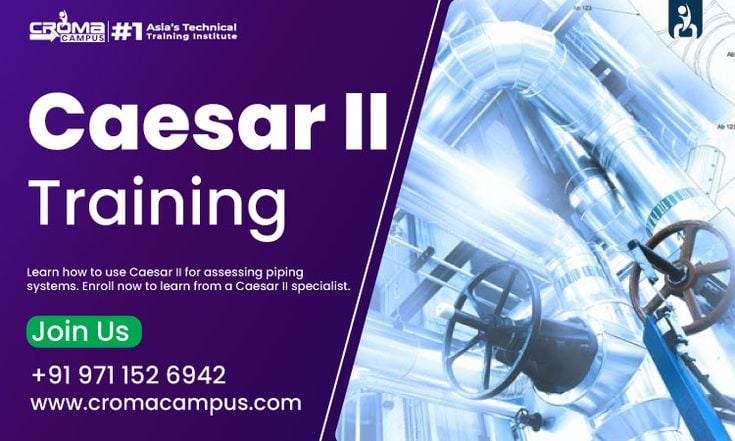
But things have changed a lot now. Because plants are now designed in 3D models that are full of data, and stress analysis is slowly moving closer to that model. It is not considered a separate job now. If you are looking to learn how this works, then applying for the Caesar II Course can help with the same. So let’s begin to discuss this in detail:
What is Stress Analysis for?
Pipes carry hot fluids, cold fluids, and high pressure. They expand when they heat up, they have weight, and they get pushed by wind, earthquakes, and vibration. If nobody checks these loads, a pipe can crack, a support can fail, or a pump nozzle can get pulled out of shape.
CAESAR II checks the loads against codes like ASME B31.3. Based on the results, the engineer decides where supports go, whether a loop is needed, and whether the forces on equipment are within limits.
The old Problem
The stress model was built from drawings, separate from the design model. If the designer moved a line, the stress file did not change. Sometimes the stress engineer heard about it days later, after finishing an analysis of a layout that no longer existed. That wasted time and caused arguments.
Data now comes from the 3D model
Designers build the plant in software like SP3D or AVEVA E3D. The model already holds pipe size, material, wall thickness, insulation, temperature, and pressure. So instead of typing it all again, you can export it from the model and bring it into CAESAR II.
This saves a lot of time on large projects and cuts down on typing mistakes. But the import is never perfect. The 3D model may not carry every design condition or support type, so the engineer still has to check the imported data line by line.
Changes are Quicker to Handle
Say a line has to go around a new steel beam. The designer updates the 3D model. The stress engineer brings in the new geometry and runs the analysis again. If the file was set up well, most of the load cases carry over. This takes hours where it once took days, and everyone knows which revision was used.
Both Teams see the Same Model
A stress result might say you need a support at a certain point. In the old way, the designer would later find there was no steel nearby to hold it. Now both sides can look at the 3D model together and sort this out early. That means less rework at site, and rework at site is where mistakes cost the most.
Scripts, Cloud and Digital Twins
Some companies write scripts to run repeat analyses and prepare reports, so engineers spend less time on routine work. Some keep the 3D model going after the plant is built and use it during operation. People call this a digital twin. Cloud tools also let teams in different cities work on one project.
Not every company works like this yet. Many still use a mix of old and new methods, and it varies a lot from one firm to another.
Why Apply for the Certification?
A Caesar II Certification helps show employers that you know the software. Find out who gives the certificate and what you have to do to get it. One that needs a proper test or a project is worth far more than a certificate for just showing up.
Why Apply in SP3D Course?
On the design side, an SP3D Course teaches you to build piping models, make isometrics, and handle the data in Smart 3D. Also, this matters a lot for Stress work too, due to pipe size, material, as well as temperature that go into CAESAR II coming from the same model. When you have an idea of how the data gets stored, it will help you spot the mistakes when you import this.
How Taking E3D Training Can Help?
If the companies you like use AVEVA, E3D Online Training covers the same sort of work in E3D. Online classes suit people with jobs, but make sure there are live sessions and practice work, so you can ask questions when you are stuck.
If you know a bit of both stress analysis and 3D modeling, you are more useful, because you understand how the data moves between them.
Before you join a Course
Ask if the trainer has worked on real projects. Ask if you will practice on the actual software, and whether the course covers code checks like B31.3. It is a good sign if you get to work on a complete project from start to finish. Find out what certificate you will get and who issues it. And ask for a demo class. Ten minutes is enough to see if the teacher explains things well.
Conclusion
Digital engineering has not changed what stress analysis is for. Pipes still need to stay safe under heat, pressure, and weight. What has changed is how the information reaches the engineer and how fast a change can be checked. There is less retyping, fewer old drawings, and closer work between designers and stress engineers. If you want a career here, learn CAESAR II well, pick up one 3D tool next to it, and practice on real examples.