




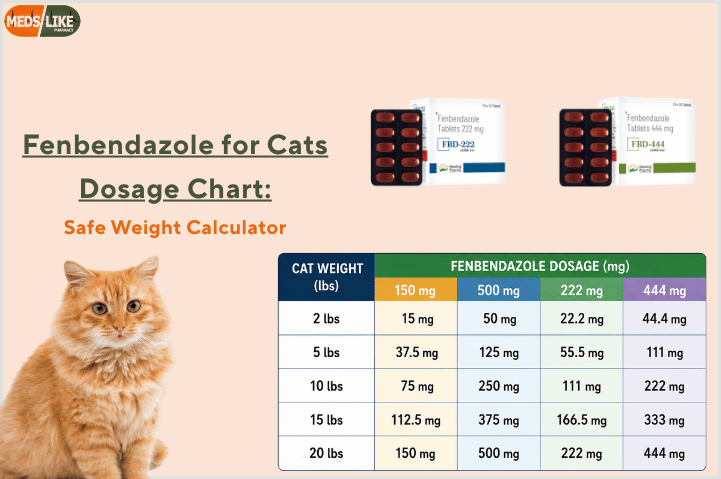
Fenbendazole is a veterinary antiparasitic medication used to treat certain intestinal worms and other susceptible parasites in cats. The correct amount depends on your cat’s body weight, the parasite being treated, the medication’s concentration, and the veterinarian’s prescribed treatment schedule. Understanding a fenbendazole for cats dosage chart by weight can help cat owners understand weight-based dosing and administer prescribed medication more accurately.
For more information about veterinary medications and pet health topics, visit medslike.com. Before using any dosage information found online, consult a veterinarian to confirm the appropriate treatment for your cat. Fenbendazole products come in different formulations and strengths, so calculating the dose in milligrams is not the same as measuring the required amount in milliliters or grams.
What Is Fenbendazole for Cats?
Fenbendazole is an anthelmintic medication belonging to the benzimidazole family. It works by interfering with essential cellular processes in susceptible parasites, preventing them from functioning normally.
Veterinarians may prescribe fenbendazole for certain roundworm, hookworm, and other parasitic infections. It is also sometimes used to treat Giardia infections, depending on the clinical situation. However, it does not treat every parasite, and the correct medication depends on the organism involved. A fecal examination can help identify the cause of your cat’s symptoms.
Fenbendazole for Cats Dosage Chart by Weight
Veterinary references describe a commonly used regimen of 50 mg per kilogram of body weight once daily for a prescribed course, often lasting three to five days for certain infections. The appropriate regimen varies by parasite, product, and country. This reference should not replace your veterinarian’s instructions.
The following chart illustrates the amount corresponding to 50 mg/kg per dose. Use it only if your veterinarian has specifically prescribed this dosage.
| Cat’s weight | Approximate weight in kg | Amount at 50 mg/kg |
|---|---|---|
| 2 lb | 0.91 kg | 45 mg |
| 4 lb | 1.81 kg | 91 mg |
| 6 lb | 2.72 kg | 136 mg |
| 8 lb | 3.63 kg | 181 mg |
| 10 lb | 4.54 kg | 227 mg |
| 12 lb | 5.44 kg | 272 mg |
| 14 lb | 6.35 kg | 318 mg |
| 16 lb | 7.26 kg | 363 mg |
| 18 lb | 8.16 kg | 408 mg |
| 20 lb | 9.07 kg | 454 mg |
Important: This is a mathematical reference for one possible prescribed dose, not a universal treatment schedule. It does not establish how many days your cat should receive medication. Do not use it to select a dose independently, particularly for kittens, pregnant cats, or cats with other health concerns.
How to Calculate Fenbendazole Dosage
When a veterinarian prescribes a dose in milligrams per kilogram, the calculation is straightforward:
Dose in mg = Body weight in kg × Prescribed mg/kg
For example, a cat weighing 4 kg would correspond to 200 mg per dose under a prescription of 50 mg/kg.
However, the amount of liquid or paste required depends on the product concentration. A 200 mg dose cannot automatically be converted into 2 mL unless the product contains exactly 100 mg/mL. Always check the label and confirm the measurement with your veterinarian or pharmacist. Fenbendazole for cats is an antiparasitic medication used to treat certain intestinal worms and other susceptible parasites under veterinary guidance.
Accurately weighing your cat is essential. Estimates based on age, breed, or appearance may result in incorrect dosing.
How Is Fenbendazole Given to Cats?
Depending on the prescribed product, fenbendazole may be available as an oral suspension, granules, paste, or another formulation. Follow the product-specific instructions and your veterinarian’s directions.
If the medication is intended to be given with food, confirm whether it can be mixed into your cat’s meal. Make sure your cat receives the complete prescribed amount. Never substitute a dog or livestock product without veterinary approval, as formulations and measuring instructions can differ.
Complete the prescribed course even if your cat appears to improve, unless your veterinarian advises otherwise. Do not repeat treatment automatically if symptoms continue.
Possible Side Effects and Safety Precautions
Fenbendazole is generally considered well tolerated when appropriately prescribed, but side effects can occur. Possible reactions include:
- Vomiting
- Diarrhea or loose stools
- Reduced appetite
- Temporary digestive discomfort
Contact your veterinarian if these symptoms are persistent or worsening. Seek urgent veterinary attention for severe weakness, difficulty breathing, collapse, or other serious reactions.
Extra care is necessary when treating very young kittens, pregnant or nursing cats, elderly cats, and animals with existing medical conditions. Tell your veterinarian about any other medicines or supplements your cat receives.
Never increase the dose to treat a suspected heavy parasite burden. A veterinarian may need to identify the parasite, reassess the diagnosis, and choose a different treatment plan.
When Should You Contact a Veterinarian?
Arrange a veterinary assessment if your cat has persistent diarrhea, unexplained weight loss, a swollen abdomen, visible worms, vomiting, or changes in appetite. These symptoms can have causes other than intestinal parasites.
Your veterinarian may recommend fecal testing and follow-up examinations to determine whether treatment has worked. Some infections require a different medication or additional management measures to prevent reinfection.
Frequently Asked Questions
1. How much fenbendazole should I give my cat?
The correct dose depends on body weight, the diagnosed parasite, the formulation, and the prescribed treatment schedule. A commonly referenced regimen is 50 mg/kg once daily for certain infections, but not every condition uses the same regimen.
2. Can kittens take fenbendazole?
Veterinarians may prescribe fenbendazole for kittens when appropriate. The kitten’s age, weight, health, and specific product must be considered before treatment.
3. How long does fenbendazole take to work?
The response varies with the parasite and the treatment plan. Improvement in symptoms does not necessarily confirm that the infection has cleared, so follow-up testing may be recommended.
4. Can I use a dosage chart instead of seeing a veterinarian?
No. A chart can help explain a prescribed dose, but it cannot identify the parasite or determine the correct treatment duration.