





Sound has long been part of human approaches to meditation, reflection, and relaxation. From traditional chanting and devotional music to modern ambient soundscapes, people use sound to create a particular atmosphere, focus their attention, and establish meaningful daily rituals. One concept that has attracted growing interest in wellness circles is the system of nine Solfeggio frequencies.
Each frequency in this system is commonly associated with a particular intention, such as relaxation, emotional release, creativity, or spiritual reflection. These associations have helped Solfeggio tones become popular in meditation recordings, sound baths, and personal listening practices.
However, understanding these frequencies requires more than memorizing a list of numbers. It helps to explore where the system comes from, what each tone represents, how people use it, and what scientific evidence can—and cannot—tell us about its effects.
What Are Solfeggio Frequencies?
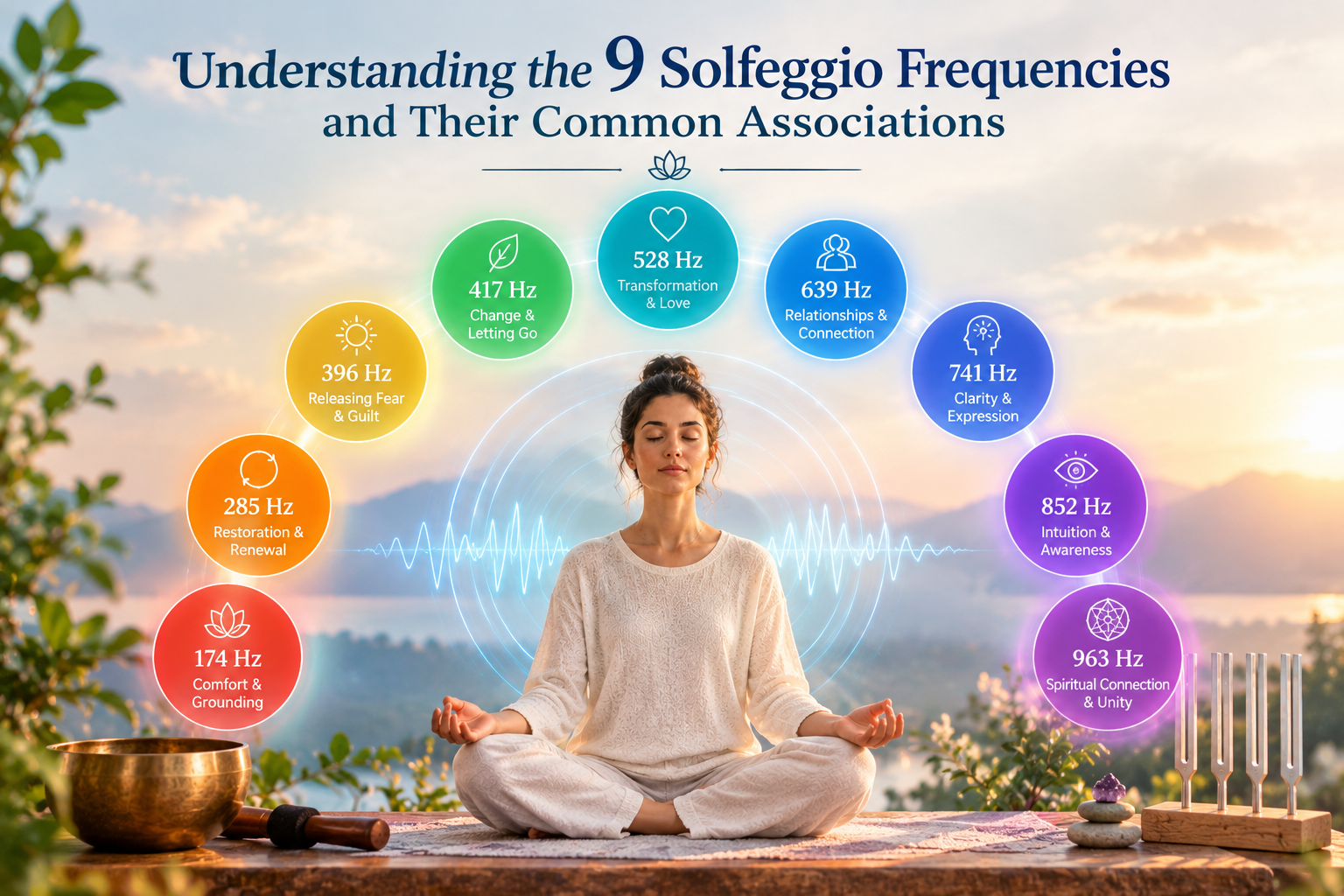
Solfeggio frequencies are a group of specific audio tones used in contemporary sound therapy and meditation practices. The modern system commonly includes nine frequencies: 174 Hz, 285 Hz, 396 Hz, 417 Hz, 528 Hz, 639 Hz, 741 Hz, 852 Hz, and 963 Hz.
Supporters associate these tones with different emotional, mental, or spiritual themes. For example, 396 Hz is often linked with releasing fear, while 639 Hz is associated with relationships and connection.
The word solfège has a separate, established meaning in music education. It refers to a system for teaching pitch and musical relationships through syllables such as do, re, mi, fa, sol, la, and ti. The modern Solfeggio frequency system draws on spiritual interpretations and alternative wellness traditions rather than representing a standard set of frequencies recognized by conventional music theory.
Some contemporary accounts connect Solfeggio tones with ancient Gregorian chanting and sacred musical traditions. However, the historical evidence for the precise nine-frequency system as an intact ancient practice is limited. It is more accurate to distinguish the long history of sacred music from the modern framework that assigns particular wellness meanings to these nine numbers.
The 9 Solfeggio Frequencies at a Glance
The following table summarizes the nine commonly discussed frequencies and their usual associations in modern sound therapy.
-
174 Hz – Comfort and Grounding: Commonly associated with relaxation, physical awareness, and a sense of stability.
-
285 Hz – Restoration and Renewal: Often linked with renewal, balance, and personal reflection.
-
396 Hz – Releasing Fear and Guilt: Associated with emotional reflection and letting go of negative feelings.
-
417 Hz – Change and New Beginnings: Commonly connected with personal transformation, transitions, and fresh starts.
-
528 Hz – Love and Transformation: Often associated with positivity, love, and personal growth.
-
639 Hz – Relationships and Connection: Linked with compassion, communication, and interpersonal harmony.
-
741 Hz – Clarity and Expression: Commonly associated with focus, clear communication, and creative thinking.
-
852 Hz – Intuition and Awareness: Connected with mindfulness, inner awareness, and spiritual reflection.
-
963 Hz – Spiritual Connection and Unity: Often associated with deep meditation, spiritual contemplation, and a sense of unity.
These meanings are conventions within the modern Solfeggio community, not established biological effects. Listening to a particular frequency does not guarantee a specific emotional response, and individuals may interpret the same sound differently.
Exploring Each Solfeggio Frequency
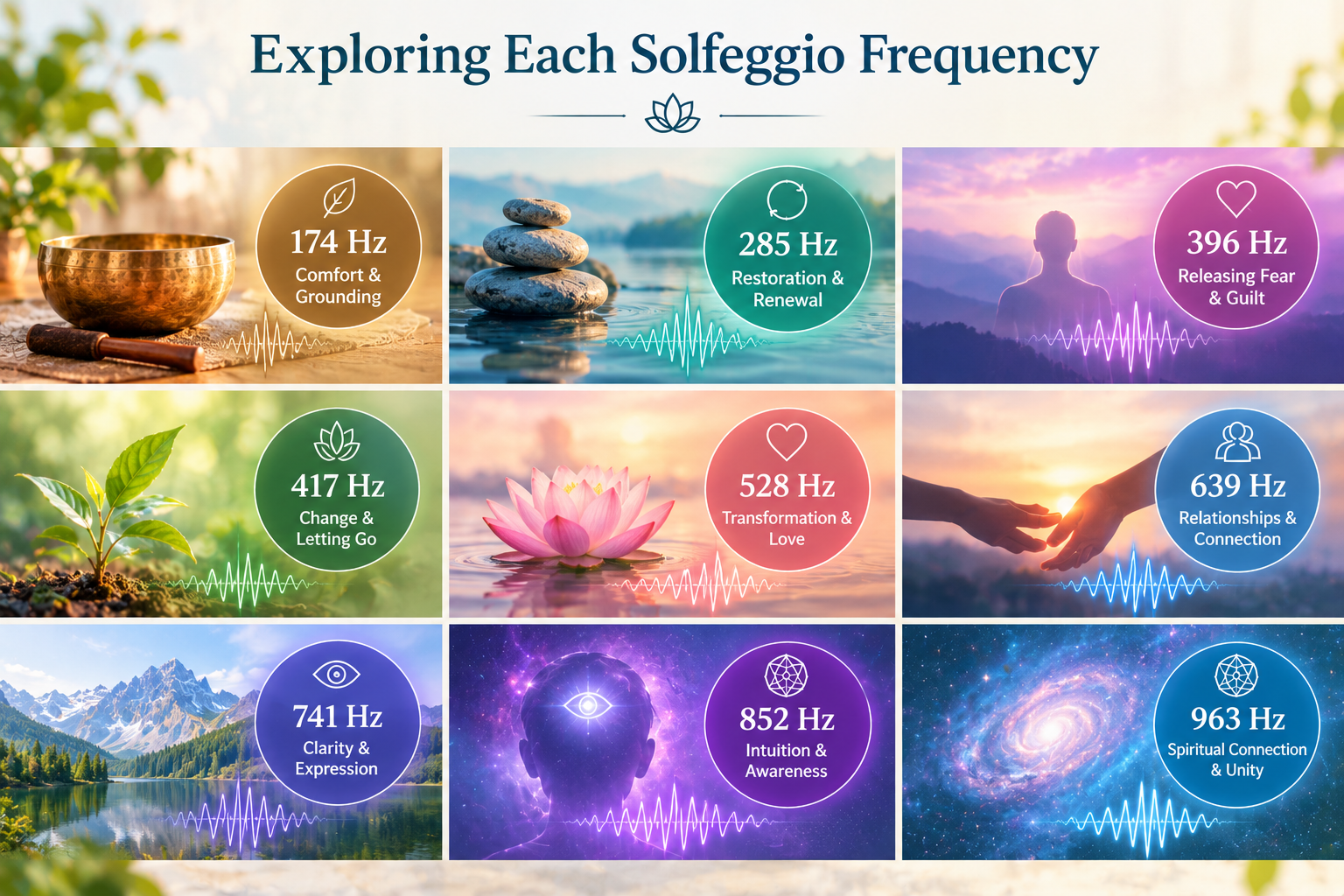
1. 174 Hz: Comfort and Grounding
The 174 Hz tone is commonly described as a grounding or comforting frequency. In sound therapy settings, it is often used to create a calm atmosphere and encourage listeners to pay attention to physical sensations.
Its relatively low pitch may appeal to people who prefer deeper, less bright sounds. Depending on the recording and playback equipment, the tone can feel steady and unobtrusive or more pronounced and resonant.
Listeners may incorporate 174 Hz into a relaxation routine by sitting comfortably, observing their breathing, and noticing areas of tension without trying to force them to change.
Although some wellness sources describe this frequency as relieving physical pain, such claims should not be interpreted as established medical benefits. Its more defensible use is as an optional auditory element in a personal relaxation practice.
2. 285 Hz: Restoration and Renewal
The 285 Hz frequency is commonly associated with restoration, renewal, and balance. Some practitioners describe it as a sound for reconnecting with a sense of stability after a stressful day.
In practice, a 285 Hz recording can be used as background audio during quiet reflection, gentle stretching, or a mindfulness session. The repetitive sound offers an external point of attention, which may be useful for people who find silence distracting.
Claims that 285 Hz repairs tissue, regenerates cells, or accelerates physical healing are not supported by sufficient clinical evidence. These interpretations belong to alternative sound therapy traditions rather than established medical science.
3. 396 Hz: Releasing Fear and Guilt
Among the nine frequencies, 396 Hz is frequently associated with releasing fear, guilt, and other difficult emotions.
This association makes it a popular choice for journaling, meditation, and personal reflection. A listener might play the tone while identifying a recurring worry, writing down a concern, or considering a more constructive response to a challenging situation.
The process of acknowledging emotions can be useful in its own right. However, there is no strong evidence that 396 Hz specifically removes fear or guilt through a unique frequency-dependent mechanism.
Its value is better understood as part of a broader reflective practice, with the sound serving as a reminder to pause and examine one’s feelings.
4. 417 Hz: Change and New Beginnings
The 417 Hz tone is commonly linked with change, transition, and letting go of unwanted patterns.
People often select it when establishing a new routine, reflecting on a personal transition, or creating space for a fresh perspective. It may also be used during meditation focused on accepting uncertainty.
One simple approach is to listen for several minutes while considering a habit or situation that you would like to approach differently. Rather than expecting the sound to change circumstances automatically, use it as a cue for identifying practical next steps.
The association between 417 Hz and transformation is symbolic. There is no reliable evidence that this particular tone independently removes negative energy or resets ingrained psychological patterns.
5. 528 Hz: Love and Transformation
The 528 Hz frequency is among the most widely discussed tones in modern Solfeggio practices. It is often called the “love frequency” and associated with positivity, transformation, and personal growth.
Some wellness claims also describe 528 Hz as a DNA-repairing frequency. Such statements go beyond the available evidence and should not be treated as established scientific findings.
Nevertheless, listeners may find the tone useful when building a positive meditation routine. It can accompany gratitude exercises, reflective writing, or a quiet period devoted to personal goals.
The sound’s actual pitch, timbre, and musical context are important to the listening experience. A 528 Hz sine wave, a musical note containing a 528 Hz component, and a layered recording marketed around this frequency may sound quite different.
6. 639 Hz: Relationships and Connection
The 639 Hz tone is commonly associated with compassion, communication, and harmonious relationships.
This makes it a frequent choice for meditation focused on empathy, forgiveness, or interpersonal awareness. Someone preparing for a difficult conversation might use the recording as part of a routine that encourages them to slow down and reflect before responding.
A practical exercise is to listen quietly while considering another person’s perspective or identifying one constructive action that could improve a relationship.
The frequency itself has not been shown to resolve conflicts or directly strengthen emotional bonds. Any value is more plausibly connected to the reflective activity, the listener’s expectations, and the broader listening environment.
7. 741 Hz: Clarity and Expression
The 741 Hz frequency is commonly associated with clarity, communication, and creative expression. Some practitioners use it when seeking a focused atmosphere for writing, brainstorming, or contemplative work.
For example, you might play a recording at a comfortable volume before beginning a creative task. After a few minutes, turn your attention to the work itself and evaluate whether the sound helps or distracts you.
It is worth remembering that auditory stimulation affects people differently. Some find a steady tone helpful, while others concentrate better in silence or with unobtrusive instrumental music.
There is no established evidence that 741 Hz uniquely removes toxins, purifies the body, or improves cognitive performance. Its practical role is best considered a matter of listening preference and personal routine.
8. 852 Hz: Intuition and Awareness
The 852 Hz frequency is often connected with intuition, inner awareness, and spiritual reflection.
In meditation practices, listeners may use it to create a quiet setting for observing thoughts, examining personal values, or simply allowing the mind to settle. The tone can serve as an anchor when attention drifts.
The frequency is also associated with the idea of developing deeper insight. That association should not be confused with evidence that listening improves supernatural perception or grants special knowledge.
A more grounded approach is to treat the recording as a tool for making time for reflection. Whether it is useful depends on how the listener responds and whether the practice supports their broader goals.
9. 963 Hz: Spiritual Connection and Unity
The 963 Hz tone is commonly described as a frequency associated with spiritual connection, unity, and expanded awareness.
It is often used in longer meditation sessions or recordings intended to create a contemplative atmosphere. Some listeners incorporate it into spiritual rituals, while others simply enjoy the sound as part of a quiet evening routine.
Ideas such as universal consciousness and spiritual unity are matters of personal belief and interpretation. They are not effects that can be assumed to occur whenever someone listens to a 963 Hz recording.
For those who find the association meaningful, the tone may act as a reminder to pause, reflect, and connect with their own sense of purpose.
How to Choose the Right Solfeggio Frequency
With nine options and overlapping associations, selecting a frequency can feel confusing at first. A useful starting point is to focus on your intention rather than searching for a tone that promises a guaranteed outcome.
A guide to solfeggio frequencies can help you compare the commonly assigned meanings and choose a recording that fits your preferred meditation or listening routine.
Consider these practical approaches:
-
For relaxation: Experiment with 174 Hz or 285 Hz if you prefer the grounding associations commonly attached to lower tones.
-
For emotional reflection: Try 396 Hz or 417 Hz as background audio for journaling or examining difficult feelings.
-
For positive reflection: Explore 528 Hz if its association with love and personal transformation resonates with you.
-
For connection and compassion: Consider 639 Hz while reflecting on relationships or communication.
-
For focused work: Test 741 Hz and compare your experience with silence or ordinary instrumental music.
-
For contemplative practice: Explore 852 Hz or 963 Hz if their spiritual associations align with your interests.
These suggestions describe traditional associations, not evidence-based prescriptions. There is no need to use a different frequency for every emotional state, and you do not have to follow a prescribed order.
What Does Scientific Research Say About Solfeggio Frequencies?
A distinction between sound in general and specific Solfeggio claims is essential.
Sound is a physical stimulus that can affect hearing, attention, perception, and emotional experience. Research into music-based interventions has also explored possible benefits for stress, anxiety, pain management, and quality of life in certain settings.
However, evidence supporting music or sound-based relaxation does not establish that every individual frequency has a unique therapeutic effect.
For example, a listener may feel calmer after listening to a 528 Hz recording. That experience is real as a subjective response, but it does not demonstrate that 528 Hz has a special biological property or that the same effect will occur in other people.
Likewise, the fact that frequency can be measured precisely does not prove claims about cellular regeneration, detoxification, organ balancing, or DNA repair.
The American Music Therapy Association’s overview of music therapy provides useful context for distinguishing a structured, professionally delivered therapeutic practice from the informal use of music or tones for relaxation. Music therapy involves clinical goals and qualified practitioners; listening to a Solfeggio recording at home is not automatically equivalent to that form of care.
More research would be needed to determine whether any of the nine specific frequencies offers reproducible benefits beyond those associated with other pleasant sounds, music, or quiet rest.
How to Incorporate Solfeggio Frequencies Into Daily Life
The easiest way to explore Solfeggio tones is to start with a short, simple listening session.
-
Choose one frequency. Select a tone whose common association matches your intention, or choose one that simply sounds pleasant.
-
Create a comfortable environment. Sit or lie down in a safe, quiet place where you can relax without interruption.
-
Keep the volume moderate. The sound should be clear without becoming intrusive or uncomfortable.
-
Listen for five to ten minutes. Focus on the tone, notice your breathing, and allow thoughts to come and go naturally.
-
Evaluate your response. Afterward, consider whether the sound helped you feel more settled, made concentration difficult, or had no noticeable effect.
You can repeat the same session for several days before experimenting with another frequency. Changing one variable at a time makes it easier to determine which sounds you actually enjoy.
It is also useful to compare the experience with ordinary music, nature sounds, or silence. This helps you distinguish the effects of a specific recording from the broader benefits of taking a break and creating a calm environment.
Solfeggio tones should be treated as optional tools rather than substitutes for medical or mental health care. If a recording causes discomfort, headaches, sound sensitivity, or distress, stop using it or adjust the listening conditions.
Common Misconceptions About Solfeggio Frequencies
As the popularity of sound-based wellness practices has grown, some claims have become more confident than the evidence warrants.
Every frequency produces a predictable emotional response. In reality, responses vary according to individual preference, listening context, expectations, and the characteristics of the recording.
The nine-frequency system is conclusively documented as an ancient healing method. Sacred music and chanting have long histories, but that does not establish that the modern nine-frequency framework existed in its current form in antiquity.
A particular tone can repair DNA or cure illness. These are medical claims that require rigorous evidence. They cannot be established through anecdotal reports or traditional associations alone.
Higher frequencies are inherently more spiritual or powerful. Frequency describes the rate of vibration, not a universal scale of spiritual value. A higher numerical pitch is not automatically more beneficial than a lower one.
A recording must be played for a specific duration to work. There is no universally validated listening schedule for the nine Solfeggio tones. Session length should be guided by comfort, context, and personal preference.
Understanding these limitations does not require dismissing the practice. It simply allows people to explore it with realistic expectations and make informed choices.
Final Thoughts
The nine Solfeggio frequencies offer a structured way to explore sound in meditation, relaxation, and personal reflection. Their common associations—from grounding and emotional release to compassion and spiritual awareness—provide a vocabulary for choosing recordings that align with individual intentions.
The most useful approach is to understand these associations as part of a contemporary wellness tradition rather than as proven medical effects. A particular tone may become a meaningful part of a daily routine, but its value depends on the listener’s experience and should not be confused with evidence of a unique healing mechanism.
By experimenting with different sounds, maintaining comfortable listening levels, and observing your own responses, you can discover whether Solfeggio frequencies complement your preferred approach to mindfulness. The goal is not to find a universally perfect number, but to use sound thoughtfully in support of a more intentional and balanced daily life.