





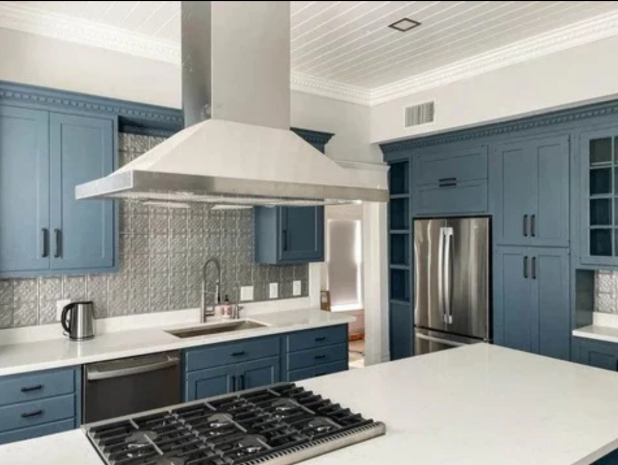
Kitchen ventilation plays an important role in managing cooking odors, moisture, smoke, grease, and airborne combustion byproducts. The right hood should not only fit the available space but also provide suitable airflow and connect properly to an exterior exhaust system when required. For smaller cooking areas, a 24 range hood can provide a practical ventilation solution when its dimensions and performance match the cooktop or range.
Choosing a hood involves more than measuring the cabinet opening. Homeowners should consider cooking habits, hood coverage, airflow, duct configuration, noise levels, controls, filters, and installation requirements. The U.S. Environmental Protection Agency notes that range hoods are one of the most common ways to ventilate kitchens and recommends correctly sized ventilation for effective pollutant removal.
What Is a 24 Range Hood?
A 24 range hood generally refers to a kitchen exhaust hood designed around a 24-inch width. The width is important because the hood needs to provide adequate coverage over the cooking surface. However, width alone does not determine ventilation performance.
Different hood designs can have different blower capacities, depths, filtration systems, noise ratings, and duct requirements. A homeowner should therefore compare the hood’s technical specifications with the cooking appliance and the manufacturer’s installation instructions rather than selecting a model based solely on its external dimensions.
A 24 range hood can be particularly relevant in compact kitchens, apartments, smaller homes, or layouts where cabinetry and appliances have been designed around a narrower cooking surface.
How Much Airflow Does a Range Hood Need?
Airflow is usually measured in cubic feet per minute, or CFM. The appropriate capacity depends on factors such as the cooking appliance, cooking style, hood configuration, and applicable installation requirements.
The U.S. Department of Energy has cited guidance of at least 100 CFM or 40 CFM per linear foot of hood for kitchen range ventilation, with higher requirements potentially applying to certain configurations.
The EPA similarly notes that ASHRAE and the Home Ventilating Institute recommend approximately 100 CFM for a typical range, while larger exhaust fans can create pressure imbalances that may affect combustion appliances.
This means homeowners should avoid assuming that a smaller hood automatically requires very low airflow. The cooking appliance, installation arrangement, and manufacturer’s specifications all matter.
Why Ducting Matters
Even a powerful blower can perform poorly if the exhaust duct is badly designed. The Department of Energy recommends keeping kitchen exhaust duct runs as short as practical, minimizing turns, and routing the exhaust to the exterior. Properly sealed joints and appropriately sized ductwork also help support effective airflow.
A 24 range hood should therefore be evaluated as part of the complete ventilation system rather than as an isolated appliance. Long duct runs, multiple elbows, restrictive ductwork, and unsuitable termination points can increase resistance and reduce actual performance.
Exhaust should also be directed outdoors rather than into an attic, crawlspace, or enclosed building cavity.
What About Noise and Filters?
Noise is another practical consideration. A hood that is technically powerful but excessively loud may be used less frequently. The Department of Energy notes that quieter range hoods can encourage regular use, while ENERGY STAR guidance has included sound-performance requirements for qualifying models.
Filters are equally important because they help capture grease and cooking particles before air reaches the exhaust system. Homeowners should check whether a model uses removable metal filters, dishwasher-safe components, or other filtration systems and follow the manufacturer’s cleaning instructions.
Regular filter maintenance helps keep the ventilation system functioning properly and can reduce accumulated grease.
Should You Consider an Insert-Style Hood?
An insert hood is designed to fit inside custom cabinetry or another enclosure. This configuration can create a more integrated appearance while allowing the ventilation equipment to remain visually less prominent.
When evaluating an insert, homeowners should confirm the required cabinet dimensions, blower location, duct outlet position, electrical requirements, and minimum clearance above the cooking surface. Manufacturer instructions should take priority because installation requirements can vary between models.
Conclusion
Selecting kitchen ventilation requires more than matching a hood to the width of a cooking appliance. A 24 range hood should be evaluated according to its coverage, airflow capacity, duct configuration, noise performance, filtration, and installation requirements. Proper ducting is especially important because a short, well-sealed exhaust path can help the system operate more effectively. Homeowners should also account for their cooking habits and appliance type when determining the appropriate ventilation capacity. For homeowners comparing insert configurations, a detailed Range Hood Insert Buyer’s Guide can also help organize considerations such as dimensions, airflow, ducting, controls, filtration, and installation. By comparing the complete specifications and following the manufacturer’s installation requirements, it becomes easier to select a hood that provides practical and reliable kitchen ventilation.