





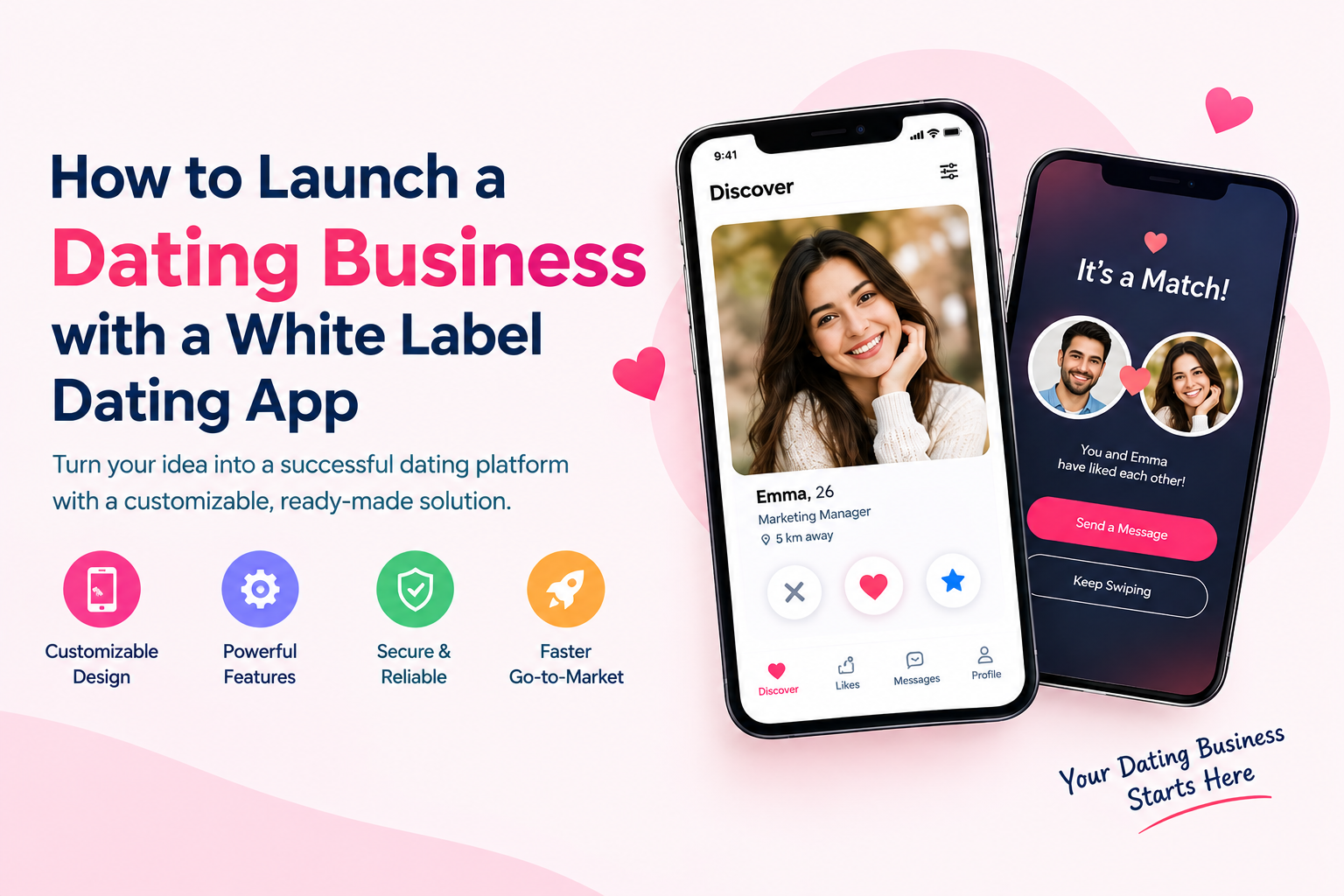
How to Launch a Dating Business with a White Label Dating App
Online dating has changed the way people meet, communicate, and build relationships. From casual connections to long-term partnerships, users now rely on digital platforms to discover people who share their interests, values, and lifestyle. This growing demand has created opportunities for entrepreneurs who want to enter the online dating industry.
However, launching a dating platform involves more than creating a profile page and adding a matching feature. Business owners must consider app functionality, user privacy, monetization, marketing, and long-term scalability. A white label dating app offers a practical starting point for entrepreneurs who want to launch their own dating platform without developing every feature from scratch.
With the right business strategy and customization, entrepreneurs can establish a dating brand that serves a specific audience and grows with user demand.
Understanding the White Label Dating App Business Model
A white label dating app is a pre-built application that businesses can customize with their own branding, design, features, and business requirements. Instead of starting the entire development process from zero, entrepreneurs can use an existing software foundation and adapt it to their target market.
For example, a business might create a dating platform for professionals, people with shared hobbies, a particular age group, or individuals looking for serious relationships. The platform can be designed around the preferences and expectations of that audience.
The main advantage of this model is that it can reduce development time and simplify the initial launch process. However, the actual timeline, cost, and customization options depend on the provider, technology stack, and features required.
Before choosing a solution, business owners should review its technical capabilities, security measures, ownership terms, and options for future upgrades.
Step 1: Identify Your Target Dating Audience
Before investing in app development, determine whom your platform will serve. A dating app that tries to attract everyone may struggle to establish a clear identity, particularly when competing with established platforms.
Start by researching a specific audience and understanding its dating preferences, common frustrations, and expectations from a digital platform.
Potential niches include:
- Professionals looking for meaningful relationships.
- Users interested in long-term commitments.
- People who want to connect through shared hobbies and interests.
- Communities seeking a more focused dating experience.
- Users looking for location-based connections.
Conduct surveys, interview potential users, and analyze existing dating platforms to identify gaps in the market. This research can help you decide which features deserve priority and how your business can offer a more relevant experience.
A clearly defined audience also makes marketing easier because your messaging, partnerships, and advertising can focus on people who are more likely to use the platform.
Step 2: Research Competitors and Choose Your Positioning
Established dating apps provide useful examples of how matching systems, user profiles, messaging, and discovery features can work together. Studying these platforms can help you understand user expectations without simply copying their entire business models.
For instance, a Tinder clone app concept can help entrepreneurs explore a dating experience built around quick profile discovery, mutual interest, and convenient matching. A Hinge clone app concept may be more appropriate for a business interested in detailed profiles, conversation prompts, and interactions designed to encourage meaningful connections.
These concepts can serve as product references when defining your own requirements. Your final application should have its own brand identity, original design elements, and clearly differentiated user experience.
Compare competitors based on their onboarding process, subscription options, profile verification, matching preferences, and communication features. Pay particular attention to recurring complaints in user reviews, as these can reveal opportunities to improve the experience.
The objective is not to reproduce another company’s identity but to understand the market and create a product that addresses a specific customer need.
Step 3: Select the Essential Features
The features included in your first release will influence development costs, usability, and the time needed to launch. Begin with the functionality necessary for users to create accounts, discover compatible people, communicate safely, and manage their preferences.
User registration and profiles: Allow users to register, upload photographs, add personal information, and describe their interests. Keep the onboarding process straightforward so new members can complete it without unnecessary steps.
Matching and discovery: Give users options to explore profiles based on location, interests, age preferences, and other relevant criteria. Matching logic should reflect the purpose of your platform.
Messaging and notifications: Enable matched users to communicate and receive notifications about relevant activity. Include controls that allow members to manage notification preferences.
Search and filters: Help users narrow their discovery results according to their preferences. The available filters should be relevant to the audience you intend to serve.
Profile verification: Consider verification features that help reduce fake profiles and improve trust. Explain what verification means and avoid presenting it as a guarantee of another user’s intentions.
Safety and reporting: Include blocking, reporting, moderation, and account-management tools. Dating platforms should have clear procedures for handling harassment, impersonation, and suspicious activity.
Admin dashboard: Business owners need tools to manage users, review reports, moderate content, monitor subscriptions, and understand platform activity.
Subscription management: If you plan to charge for premium services, provide a clear way to view plans, manage payments, and cancel subscriptions.
Choose features according to your target audience rather than adding every possible function at launch. A smaller, reliable product can be easier to test and improve than an overloaded application.
Step 4: Choose the Right Technology Partner
The software provider you choose will have a significant impact on your launch and future growth. Not every white label solution offers the same level of customization, security, or technical support.
Review potential providers against several important criteria.
First, examine the existing application and confirm that it supports your essential business requirements. Ask for a demonstration of the user experience and administrative dashboard.
Second, understand the customization process. Find out whether you can change the interface, matching logic, registration flow, subscription plans, and other important components.
Third, clarify the ownership agreement. Determine who owns the source code, design assets, user data, and custom-developed features. Do not assume that purchasing a white label solution automatically gives you unrestricted ownership of every component.
You should also discuss hosting, maintenance, third-party integrations, backup procedures, security updates, and technical support. These ongoing responsibilities can affect the total cost of operating your dating business.
Finally, confirm whether the application can accommodate additional users and features as your audience grows.
Step 5: Customize Your App and Build Your Brand
Your dating app should feel like a distinct product rather than a generic software package. Branding and user experience are particularly important because dating platforms depend on trust, comfort, and repeated engagement.
Choose a memorable name, a recognizable visual identity, and a consistent interface. Write clear descriptions of the platform’s purpose and explain how users can manage their profiles and privacy settings.
Customize the onboarding experience around your audience. A platform for serious relationships, for example, might encourage users to provide more information about their interests and relationship preferences.
Review the application on different screen sizes and test important journeys, including registration, profile creation, matching, messaging, reporting, and subscription payments.
Before launch, verify that account deletion, consent processes, privacy controls, and moderation features work as expected. Dating businesses should also assess applicable privacy, consumer protection, age-restriction, and payment requirements in their operating markets.
A well-branded application is valuable, but reliability and user safety are equally important to building a sustainable business.
Step 6: Decide How Your Dating App Will Generate Revenue
A dating platform needs a clear revenue model that supports operating expenses without making the experience frustrating for users.
Several monetization options are worth considering.
Freemium subscriptions: Offer essential dating features for free while charging for selected premium capabilities. Possible benefits include advanced filters, additional discovery options, or enhanced profile visibility.
Monthly and annual plans: Provide subscription packages for users who want continued access to premium features. Explain the pricing, renewal terms, and cancellation process clearly.
One-time purchases: Depending on your product design, users may pay for optional features such as profile boosts or additional discovery opportunities.
Advertising: Advertising can generate revenue once your platform has sufficient engagement. However, excessive or poorly targeted ads can reduce user satisfaction, so placement should be carefully considered.
Premium memberships: You can offer different membership levels with clearly defined benefits. Each tier should provide genuine value rather than restricting basic safety or privacy features behind a paywall.
Choose a model that matches your audience and test its performance after launch. Track subscription conversions, cancellations, customer acquisition costs, and revenue per paying user to understand whether the business is financially sustainable.
Step 7: Estimate the Budget and Prepare for Launch
The total cost of launching a dating platform depends on the software license, customization requirements, design changes, integrations, infrastructure, and ongoing maintenance.
A white label solution may reduce the amount of custom development required, but it does not eliminate every expense. Business owners should prepare a budget that includes both the initial launch and the resources needed to operate the service.
Common expenses include software licensing, branding, feature customization, hosting, payment integration, testing, marketing, customer support, and security maintenance.
Request a detailed quotation from potential providers and confirm which services are included. Ask about additional charges for upgrades, third-party tools, increased usage, and future feature development.
Before making the application publicly available, conduct a controlled beta launch. Invite a limited group of users to test the registration process, matching experience, messaging, and reporting tools. Gather feedback and resolve important problems before expanding access.
Launching with a smaller audience also gives you an opportunity to understand user behavior and improve the product using real feedback.
Step 8: Market the App and Build an Active Community
A dating application needs more than downloads to succeed. Users must find relevant profiles, experience meaningful interactions, and have reasons to return.
Begin with a focused launch strategy that reaches your intended audience. Create a website explaining your platform’s benefits, publish useful content related to dating and relationships, and build a presence on social media channels used by your target customers.
You can also explore partnerships with relevant communities, creators, local organizations, and event organizers where appropriate.
App store optimization can improve the discoverability of your mobile application through relevant titles, descriptions, screenshots, and clear feature explanations. Paid campaigns may help attract early users, but their performance should be measured against actual registrations and engagement rather than downloads alone.
One important challenge is balancing the number of users across locations and audience groups. A large registration count does not necessarily create a useful dating experience if members cannot find compatible people nearby.
Consider launching in a defined geographic area or niche before expanding. Monitor profile completion, matching activity, conversations, user retention, and reports of inappropriate behavior.
Use this information to improve the platform and build a community where members feel comfortable participating.
Common Mistakes to Avoid When Starting a Dating Business
Entrepreneurs can avoid unnecessary expenses by addressing several common problems early.
One mistake is building too many features before validating the business idea. Start with the essential user experience and add functionality when feedback and usage data justify it.
Another is choosing software based only on its initial price. A low upfront cost may not represent good value if the solution has limited customization, weak support, or expensive upgrade requirements.
Ignoring moderation is another serious risk. A dating platform should have clear community guidelines, accessible reporting tools, and a practical process for reviewing complaints.
Businesses should also avoid relying entirely on paid advertising. Partnerships, referrals, organic content, and community engagement can provide additional ways to reach suitable users.
Finally, do not assume that launching the app is the end of the project. Regular maintenance, security updates, customer support, and product improvements are necessary to maintain a dependable service.
Conclusion
Launching a dating business requires a clear audience, a useful product, a sustainable revenue model, and a strategy for building trust. A white label dating app can provide a practical foundation for entrepreneurs who want to enter the market without creating every component from scratch.
Concepts inspired by a Tinder clone app or a Hinge clone app can help clarify different approaches to profile discovery, matching, and meaningful interactions. However, the strongest business opportunity often comes from serving a specific audience with a distinctive experience rather than competing on features alone.
By researching the market, selecting a suitable technology partner, prioritizing safety, and testing the product before a wider launch, entrepreneurs can make more informed decisions and build a dating platform with room to grow.
The key is to treat the app as a long-term business, not simply a software launch. Consistent improvements, responsible operations, and a clear understanding of users will help determine whether the platform can develop into a sustainable brand.
Frequently Asked Questions
1. What is a white label dating app?
A white label dating app is a pre-built application that a business can customize with its branding, selected features, and business requirements to launch its own dating platform.
2. Is a white label dating app suitable for startups?
Yes. It can be suitable for startups that want to reduce the amount of custom development required at the beginning. The best option depends on the available budget, customization needs, ownership terms, and technical support.
3. What features should a dating app include?
Essential features commonly include user profiles, matching, profile discovery, messaging, notifications, reporting, blocking, moderation, and an administrative dashboard. Subscription features can be added when they support the business model.
4. How does a Tinder clone app differ from a Hinge clone app?
A Tinder clone app concept typically emphasizes quick profile discovery and mutual matching, while a Hinge clone app concept may emphasize detailed profiles and conversation prompts. These are product-design references, and the final features depend on the application being developed.
5. How can a dating app generate revenue?
A dating platform can generate revenue through premium subscriptions, paid upgrades, optional profile boosts, and advertising. The right approach depends on the audience, user experience, and operating costs.
6. What should entrepreneurs check before selecting a dating app solution?
Review customization options, security, scalability, source code and licensing terms, payment integrations, maintenance, support, and the provider’s policies for future upgrades.