






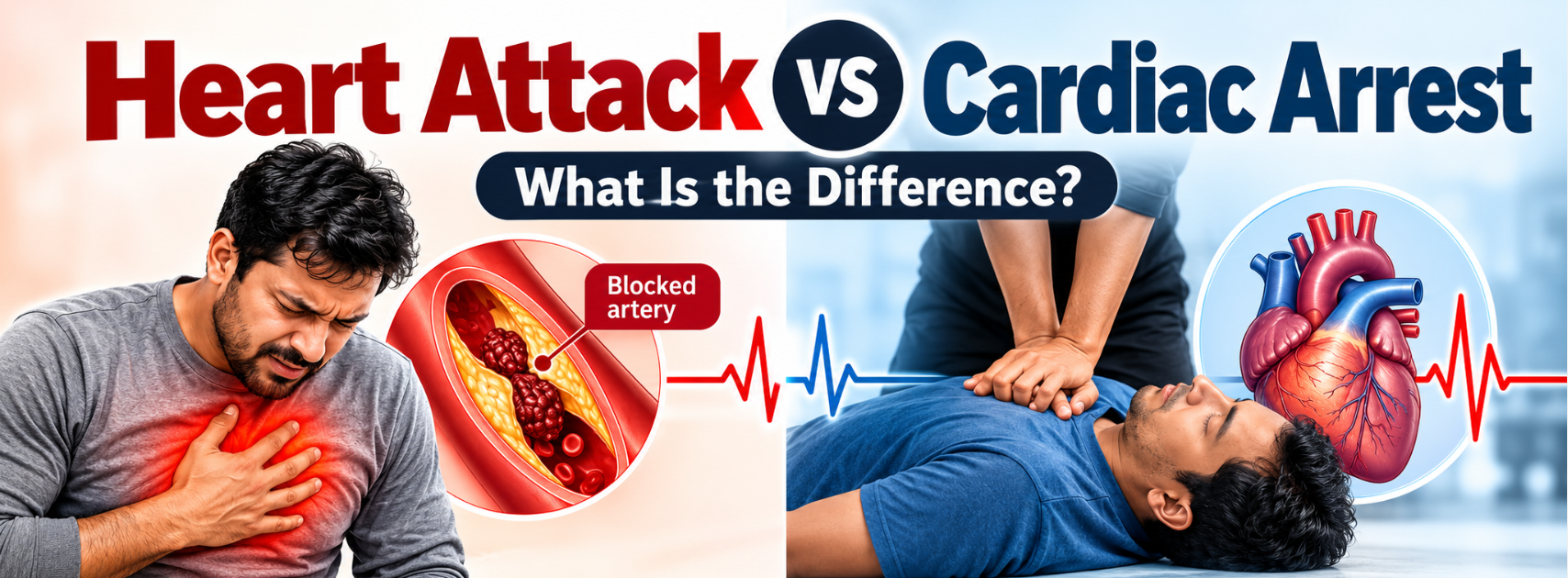
A heart attack and cardiac arrest are two serious heart emergencies that can happen without much warning. Although people use these terms for the same condition, they affect the heart differently and need different immediate responses.
In this blog, you will understand the difference between a heart attack and cardiac arrest, learn their warning signs, and know what to do when every minute matters.
What Happens During a Heart Attack?
A heart attack happens when blood flow through an artery supplying the heart becomes blocked by a blood clot. Without enough oxygen, the affected heart muscle begins to get damaged.
For example, imagine a water pump with a pipe that supplies water to the pump itself. If that pipe gets blocked, the pump continues running, but its parts can start getting damaged because they are not receiving enough water. Similarly, during a heart attack, the heart keeps beating, but the part that is not receiving enough blood starts getting damaged.
In everyday life, a person can experience chest pain while climbing stairs. They are still able to walk and talk because their heart continues beating, even though a part of it is not getting enough blood.
What Happens During Cardiac Arrest?
Cardiac arrest occurs when the heart suddenly stops pumping blood effectively because its electrical signals develop a dangerous abnormal rhythm. Within seconds, the person collapses, becomes unresponsive and stops breathing normally.
For example, imagine a water pump that suddenly develops an electrical fault and stops working. Even if the pipes are clear, water can no longer flow because the pump is not working. Similarly, during cardiac arrest, the heart suddenly stops pumping blood effectively, cutting off blood flow to the brain and other organs.
In everyday life, a person is talking to their family and suddenly collapses on the floor. They do not respond when called or touched and are not breathing normally. This could be cardiac arrest because their heart is no longer pumping blood effectively.
Heart Attack vs Cardiac Arrest: Key Differences
The following are the key difference between a heart attack and a cardiac arrest:
| Feature | Heart Attack | Cardiac Arrest |
| Main problem | Blocked blood supply to heart muscle | Sudden failure of effective heart pumping |
| Heartbeat | Continues | No effective heartbeat or circulation |
| Person’s condition | Awake and able to speak | Unconscious and not breathing normally |
| Immediate treatment | Emergency medical assessment and treatment to restore blood flow | CPR as soon as possible |
Note: A heart attack can trigger cardiac arrest, but most heart attacks do not.
Warning Signs You Should Not Ignore
A heart attack begins with chest pressure, tightness or pain. Discomfort spread to the arm, jaw, neck, back or upper stomach. Some people experience breathlessness, cold sweat, nausea or unusual tiredness instead. Symptoms can be mild, so do not wait for severe chest pain.
During cardiac arrest, the person suddenly collapses, becomes unresponsive and stops breathing normally. Occasional gasping is also a warning sign.
What Should You Do in an Emergency?
Knowing how to respond can make a major difference, especially during cardiac arrest. One important emergency procedure is CPR (Cardiopulmonary Resuscitation), which involves repeatedly pressing on a person’s chest to help blood reach the brain and other organs when the heart is not pumping effectively.
According to the American Heart Association, immediate CPR can double or triple a person’s chances of survival after cardiac arrest.
Step 1: Identify the Emergency and Call for Help
If someone has symptoms of a heart attack or cardiac arrest, call 112, India’s national emergency numb er.
- In case someone is having a heart attack, help the person sit comfortably and wait for medical assistance. Do not let them drive themselves to the hospital.
- However, if someone suddenly collapses, they are having a cardiac arrest, first check whether the surroundings are safe. Tap their shoulders, call out loudly and check whether they are breathing normally for no more than 10 seconds.
Step 2: Start CPR if the Person Is Unresponsive and Not Breathing Normally
For an adult, you can perform hands-only CPR even without formal training. Follow these instructions:
- Position the person: Lay them flat on their back on a firm surface and kneel beside their chest.
- Place your hands correctly: Put the heel of one hand in the centre of the chest, on the lower half of the breastbone. Place your other hand on top and interlock your fingers.
- Start chest compressions: Keep your arms straight and shoulders directly above your hands. Press down about 5–6 cm, at a speed of 100–120 compressions per minute.
- Allow the chest to rise: After every compression, release the pressure completely without removing your hands. Continue pressing without unnecessary breaks.
Remember: CPR is not needed for someone who is awake and breathing normally, even if they are experiencing heart attack symptoms.
Conclusion
The simplest way to remember heart attack vs cardiac arrest is that a heart attack blocks blood flow to the heart, while cardiac arrest stops effective blood flow from the heart.
Both are medical emergencies, and recognising their signs can help you respond quickly. Your quick action can save a precious life.
FAQs
- Which is more dangerous, a heart attack or cardiac arrest?
Both a heart attack or cardiac arrest are dangerous, but cardiac arrest stops circulation immediately and needs CPR within minutes.
- Can a heart attack cause cardiac arrest?
Yes, a heart attack can cause cardiac arrest by disrupting the heart’s electrical rhythm, although most heart attacks do not cause arrest.
- Can someone have cardiac arrest without a heart attack?
Ye, someone can have cardiac arrest without a heart attack. Abnormal heart rhythms or heart muscle disease can cause arrest without a heart attack.
- Can a person survive cardiac arrest?
Yes, a person can survive cardiac arrest with an immediate CPR as it can improve survival chances significantly until medical help arrives.
- Does heart failure mean the heart is about to stop?
No, a heart failure does not mean the heart is about to stop and just that the heart is pumping less effectively, not necessarily stopping.