




United States Cosmetics Market Size and Forecast
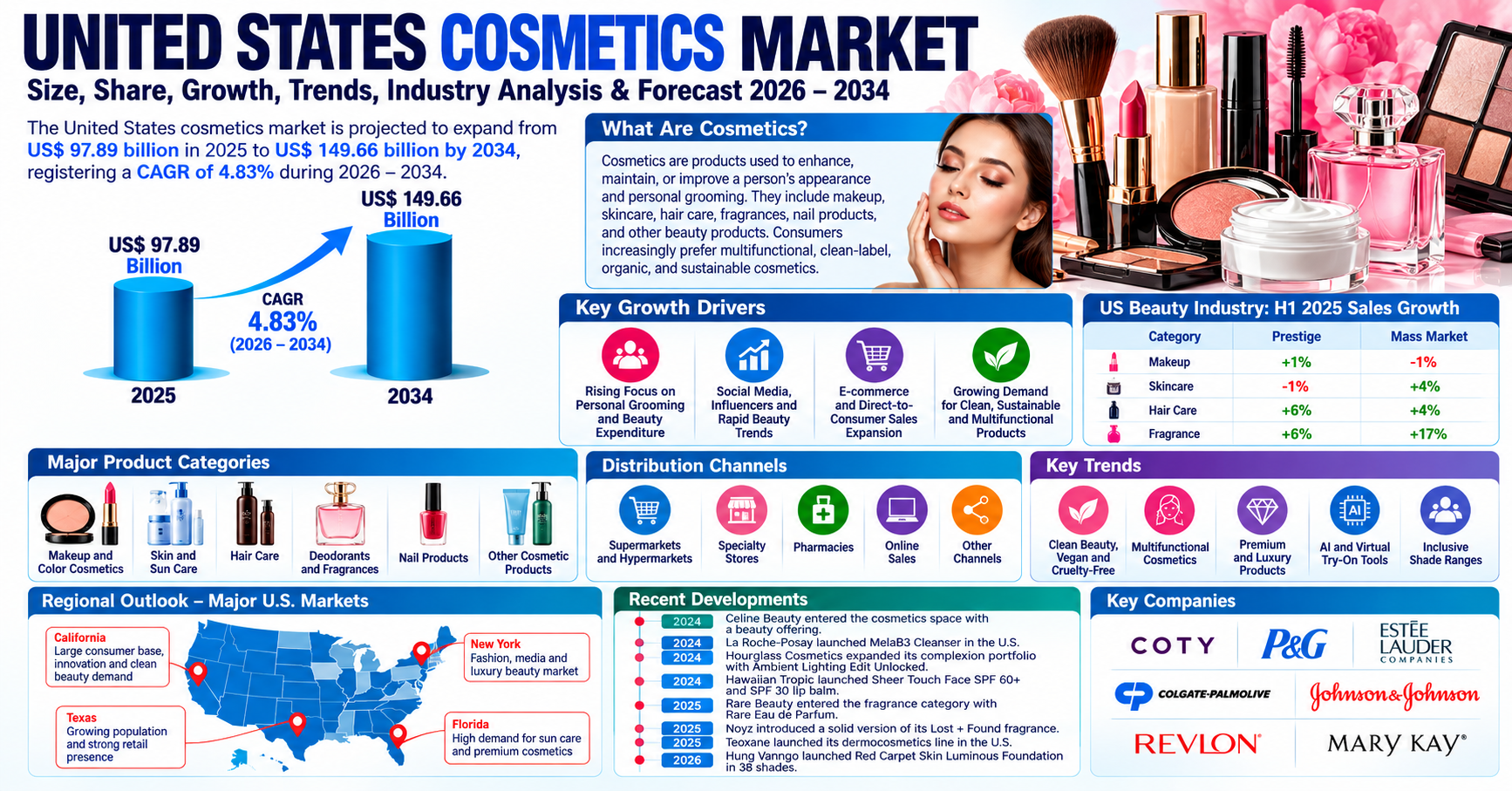
The United States cosmetics market is projected to grow from US$97.89 billion in 2025 to US$149.66 billion by 2034, registering a compound annual growth rate (CAGR) of 4.83% during 2026–2034. Growth is supported by rising personal-care expenditure, increasing interest in grooming and appearance, premium beauty products, and demand for clean, sustainable, and multifunctional cosmetics.
Cosmetics have become an important part of everyday personal-care routines, covering makeup, fragrances, skin and sun care, hair care, and other beauty products. Consumers increasingly prefer formulations that combine appearance-enhancing benefits with hydration, sun protection, anti-aging properties, and long-lasting performance.
Social media, beauty influencers, celebrity brands, and online shopping platforms are also influencing product discovery and purchasing behavior. Meanwhile, artificial intelligence (AI), virtual try-on tools, personalized recommendations, and inclusive shade ranges are helping brands improve the consumer experience.
However, regulatory compliance, intense competition, changing beauty trends, and price sensitivity remain important challenges. Companies that combine product innovation, quality, sustainability, and effective digital marketing are well positioned to compete in the evolving U.S. cosmetics industry.
🔗 Request a Sample: https://www.renub.com/request-sample-page.php?gturl=united-states-cosmetics-market-p.php
What Are Cosmetics and Why Are They Popular in the United States?
Cosmetics are products used to enhance, maintain, or improve personal appearance and grooming. They include foundations, concealers, lipsticks, mascara, eyeliners, blushes, nail products, fragrances, and hair-coloring products.
In the United States, cosmetics serve both everyday grooming needs and specialized beauty preferences. Consumers increasingly seek products that provide additional benefits, including moisturization, sun protection, skin-brightening effects, and anti-aging properties.
Clean beauty, vegan, cruelty-free, organic, and sustainable cosmetics are gaining attention as consumers become more conscious of ingredients and environmental impact. Social media platforms such as TikTok, Instagram, and YouTube have accelerated product discovery through tutorials, reviews, influencer recommendations, and viral beauty trends.
E-commerce and direct-to-consumer channels have also expanded access to domestic and international brands. Premium formulations, inclusive product ranges, and multifunctional cosmetics continue to create opportunities across the market.
Key Growth Drivers of the United States Cosmetics Market
1. Rising Personal Grooming and Beauty Expenditure
Increasing consumer interest in personal appearance, self-care, and grooming is a major market driver. Cosmetics are increasingly integrated into daily routines rather than being reserved exclusively for special occasions.
Consumers are showing interest in premium foundations, long-lasting makeup, fragrances, and products that combine skincare and cosmetic benefits. Men are also becoming a more important consumer group as grooming and skincare routines gain broader acceptance.
Premiumization is encouraging brands to invest in innovative formulations, high-quality ingredients, distinctive packaging, and sustainable product development. These trends are supporting opportunities across prestige and mass-market cosmetics.
2. Social Media, Influencers, and Viral Beauty Trends
Social media has transformed how consumers discover and purchase beauty products. Influencers, celebrity collaborations, makeup tutorials, product reviews, and short-form videos can rapidly increase awareness of new launches.
Viral trends encourage consumers to experiment with colors, textures, finishes, and new product categories. Social commerce also reduces the time between product discovery and purchase, helping brands convert online engagement into sales.
However, rapidly changing trends can shorten product lifecycles. Cosmetics companies must continuously monitor consumer preferences and develop relevant products to maintain brand visibility.
3. E-Commerce and Beauty Technology Innovation
Online shopping has expanded access to cosmetics across the United States. Consumers can compare prices, ingredients, reviews, shades, and brand offerings through online marketplaces and direct-to-consumer websites.
Beauty companies are also adopting AI-powered recommendations, virtual try-on tools, digital shade matching, and personalized product discovery. These technologies can help consumers explore products and make more informed purchasing decisions.
The combination of online and physical retail is strengthening omnichannel shopping, while subscription programs, loyalty initiatives, and personalized marketing help brands maintain customer engagement.
4. Growing Demand for Clean, Sustainable, and Multifunctional Products
Consumers are increasingly interested in products marketed around vegan formulations, cruelty-free practices, ingredient transparency, and environmentally conscious packaging.
Multifunctional cosmetics are another important opportunity. Products combining makeup with hydration, sun protection, or other skincare benefits appeal to consumers seeking convenience and simplified beauty routines.
Brands must support their ingredient, safety, sustainability, and performance claims with appropriate evidence to maintain credibility.
U.S. Beauty Industry: First-Half 2025 Sales Performance
The source material reports different growth patterns across prestige and mass-market beauty categories during the first half of 2025 compared with the same period in 2024.
| Beauty category | Prestige sales | Mass-market sales |
|---|---|---|
| Makeup | +1% | -1% |
| Skincare | -1% | +4% |
| Hair care | +6% | +4% |
| Fragrance | +6% | +17% |
Fragrance was the strongest-performing category and channel combination, with mass-market fragrance sales increasing by 17%. Prestige fragrance and prestige hair care each recorded 6% growth.
Skincare performance differed by channel: prestige skincare declined by 1%, while mass-market skincare increased by 4%. Makeup remained relatively stable, with only modest changes in both channels.
These results highlight the importance of product category, pricing, distribution, and consumer preferences in determining beauty sales performance.
Major Challenges Facing the U.S. Cosmetics Industry
Regulatory Compliance and Product Safety
Cosmetics manufacturers must comply with U.S. requirements governing product safety, labeling, manufacturing, and marketing. The Modernization of Cosmetics Regulation Act of 2022 (MoCRA) introduced significant changes to the regulatory framework, including applicable requirements related to facility registration, product listing, adverse-event reporting, and safety substantiation.
These responsibilities can increase compliance costs, particularly for smaller brands. Companies must also manage ingredient transparency, product testing, manufacturing consistency, and marketing claims.
Investment in quality assurance, appropriate documentation, and responsible product communication is essential for maintaining consumer confidence and reducing regulatory risk.
Intense Competition and Changing Consumer Preferences
The U.S. cosmetics market includes established multinational companies, independent beauty brands, celebrity-backed businesses, and digital-first manufacturers.
Consumers can purchase products through department stores, specialty beauty retailers, pharmacies, supermarkets, online marketplaces, and direct-to-consumer websites. This creates intense competition for attention, shelf space, and customer loyalty.
Social media trends can produce sudden demand for specific products, but popularity may decline quickly. Inflation and household budget pressures can also encourage consumers to switch between premium and affordable alternatives.
Brands must continually invest in product development, marketing, packaging, distribution, and customer experience to remain competitive.
Recent Cosmetics Launches and Developments in the United States
The source material highlights several launches and portfolio expansions illustrating the diversity of innovation across beauty categories.
- 2024 — Celine Beauty: The luxury fashion house entered the cosmetics space with a beauty offering, expanding into makeup.
- 2024 — La Roche-Posay: Introduced MelaB3 Cleanser in the U.S. market, featuring Melasyl, niacinamide, and PHA.
- 2024 — Hourglass Cosmetics: Expanded its premium complexion portfolio with the Ambient Lighting Edit Unlocked collection.
- 2024 — Hawaiian Tropic: Expanded its facial sun-care offering with Sheer Touch Face SPF 60+ and an SPF 30 lip balm.
- 2025 — Rare Beauty: Entered the fragrance category with Rare Eau de Parfum, extending its portfolio beyond color cosmetics.
- 2025 — Noyz: Introduced a solid version of its Lost + Found fragrance in a portable stick format.
- 2025 — Teoxane: Brought its dermocosmetics line to the U.S. market.
- 2026 — Hung Vanngo: Launched Red Carpet Skin Luminous Foundation, a serum-based foundation offered in 38 shades, according to the source material.
These developments demonstrate opportunities in premium makeup, fragrance, skincare, sun protection, convenient formats, and multifunctional beauty products. Individual launch dates and product details should be verified against official brand announcements before publication.
United States Cosmetics Market Segmentation
The market can be analyzed across four principal categories.
By product type
- Skin and sun care products
- Hair care products
- Deodorants and fragrances
- Makeup and color cosmetics
- Other cosmetic products
By gender
- Men
- Women
- Unisex
By distribution channel
- Supermarkets and hypermarkets
- Specialty stores
- Pharmacies
- Online sales
- Other channels
By geographic coverage
The report covers California, Texas, New York, Florida, Illinois, Pennsylvania, Ohio, Georgia, New Jersey, Washington, North Carolina, Massachusetts, Virginia, Michigan, Maryland, Colorado, Tennessee, Indiana, Arizona, Minnesota, Wisconsin, Missouri, Connecticut, South Carolina, Oregon, Louisiana, Alabama, Kentucky, and the rest of the United States.
Regional Outlook: Major U.S. Cosmetics Markets
California
California is an important beauty market supported by its large population, entertainment industry, technology ecosystem, and influential beauty brands. Consumer interest in clean beauty, vegan products, sustainability, inclusive shades, and personalized cosmetics creates opportunities for innovation.
Texas
Texas benefits from population growth, expanding metropolitan areas, and demand for skincare, makeup, fragrances, and hair care. Houston, Dallas–Fort Worth, Austin, and San Antonio are important urban markets.
New York
New York’s fashion, media, luxury retail, and entertainment industries influence beauty trends. Consumers have extensive access to prestige cosmetics, emerging brands, specialty stores, and innovative products.
Florida
Florida’s warm climate and outdoor lifestyle support demand for sun care, SPF-infused makeup, moisturizers, and long-lasting formulations. Tourism and interest in anti-aging skincare also contribute to product demand.
Competitive Landscape and Key Companies
Competition in the U.S. cosmetics market is driven by brand recognition, product performance, innovation, pricing, distribution, and consumer loyalty.
Key companies covered in the source material include:
- Coty Inc.
- Procter & Gamble
- The Estée Lauder Companies Inc.
- Colgate-Palmolive Company
- Johnson & Johnson Services Inc.
- Revlon Inc.
- Mary Kay Inc.
Market participants compete through product launches, brand extensions, digital marketing, retail partnerships, and investments in innovative formulations. Companies that respond effectively to evolving consumer preferences and maintain consistent product quality can strengthen their market positions.
Future Outlook: United States Cosmetics Market 2026–2034
The U.S. cosmetics market is expected to expand steadily through 2034, supported by personal-care spending, premium beauty, social commerce, and ongoing product innovation.
The projected increase from US$97.89 billion in 2025 to US$149.66 billion by 2034 reflects opportunities across makeup, skincare, hair care, fragrances, and other cosmetics.
AI-enabled beauty recommendations, virtual try-on tools, clean beauty products, inclusive shade ranges, and multifunctional formulations are likely to remain important areas of development. At the same time, regulatory compliance, intense competition, and changing consumer preferences will require companies to remain agile.
Brands that combine credible product claims, differentiated formulations, strong digital engagement, and convenient shopping experiences will be well positioned to compete in the evolving U.S. beauty market.
Frequently Asked Questions (FAQs)
1. What is the size of the United States cosmetics market?
The United States cosmetics market is projected to reach US$97.89 billion in 2025, according to the supplied market estimates.
2. What will the U.S. cosmetics market be worth by 2034?
The market is forecast to reach US$149.66 billion by 2034.
3. What is the expected CAGR of the United States cosmetics market?
The market is projected to grow at a CAGR of 4.83% during 2026–2034.
4. What are the main drivers of the U.S. cosmetics market?
Key drivers include rising personal grooming expenditure, premium beauty demand, social media influence, e-commerce expansion, and interest in clean and multifunctional cosmetics.
5. Which cosmetics categories are covered in the market?
Major categories include skin and sun care, hair care, deodorants and fragrances, makeup and color cosmetics, and other products.
6. How is social media influencing cosmetics sales?
Social media enables brands to reach consumers through tutorials, influencer recommendations, reviews, and viral trends. Social commerce also makes it easier to move from product discovery to purchase.
7. What are the major challenges facing U.S. cosmetics companies?
Key challenges include regulatory compliance, product safety, intense competition, changing consumer preferences, and pricing pressure.
8. Which distribution channels are important for cosmetics in the United States?
Important channels include supermarkets and hypermarkets, specialty beauty stores, pharmacies, and online sales platforms.
9. Which companies are key players in the U.S. cosmetics market?
Companies covered in the source material include Coty, Procter & Gamble, Estée Lauder, Colgate-Palmolive, Johnson & Johnson, Revlon, and Mary Kay.
10. What is the future outlook for the U.S. cosmetics market?
The market is expected to grow through 2034, supported by premiumization, digital beauty technology, clean beauty, multifunctional formulations, and expanding online distribution.
Conclusion
The United States cosmetics market is positioned for continued growth as consumers prioritize personal grooming, premium beauty, convenient shopping, and innovative formulations. Social media, e-commerce, AI-powered personalization, and demand for sustainable products are reshaping how brands develop and market cosmetics.
Companies that balance innovation, product quality, regulatory compliance, and customer experience will be better positioned to capitalize on emerging opportunities.
Explore the full report: United States Cosmetics Market — Renub Research.
About Renub Research: Renub Research provides market intelligence and industry analysis to help businesses understand market trends, competitive developments, and growth opportunities.