





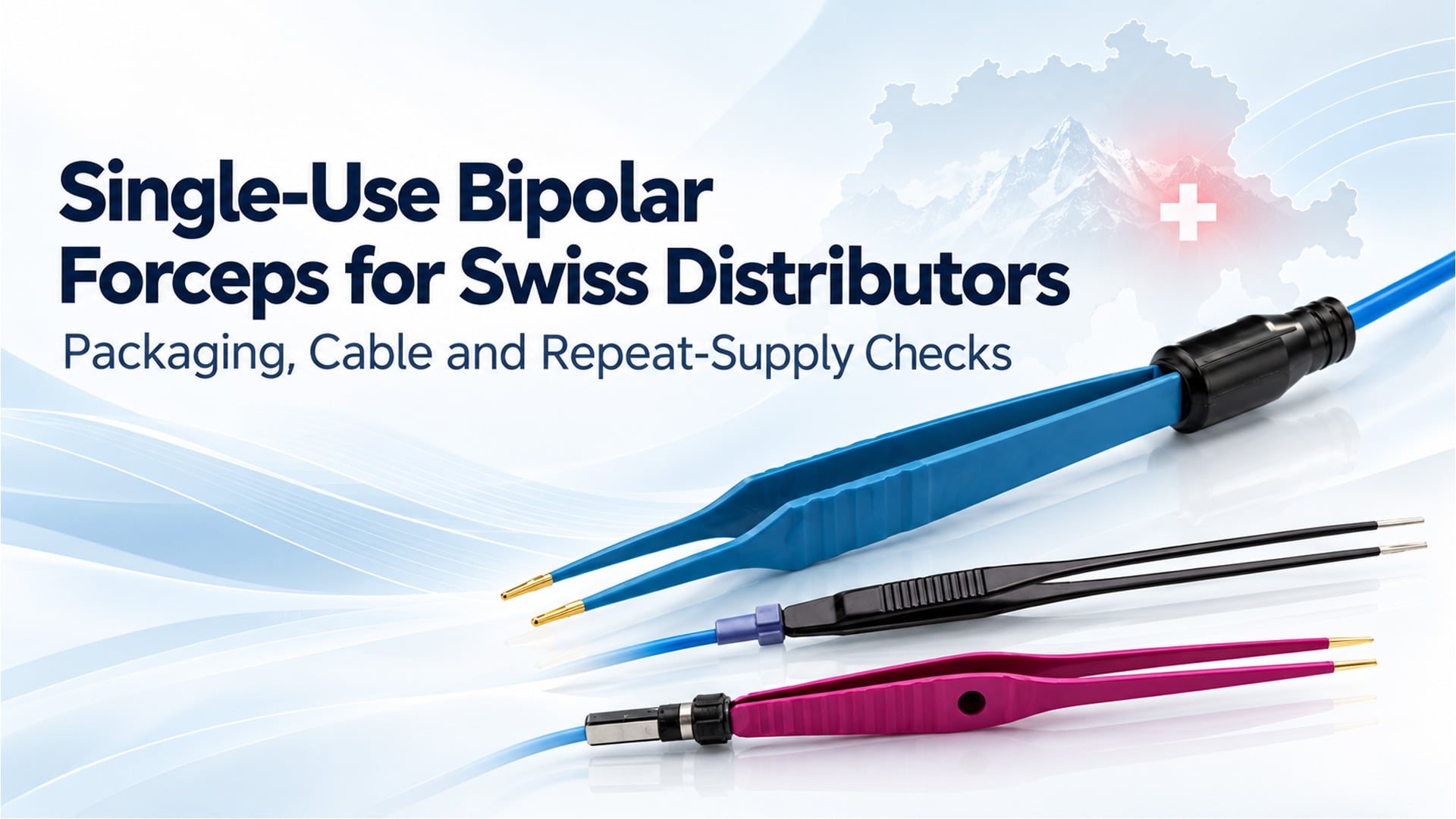
When a Swiss distributor adds single-use bipolar forceps to its range, it takes on a responsibility the manufacturer cannot fully carry: making sure every hospital and clinic receives exactly the product it approved, order after order. Most of the risk sits in three areas, which are packaging, cable and connector details, and the reliability of repeat supply. Checking each before the product is listed saves problems once customers start ordering.
Packaging checks
Single-use products are received, stored and used straight from their packaging, so the packaging carries more information than it does for reusable instruments. Before listing a reference, confirm:
– Pack configuration: how many instruments are in each unit pack and in each outer carton. This defines your unit of sale and your customers’ order quantities.
– Identification: how the product reference and batch or lot are shown on the label, so goods-in checks at your warehouse and your customers’ sites can match stock to records.
– Sterile status: whether the reference is supplied sterile, and what the label states. “Single-use” does not by itself mean sterile, and the answer must come from the product’s own labelling and documentation.
– Date information: any dates shown on the label, so stock can be rotated correctly.
– Language needs: which languages your customers need for labelling or instructions for use. This is worth raising with the manufacturer early, because Swiss customers may work in different national languages.
Cable and connector checks
Many single-use bipolar forceps are supplied with the cable attached. That is convenient for users, but it makes the cable part of the product, and it means the generator-end connector must suit each customer’s equipment.
– Record the connector type for each reference in your catalogue.
– Collect customers’ generator models before recommending a reference, and keep this information on the customer record.
– Confirm compatibility properly. A connector that fits a socket has not, on that evidence alone, been confirmed as electrosurgically compatible. The forceps, connector and generator combination should be confirmed, with customers involving their own technical teams where their processes require it.
– Code connector variants separately. If a reference exists in more than one connector version, each needs its own catalogue code.
Repeat-supply checks
A single-use line only earns its place in the range if it can be resupplied consistently. Before launch, agree the following with the manufacturer:
– Reference lock: your catalogue code maps to one manufacturer reference, and substitutions are never made without your agreement.
– Forecasting by reference: volumes are shared per product code, not per category, so production and stock planning reflect real demand.
– Change notification: how and when you will be told about changes to specification, packaging or labelling, so you can inform customers before changed stock reaches them.
– Documentation upkeep: a documentation set held per reference and refreshed when anything changes.
– First-delivery verification: checking the first shipment against your catalogue record before releasing it to customers.
Why this matters more for distributors
A hospital buying directly deals with one product in one setting. A distributor may supply the same reference to many hospitals and clinics, each with its own generators, approval files and ordering patterns. A small inconsistency at source can therefore spread across several customers. Careful checks before listing are the distributor’s best protection.
Working with the manufacturer
These checks go most smoothly when the manufacturer works at reference level and is clear about what it supplies. Cosil Instruments’ established single-use range consists of integrated-cable single-use bipolar forceps. Its Swiss guidance covers pattern, connector, packaging, sterile-status verification and documentation for hospitals, clinics and distributors.
As with any supplier, packaging details, sterile status and documentation should be confirmed for each specific reference, and regulatory information assessed through the distributor’s own compliance process.
A pre-listing checklist
-
Pack configuration confirmed
-
Reference and batch identification checked
-
Sterile status confirmed from labelling
-
Language needs raised with the manufacturer
-
Connector type recorded and connector variants coded separately
-
Customer generator models collected
-
Forecast shared by reference
-
Change-notification process agreed
-
Documentation set held per reference
-
First delivery verified before release
Conclusion
Single-use bipolar forceps can be a strong addition to a Swiss distributor’s range, provided they are listed carefully. Checking packaging, cable and connector details, and the arrangements for repeat supply before launch, lets distributors give hospitals and clinics the consistency they expect from every order.
Planning to add single-use bipolar forceps to your Swiss range? Work through the pre-listing checklist with your manufacturer before your first customer order.