


Tennis and pickleball are more than games of speed and coordination. Both sports require strength, balance, endurance, and the ability to react quickly to changing situations. Whether you are chasing a deep tennis shot, moving toward the kitchen line in pickleball, or preparing for a powerful serve, your muscles play an important role in every movement.
Building strength can help players move more efficiently, maintain control during long rallies, and reduce the physical demands placed on their joints and muscles. The right training routine does not necessarily require an expensive gym membership or complicated equipment. A combination of simple, targeted exercises can make a meaningful difference in overall performance.
For players looking to improve their game, incorporating strength exercises for tennis, pickleball strength training, and general racket sport conditioning into a weekly routine is an excellent place to start.
1. Squats for Stronger Legs and Better Court Movement
Strong legs provide the foundation for almost every movement in tennis and pickleball. Players constantly bend their knees, change direction, push off the ground, and recover after hitting a shot. Squats help develop the quadriceps, glutes, and supporting muscles needed for these movements.
Bodyweight squats are a practical starting exercise for players of different experience levels. Stand with your feet approximately shoulder-width apart, push your hips backward, and lower your body while keeping your chest lifted. Return to a standing position by driving through your feet.
As your strength improves, you can introduce goblet squats using a dumbbell or kettlebell.
Performance benefits:
- Develops lower-body strength for quicker court movement.
- Supports stability when reaching low shots.
- Improves the ability to push off and recover between shots.
- Builds muscular endurance for extended playing sessions.
Start with two or three sets of 10–12 repetitions, focusing on controlled movement rather than speed.
2. Lunges for Balance and Directional Strength
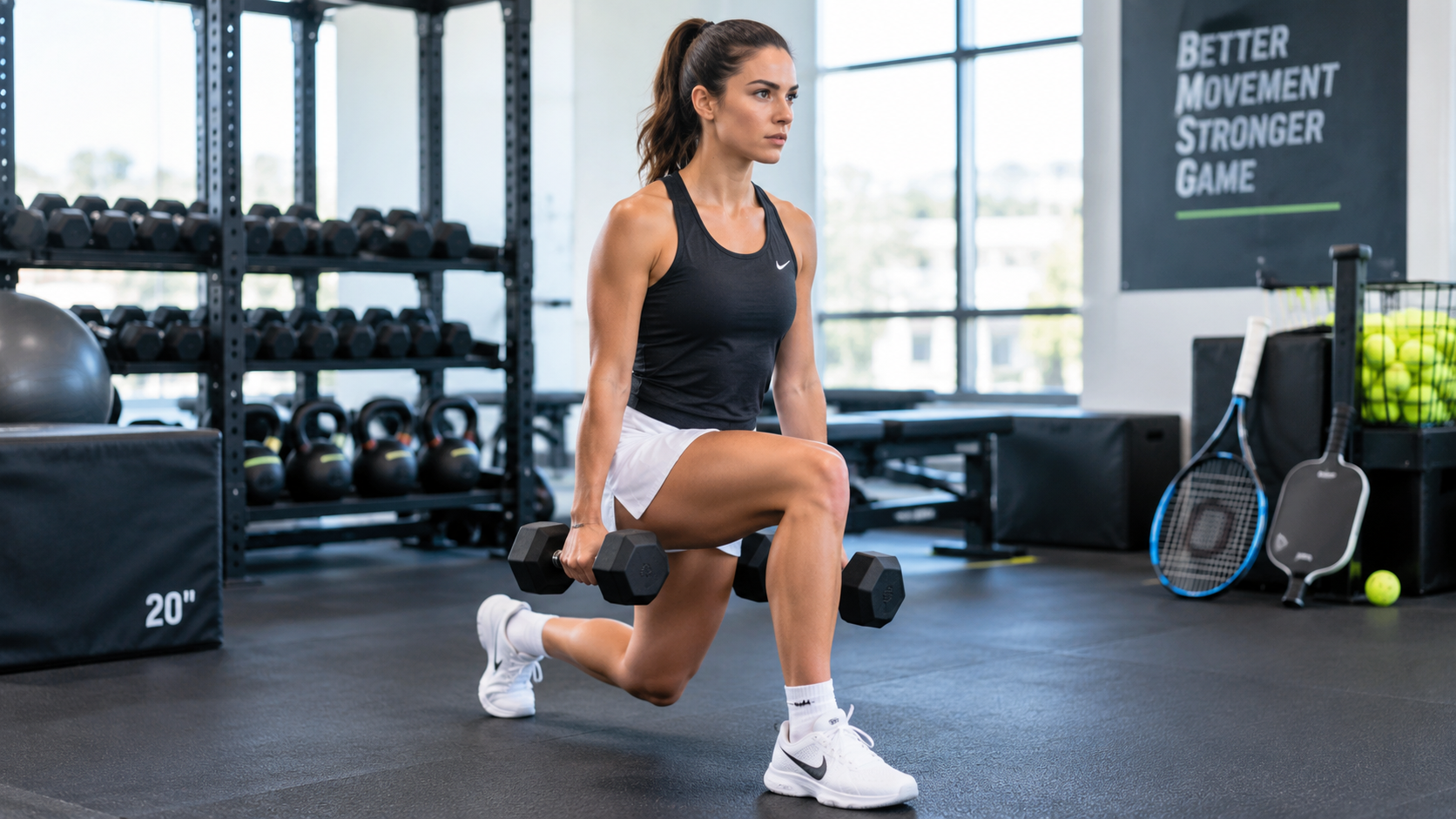
Tennis and pickleball require players to move in several directions, often stretching into uncomfortable positions to reach the ball. Lunges help develop the strength and balance needed for these movements.
Forward lunges strengthen the legs and improve control during forward movement. Reverse lunges are another useful variation because they challenge stability while allowing players to work on controlled backward movement.
To perform a forward lunge, take a comfortable step forward, bend both knees, and lower your body while keeping your torso upright. Push through your front foot to return to the starting position. Alternate legs throughout the set.
Lateral lunges are especially valuable for racket sport athletes because side-to-side movement is a major part of court positioning.
Performance benefits:
- Strengthens the muscles used during lateral movement.
- Improves single-leg balance and coordination.
- Develops control when reaching for wide shots.
- Helps players maintain a stable position during groundstrokes.
Try two sets of 8–10 repetitions per leg before gradually increasing the workload.
3. Planks and Core Exercises for Better Stability
A strong core connects the upper and lower body, helping players transfer energy efficiently during serves, groundstrokes, volleys, and overhead shots.
Without sufficient core strength, players may struggle to maintain balance while reaching or rotating. Core training also supports better posture and control during repeated movements.
Planks are among the most effective exercises for developing basic core stability. Position yourself on your forearms and toes, keeping your body in a straight line. Tighten your abdominal muscles and avoid allowing your hips to drop.
Other useful exercises include dead bugs, bird dogs, and side planks. These movements challenge the abdominal and back muscles while encouraging controlled coordination.
Performance benefits:
- Improves balance during dynamic movements.
- Supports efficient power transfer between the legs and upper body.
- Develops control during rotational movements.
- Helps maintain good posture throughout a match.
Begin with two or three sets of 20–30-second planks and increase the duration as your technique improves.
4. Push-Ups and Resistance Exercises for Upper-Body Strength
Your shoulders, chest, arms, and upper back contribute to racket control, serving, volleys, and overhead shots. Developing these muscle groups can help players maintain technique and control throughout a match.
Push-ups are an accessible exercise that strengthens the chest, shoulders, triceps, and core. Players who find standard push-ups challenging can begin with wall push-ups or incline push-ups before progressing.
Resistance-band rows are another valuable addition. Attach a resistance band securely, hold both ends, and pull toward your torso while squeezing your shoulder blades together. This movement strengthens the upper back and supports balanced shoulder development.
For tennis and pickleball players, upper-body training should focus on balanced strength rather than simply building bigger muscles.
Performance benefits:
- Supports racket control and upper-body stability.
- Develops strength for serving and overhead movements.
- Strengthens the upper back and shoulder-supporting muscles.
- Helps maintain control during repeated strokes.
Perform two or three sets of 8–12 repetitions, choosing resistance that allows you to maintain proper form.
5. Rotational Exercises for More Efficient Racket Power
Tennis and pickleball involve frequent rotation through the hips, torso, and shoulders. Groundstrokes, serves, and overhead shots all require coordinated movement throughout the body.
Rotational strength exercises help players develop control and coordination during these actions. Resistance-band rotations are a simple option. Stand sideways to a securely anchored resistance band, hold it with both hands, and rotate your torso away from the anchor while keeping your movements controlled.
Medicine ball rotational throws are another option for experienced players with access to suitable equipment and a safe training space.
The goal is not to rotate as forcefully as possible. Instead, focus on coordinated movement, controlled resistance, and maintaining good balance.
Performance benefits:
- Develops rotational strength for racket sports.
- Encourages coordination between the hips and upper body.
- Supports controlled groundstrokes and serving mechanics.
- Improves the ability to transfer energy through the body.
Start with two sets of 8–10 controlled repetitions on each side.
6. Building a Consistent Racket Sport Conditioning Routine
Individual exercises are useful, but consistency is what turns strength training into lasting progress. Players should combine lower-body strength, upper-body exercises, core stability, and mobility work rather than focusing on just one muscle group.
A simple weekly routine could include two strength-training sessions, regular tennis or pickleball practice, and appropriate recovery days. Each strength session can include squats, lunges, push-ups, resistance-band rows, planks, and rotational exercises.
Warm up before exercising with light movement and dynamic stretches. Increase resistance gradually, and allow your muscles time to recover between challenging sessions.
It is also important to adapt training to your playing experience, fitness level, and individual needs. Beginners should start with bodyweight exercises and manageable repetitions. More experienced players can gradually introduce resistance and sport-specific movements.
At WNY Tennis, players can develop their skills through consistent court time, structured practice, and an active approach to fitness. Combining strength work with regular tennis and pickleball participation can help players build confidence, improve movement, and enjoy the game for years to come.
The Bottom Line
Strength training is an important part of becoming a more complete racket sport athlete. From squats and lunges to core exercises and rotational training, each movement contributes to better physical preparation for the court. By making strength exercises for tennis and pickleball strength training part of a balanced fitness routine, players can develop greater stability, improve movement efficiency, and support long-term performance.
The best results come from training consistently, using proper technique, and building strength at a pace that suits your body. Stronger movement starts off the court and makes a difference every time you step onto it.