



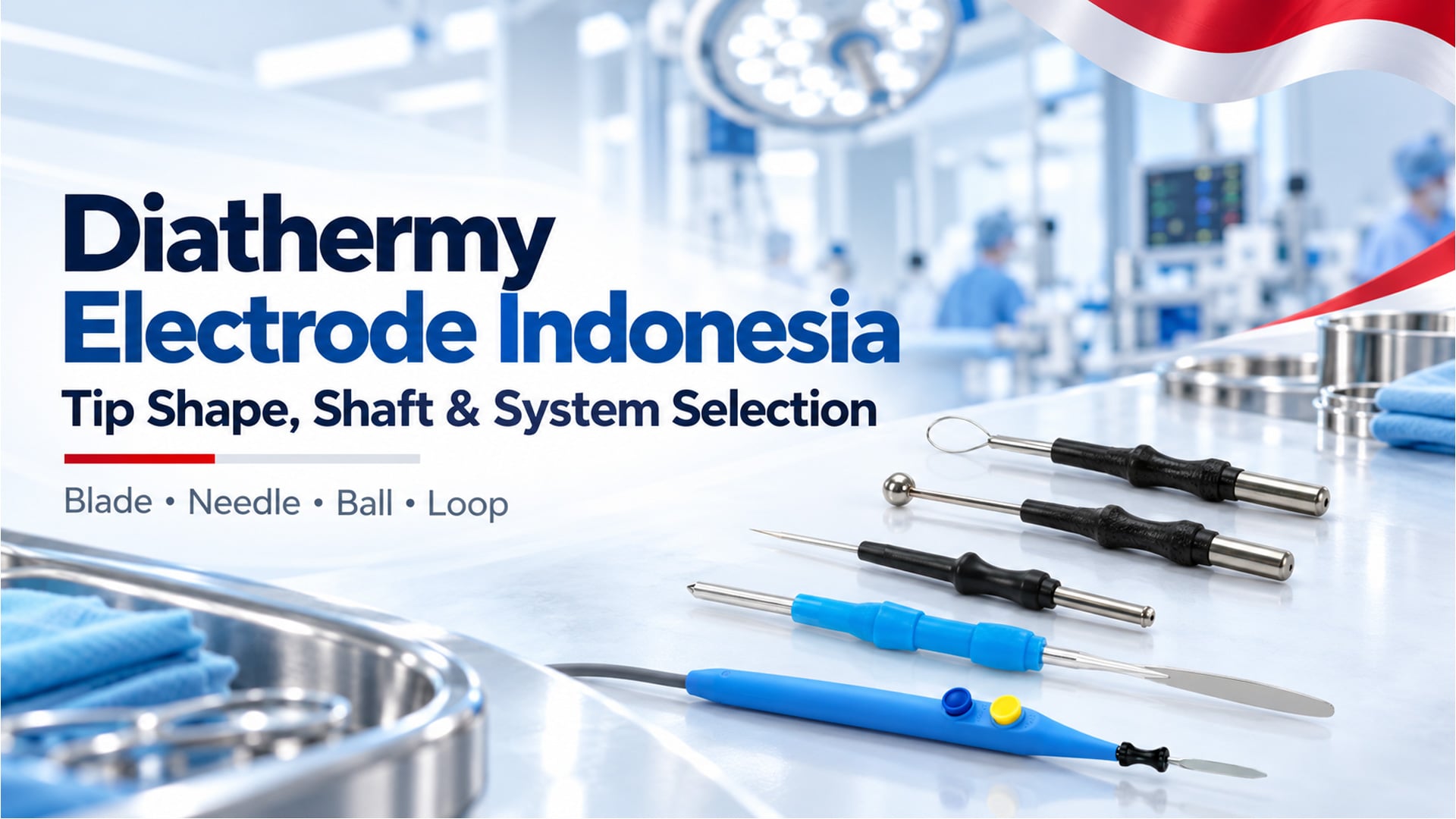
Blade, Needle, Ball or Loop? The Correct Tip Still Needs the Correct Shaft, Handpiece and System
A Diathermy Electrode may look like one of the simplest products in an electrosurgical range.
The working tip is visible, easy to describe and often becomes the first thing buyers compare.
But professional selection should not begin and end with whether the electrode is a blade, needle, ball or loop.
For Indonesian hospitals, distributors and OEM buyers, the electrode needs to fit the intended handpiece, match the required shaft size, provide the correct working length and integrate with the broader electrosurgical system.
A correct tip on the wrong shaft is still the wrong electrode.
Shaft Diameter Should Be a Core Purchasing Specification
The electrode shaft needs to fit the selected cautery pencil or compatible handpiece.
Depending on the product range, active electrodes may be available in different shaft categories such as:
-
1.6 mm;
-
2.4 mm;
-
4.0 mm;
-
or other product-specific configurations.
Indonesian buyers should not substitute one diameter for another simply because the difference appears small.
The approved specification should clearly state:
-
shaft diameter;
-
receiving handpiece;
-
retention method;
-
insertion requirements;
-
and related product reference.
This turns a broad product description into a usable procurement specification.
Tip Profile Needs Supporting Detail
A tip name can be useful, but it is not enough by itself.
For example, “needle electrode” does not tell the buyer:
-
tip dimensions;
-
exposed working area;
-
shaft diameter;
-
insulation transition;
-
or compatible handpiece.
Likewise, two blade electrodes may differ in working dimensions or shaft configuration.
A professional article description should connect the tip profile and shaft specification together.
Working Length Should Be Written Down
Length becomes especially important where extended-access or laparoscopic products are involved.
Buyers should record:
-
total length;
-
working length;
-
insulated length;
-
and exposed tip section where relevant.
Terms such as “long electrode” are too general for dependable repeat purchasing.
Measured specifications reduce ambiguity.
Insulation Coverage Is Part of the Product Design
The insulated shaft and exposed working section form part of the electrode’s intended configuration.
Buyers should inspect:
-
insulation coverage;
-
transition points;
-
exposed tip area;
-
overall surface condition;
-
and consistency with the approved sample or drawing.
A product should not be accepted simply because the working tip appears correct.
Handpiece Retention Should Be Tested
An electrode that enters the handpiece but does not remain properly retained may not meet the intended system requirement.
Sample evaluation should include:
-
insertion;
-
retention;
-
stability;
-
removal;
-
and fit within the approved handpiece.
Product photographs cannot confirm this.
Physical evaluation provides stronger evidence.
Generator Compatibility Extends Beyond the Electrode
The electrode does not operate independently.
The wider system may include:
Electrode → Handpiece → Cable → Electrosurgical Generator
Compatibility should therefore be documented across the relevant components.
A visually similar electrode should not automatically be treated as interchangeable.
Different Electrode Categories Need Different Questions
A distributor may carry several specialised categories.
Standard Active Electrodes
Important considerations may include:
-
shaft diameter;
-
tip shape;
-
exposed working area;
-
and handpiece compatibility.
Microdissection Needles
Additional attention may be needed for:
-
fine-tip dimensions;
-
insulation transition;
-
packaging protection;
-
and compatible system information.
Arthroscopic Electrodes
Buyers may need to review:
-
shaft construction;
-
tip orientation;
-
working length;
-
and intended arthroscopic system.
ENT Bipolar Electrodes
Selection may involve:
-
bipolar geometry;
-
insulation;
-
connector;
-
and compatible bipolar equipment.
Laparoscopic Electrodes
Long-shaft instruments may require closer review of:
-
working length;
-
shaft diameter;
-
insulation integrity;
-
distal tip;
-
and compatible handpiece or system.
Packaging Protects More Than Sterility
Even reusable electrodes need suitable protection during transport and storage.
Fine tips and extended shafts can be vulnerable to:
-
bending;
-
puncture;
-
deformation;
-
or insulation damage.
Packaging therefore forms part of product quality control.
For sterile single-use products, packaging also needs to support the labelled sterile condition and shelf-life requirements.
Reusable and Single-Use Electrodes Should Be Clearly Separated
Reusable and single-use products require different handling systems.
Reusable electrodes
May require:
-
inspection;
-
cleaning;
-
reprocessing;
-
storage;
-
and removal-from-service criteria.
Single-use electrodes
May require:
-
sterile packaging;
-
shelf-life monitoring;
-
stock rotation;
-
traceability;
-
and continuous replenishment.
A catalogue should not mix both under unclear descriptions.
Common Electrode-Sourcing Mistakes
Several purchasing problems can be avoided early:
-
ordering by tip name without confirming shaft diameter;
-
assuming one handpiece accepts every electrode;
-
approving from images without testing retention;
-
ignoring working length;
-
failing to distinguish reusable and single-use models;
-
using vague product descriptions;
-
ignoring packaging protection for fine tips;
-
or assuming visually similar products are interchangeable.
Each of these can create confusion during repeat orders.
A Better RFQ for Indonesian Buyers
A professional enquiry should include:
-
required tip style;
-
shaft diameter;
-
working length;
-
reusable or single-use status;
-
receiving handpiece;
-
relevant generator system;
-
packaging requirement;
-
expected quantity;
-
destination;
-
and documentation requirements.
That allows suppliers to compare the actual configuration instead of guessing.
For broader market research, buyers can review:
https://electrorange.com/electrosurgical-instruments-indonesia/
Final Thoughts
Selecting a Diathermy Electrode in Indonesia should begin with the complete application, not the visible tip alone.
The strongest specification connects:
Tip + Shaft + Length + Insulation + Handpiece + Electrosurgical System
When buyers define those relationships before ordering, they reduce substitution risk, improve quotation accuracy and make repeat purchasing much easier to manage.
Request diathermy electrode specifications, sample configurations and compatibility information from Electro Range for professional Indonesia-focused procurement.