







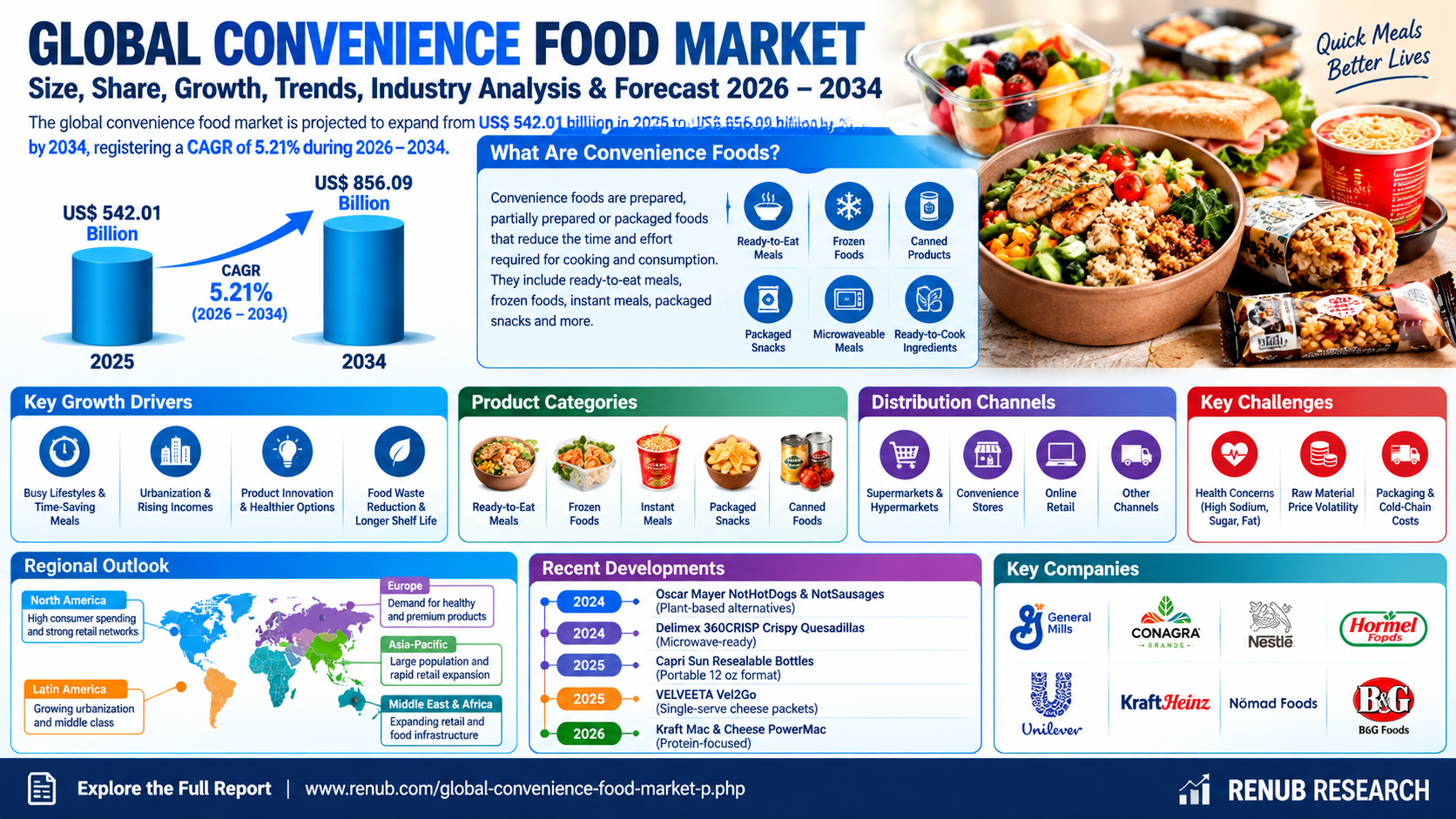
Global Convenience Food Market Size and Forecast
The global convenience food market is projected to grow from US$542.01 billion in 2025 to US$856.09 billion by 2034, registering a compound annual growth rate (CAGR) of 5.21% during 2026–2034. Market expansion is supported by busy lifestyles, urbanization, rising disposable incomes, and increasing consumer demand for quick and easy meal solutions.
Convenience foods include ready-to-eat meals, frozen foods, instant noodles, canned products, packaged snacks, microwaveable meals, and ready-to-cook ingredients. These products help consumers reduce meal preparation time while maintaining access to a wide variety of food options.
The growing number of working professionals, smaller households, and time-constrained consumers is encouraging manufacturers to introduce convenient packaging, improved shelf life, and microwave- and air-fryer-friendly products. At the same time, demand for healthier, high-protein, plant-based, and clean-label foods is influencing product development.
However, health concerns associated with highly processed foods, fluctuating raw-material prices, and cold-chain expenses remain important challenges. Manufacturers that combine convenience, affordability, taste, and nutritional value are well positioned to capitalize on changing food consumption patterns.
Request a Sample Report: https://www.renub.com/request-sample-page.php?gturl=convenience-food-market-p.php
What Is Convenience Food?
Convenience food refers to food that is prepared, partially prepared, or packaged to reduce the time and effort required for cooking and consumption. Common examples include frozen meals, instant noodles, canned foods, packaged snacks, ready-to-eat meals, and ready-to-cook ingredients.
These products serve households, students, working professionals, travelers, and foodservice operators seeking quick and accessible meal solutions. Supermarkets, convenience stores, online grocery platforms, and food-delivery services have expanded product availability across developed and emerging economies.
Consumers are also becoming more selective about ingredients and nutrition. Consequently, manufacturers are introducing products with higher protein content, reduced sodium, less added sugar, plant-based ingredients, and convenient portion sizes.
Key Growth Drivers of the Global Convenience Food Market
1. Busy Lifestyles and Demand for Time-Saving Meals
Busy work schedules, commuting, education, and household responsibilities are major drivers of convenience food consumption. Ready-to-eat (RTE), ready-to-heat (RTH), and ready-to-cook (RTC) products allow consumers to prepare or consume meals with less effort.
Urbanization and the expansion of smaller households further increase demand for individually packaged meals and portion-controlled products. Consumers increasingly value foods that can be prepared in minutes without sacrificing taste or variety.
Manufacturers are responding with microwaveable meals, frozen snacks, chilled products, and air-fryer-compatible foods. Convenience is expected to remain a fundamental factor supporting market growth.
2. Urbanization, Rising Incomes, and Modern Retail Expansion
Urban populations generally have access to a wider range of supermarkets, hypermarkets, convenience stores, and online grocery services. These channels make packaged foods and prepared meals easier to purchase.
Rising disposable incomes in developing economies are also creating opportunities for value-added and premium convenience products. Retail infrastructure expansion across Asia-Pacific, Latin America, and the Middle East is improving distribution and increasing consumer choice.
Manufacturers are offering products at multiple price points to appeal to both budget-conscious consumers and shoppers seeking premium ingredients or specialized dietary options.
3. Product Innovation and Healthier Convenience Foods
Consumers increasingly want convenience without compromising nutritional quality. This is encouraging manufacturers to develop high-protein meals, lower-sodium recipes, reduced-sugar snacks, plant-based alternatives, and products with simpler ingredient lists.
Packaging innovation is another important development. Microwaveable containers, resealable packs, single-serving portions, and improved shelf-life technologies help make convenience foods easier to store and prepare.
The growing popularity of air fryers and other countertop appliances is also influencing product development. These trends create opportunities for companies that can combine preparation speed, appealing taste, and nutritional value.
4. Food Waste Reduction and Longer Shelf Life
Frozen, canned, and shelf-stable products can help households manage food inventories and reduce spoilage-related waste when stored and used appropriately.
According to the source material, EU countries generated more than 59 million tonnes of food waste annually, equivalent to approximately 132 kilograms per person, based on a 2024 Eurostat report.
Longer shelf life, portion-controlled packaging, and improved inventory management are encouraging consumers and retailers to consider products that can be stored and consumed when needed.
Major Challenges Facing the Convenience Food Industry
Health Concerns Associated with Highly Processed Foods
Some convenience foods contain high levels of sodium, added sugars, or saturated fat. Growing awareness of nutrition-related health risks is encouraging consumers to evaluate ingredient lists and nutritional labels more carefully.
The World Health Organization recommends that adults consume less than 2,000 mg of sodium per day. Manufacturers therefore face increasing pressure to reformulate products while preserving flavor, affordability, and shelf life.
Developing healthier recipes can require investment in ingredients, manufacturing processes, and testing. Nevertheless, lower-sodium, high-protein, and plant-based alternatives also provide opportunities for differentiation.
Supply-Chain Volatility and Rising Production Costs
Convenience food manufacturers depend on agricultural commodities, including wheat, potatoes, corn, vegetable oils, meat, dairy ingredients, and spices. Prices can fluctuate because of weather conditions, energy costs, geopolitical developments, and changes in global supply and demand.
Frozen products also require temperature-controlled storage and transportation, which can increase operating expenses.
Companies are responding through diversified sourcing, improved inventory management, packaging optimization, automation, and more efficient distribution networks. Maintaining competitive prices while protecting product quality remains essential.
Convenience Food Market Trends and Product Developments
Ready-to-Eat and Frozen Foods Gain Importance
Ready-to-eat meals and frozen products are attractive to consumers seeking convenient meal solutions. Frozen foods include prepared meals, vegetables, seafood, meat products, pizzas, desserts, and snacks.
Advances in freezing, packaging, and cold-chain logistics are improving product quality and availability. Manufacturers are also introducing frozen meals containing vegetables, whole grains, plant-based proteins, and other ingredients intended to appeal to health-conscious consumers.
Online Grocery and Quick-Commerce Expansion
Online grocery services allow consumers to order ready meals, frozen foods, packaged snacks, and ready-to-cook products without visiting physical stores.
Digital promotions, personalized recommendations, subscriptions, and home delivery are improving shopping convenience. Quick-commerce services can further support demand in urban areas where rapid delivery is available.
Retailers must nevertheless manage delivery costs, temperature control, and product quality, particularly for chilled and frozen foods.
Recent Convenience Food Launches Worldwide
The source material highlights several product launches demonstrating innovation in convenience, portability, and nutritional positioning.
- 2024 — Oscar Mayer NotHotDogs and NotSausages: Kraft Heinz and TheNotCompany introduced plant-based alternatives to traditional hot dogs and sausages.
- 2024 — Delimex 360CRISP Crispy Quesadillas: Introduced chicken varieties designed to achieve a crispy texture when prepared in a microwave.
- 2025 — Capri Sun Resealable Bottles: Introduced a 12-ounce resealable bottle format in selected flavors, supporting portability and on-the-go consumption.
- 2025 — VELVEETA Vel2Go: Launched single-serve cheese-condiment packets for meals and snacks away from home.
- 2025 — HEINZ Globally Inspired Sauces: Introduced sauces inspired by Mexican, Korean, and Thai flavors.
- 2026 — Kraft Mac & Cheese PowerMac: Expanded its convenience-meal portfolio with a protein-focused variation.
- 2026 — Smucker’s Ready-to-Bake Crumb Pies: Expanded its frozen dessert offering with several ready-to-bake flavors.
- 2026 — Eggo Syrup Relaunch: Reintroduced its syrup range in updated squeeze bottles.
These launches illustrate how companies are developing new flavors, portable packaging, alternative proteins, and convenient meal formats to respond to changing consumer expectations. Product details and launch dates should be verified against official company announcements before publication.
Global Convenience Food Market Segmentation
The market can be analyzed through the following major segments.
By type
- Ready-to-eat foods
- Frozen foods
By distribution channel
- Supermarkets and hypermarkets
- Convenience stores
- Online retail
- Other distribution channels
By geographic region
- North America: United States and Canada
- Europe: Germany, France, Italy, Spain, the United Kingdom, and other markets
- Asia-Pacific: China, Japan, India, Australia, South Korea, Thailand, Malaysia, Indonesia, and New Zealand
- Latin America: Brazil, Mexico, and Argentina
- Middle East and Africa: Saudi Arabia, the United Arab Emirates, South Africa, and other markets
Regional Outlook for the Convenience Food Market
North America
North America benefits from established retail networks, high consumer purchasing power, and widespread availability of frozen meals, microwaveable foods, packaged snacks, and ready-to-eat products.
The United States is an important market, supported by busy lifestyles, developed cold-chain infrastructure, and continuous product innovation. Demand for high-protein, plant-based, and lower-sodium options is also influencing product development.
Europe
European demand is supported by modern retail infrastructure and consumers seeking convenient meal solutions. Germany and other European markets offer opportunities for frozen foods, ready meals, organic products, and plant-based alternatives.
Food quality, transparent labeling, sustainability, and packaging requirements are important considerations for manufacturers operating in the region.
Asia-Pacific
Asia-Pacific offers substantial opportunities because of its large population, urbanization, digital retail adoption, and changing food preferences.
China and India are important markets, while Japan, South Korea, Australia, and Southeast Asian countries contribute to regional demand. Online grocery services, food delivery, instant meals, and frozen products are expanding consumer access.
Middle East and Africa
Saudi Arabia and the United Arab Emirates are developing markets for packaged meals, frozen products, and convenient snacks. Modern retail, food-processing investment, and cold-chain improvements support product availability.
Traditional food preferences, affordability, and demand for fresh meals remain important considerations for companies entering these markets.
Competitive Landscape and Key Companies
The global convenience food market includes multinational food manufacturers and specialized producers competing through product innovation, brand recognition, pricing, distribution, and manufacturing efficiency.
Key companies covered in the source material include:
- General Mills Inc.
- Conagra Brands
- Nestlé S.A.
- Hormel Foods
- Unilever PLC
- The Kraft Heinz Company
- Nomad Foods Ltd
- B&G Foods, Inc.
Companies are expanding frozen meal portfolios, introducing new flavors, developing healthier formulations, and investing in packaging and distribution. Strong retail partnerships, efficient supply chains, and products aligned with consumer preferences can help manufacturers strengthen their market positions.
Future Outlook: Global Convenience Food Market 2026–2034
The global convenience food market is expected to maintain steady growth through 2034. The projected increase from US$542.01 billion in 2025 to US$856.09 billion by 2034 reflects ongoing demand for time-saving meals, modern retail access, and innovative food formats.
Ready-to-eat meals, frozen foods, healthier convenience products, and online food retail are likely to remain important areas of development.
However, manufacturers will need to balance convenience with nutrition, affordability, product quality, and sustainability. Companies that adapt to changing dietary preferences while maintaining efficient supply chains will be better positioned to capture future opportunities.
Frequently Asked Questions (FAQs)
1. What is the global convenience food market size?
The global convenience food market is projected to reach US$542.01 billion in 2025, according to the supplied market estimates.
2. What will the convenience food market be worth by 2034?
The market is forecast to reach US$856.09 billion by 2034.
3. What is the expected CAGR of the convenience food market?
The market is projected to grow at a CAGR of 5.21% during 2026–2034.
4. What are the main drivers of the convenience food market?
Key drivers include busy lifestyles, urbanization, rising disposable incomes, modern retail expansion, and demand for quick meal solutions.
5. What are the main types of convenience foods?
Common examples include ready-to-eat meals, frozen foods, instant noodles, canned products, packaged snacks, microwaveable meals, and ready-to-cook ingredients.
6. What are the major challenges facing the industry?
Health concerns associated with some highly processed foods, raw-material price volatility, packaging costs, and cold-chain logistics are major challenges.
7. How is e-commerce influencing convenience food sales?
Online grocery services provide home delivery, digital promotions, product comparisons, and convenient access to ready meals, frozen foods, and packaged snacks.
8. Which regions offer growth opportunities?
North America, Europe, Asia-Pacific, Latin America, and the Middle East and Africa offer opportunities driven by changing lifestyles, retail development, and demand for convenient meals.
9. Which companies are key players in the convenience food market?
Key companies include General Mills, Conagra Brands, Nestlé, Hormel Foods, Unilever, Kraft Heinz, Nomad Foods, and B&G Foods.
10. What is the future outlook for the convenience food market?
The market is expected to expand through 2034, supported by product innovation, frozen and ready-to-eat foods, healthier formulations, and online retail.
Conclusion
The global convenience food market is positioned for continued expansion as consumers seek meals that fit increasingly busy lifestyles. Frozen foods, ready-to-eat products, healthier formulations, innovative packaging, and online grocery services are creating new opportunities for manufacturers and retailers.
Companies that combine convenience, affordability, nutrition, and reliable supply chains will be well positioned to respond to evolving consumer demand.
Explore the full report: Global Convenience Food Market — Renub Research.
About Renub Research: Renub Research provides market intelligence and industry analysis to help businesses understand market trends, competitive developments, and growth opportunities.