





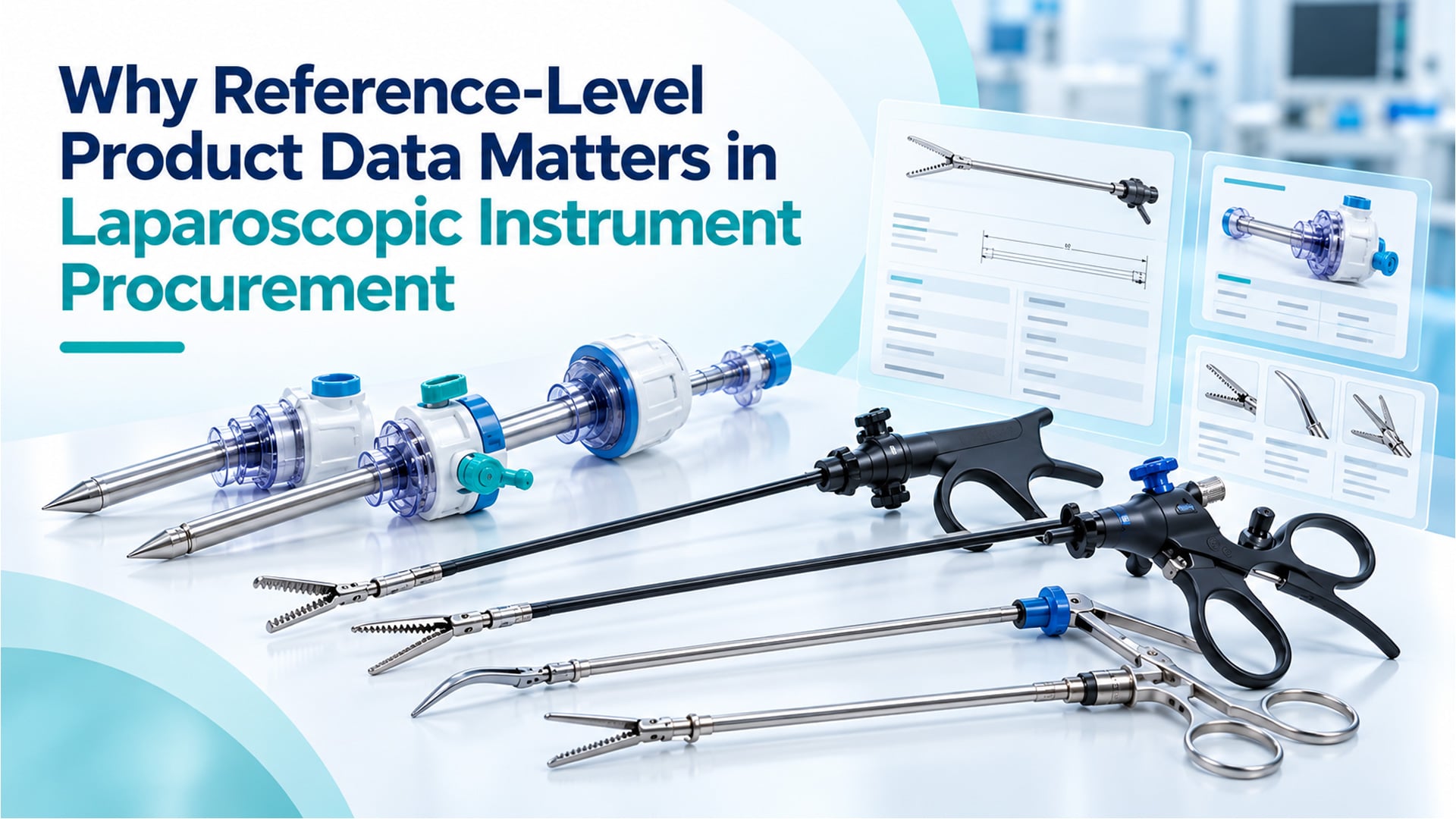
A laparoscopic catalogue can contain many instruments that appear similar at first glance. For procurement teams, however, the differences between those products often become clear only when the technical data is reviewed.
Working length, shaft diameter, distal configuration, energy type and connection requirements can all distinguish one reference from another.
This is why hospitals and medical distributors sourcing Laparoscopic Instruments benefit from reference-level product data rather than relying only on broad catalogue names.
“Laparoscopic Instrument” Covers Many Different Product Families
The term is useful for describing a broad minimally invasive surgery category, but it can include products with very different functions.
These may include:
- grasping and dissection forceps;
- scissors;
- electrosurgical electrodes;
- trocars;
- Veress needles;
- suction and irrigation instruments;
- specimen-management products.
A procurement team should therefore begin by identifying the instrument’s function before comparing individual references.
Why Product Numbers Are Useful
An identifiable product number provides a consistent way to connect information across several stages of the purchasing process.
The same reference can appear in a manufacturer’s catalogue, distributor quotation, hospital evaluation, technical documentation and purchase order.
This consistency can reduce confusion, especially where a distributor manages similar products for several healthcare customers.
When the original product number is not available, a structured technical description becomes even more important.
Working Length Should Be Clearly Documented
For many minimally invasive instruments, working length is a fundamental part of the product specification.
A product described only as a “long laparoscopic grasper” provides limited information.
An exact manufacturer-defined working length is considerably more useful.
Distributors should therefore display working length as a dedicated specification field wherever it is relevant to the product.
Shaft Diameter Deserves Its Own Data Field
Shaft diameter is another characteristic that can distinguish similar laparoscopic references.
It should be easy to find in a catalogue or product data sheet rather than hidden inside a long paragraph.
A professional listing may therefore include:
Product number – Instrument type – Shaft diameter – Working length – Distal configuration.
This structure helps buyers compare products more efficiently.
The Working End Defines More Than the Product Name
For grasping and dissection instruments, jaw geometry can be a major differentiator.
The broad term “laparoscopic forceps” does not explain whether the instrument uses a fenestrated profile, another grasping pattern or a different dissection configuration.
Similarly, a laparoscopic electrode should identify the actual working-end geometry rather than only the word “electrode”.
Where this information is documented by the manufacturer, it should form part of the purchasing specification.
Monopolar and Bipolar Products Should Be Kept Distinct
Many minimally invasive instruments also form part of an electrosurgical system.
A catalogue may include both monopolar and bipolar:
- grasping or dissection instruments;
- scissors;
- electrodes or other energy-related products.
The energy configuration should therefore appear clearly in the product information.
A mechanically similar instrument should not be treated as the same technical product when its electrosurgical configuration differs.
Connections Matter for Electrosurgical MIS Instruments
Where the product uses HF energy, procurement may also need to consider cables, handles or equipment-side connections.
The buyer should understand how the instrument fits within the wider system.
Useful information may include:
- instrument connection;
- cable requirement;
- HF handpiece where applicable;
- equipment manufacturer or model;
- existing connected-product reference.
This reduces the risk of selecting the correct physical instrument with an unsuitable connection arrangement.
Access Instruments Require Different Specification Fields
Trocars and Veress needles belong to the laparoscopic portfolio but should not be documented in the same way as forceps or electrodes.
For access products, procurement may focus more heavily on:
- diameter;
- length;
- cannula or hub configuration;
- included components;
- single-use status.
This illustrates why one universal product template is not always enough for a complete MIS catalogue.
Suction and Irrigation Products Need Their Own Data Structure
Fluid-management instruments create another set of purchasing requirements.
Relevant information may include shaft diameter, working length, control or valve arrangement, tubing and connection details.
Keeping those fields organised makes it easier for hospital customers to identify the intended configuration.
Single-Use Products Add Packaging and Stock Information
For single-use MIS instruments, buyers and distributors may also require reference-specific information concerning product presentation.
This can include:
- individual packaging;
- outer pack quantity;
- sterile presentation where applicable;
- shelf life;
- storage information;
- product labelling.
These details can be important for inventory planning as well as technical review.
Structured Product Data Helps Prevent Incorrect Comparisons
Two instruments may carry similar names while differing in several important technical characteristics.
For example, two bipolar grasping instruments might use different:
- jaw designs;
- shaft diameters;
- working lengths;
- connection arrangements.
If a buyer compares only the product title and unit price, those differences may be missed.
Structured product data makes them visible.
A Practical Distributor Product Matrix
| Field | Purpose |
|---|---|
| Product number | Provides consistent identification |
| Instrument family | Defines product function |
| Distal configuration | Identifies the working end |
| Shaft diameter | Distinguishes access dimensions |
| Working length | Separates similar references |
| Energy type | Identifies monopolar, bipolar or non-energy configuration |
| Connection | Supports system review |
| Product presentation | Supports stock and purchasing decisions |
Better Product Data Also Supports Digital Catalogues
A well-organised website can help professional buyers move from a broad product family to the exact configuration they need.
Instead of relying on long generic descriptions, product pages can display structured specifications supported by relevant technical information.
A clearly organised single-use MIS instrument range gives buyers a logical starting point for exploring connected categories such as forceps, scissors, electrodes and suction/irrigation instruments.
What Buyers Should Capture for Laparoscopic Products
The exact data depends on the instrument, but useful fields can include:
- product number;
- instrument family;
- working-end configuration;
- shaft diameter;
- working length;
- energy type;
- electrical connection where applicable;
- single-use or reusable status;
- pack information;
- required product documentation.
Conclusion
Reference-level product data gives hospitals and medical distributors a clearer way to evaluate laparoscopic instruments.
It helps separate products that may look similar but differ in dimensions, working-end design, energy configuration or connection.
For distributors, structured specifications also improve catalogue quality, quotation preparation and repeat-order management.
In a technically diverse product category, clear information is one of the most effective ways to make procurement more reliable and efficient.