



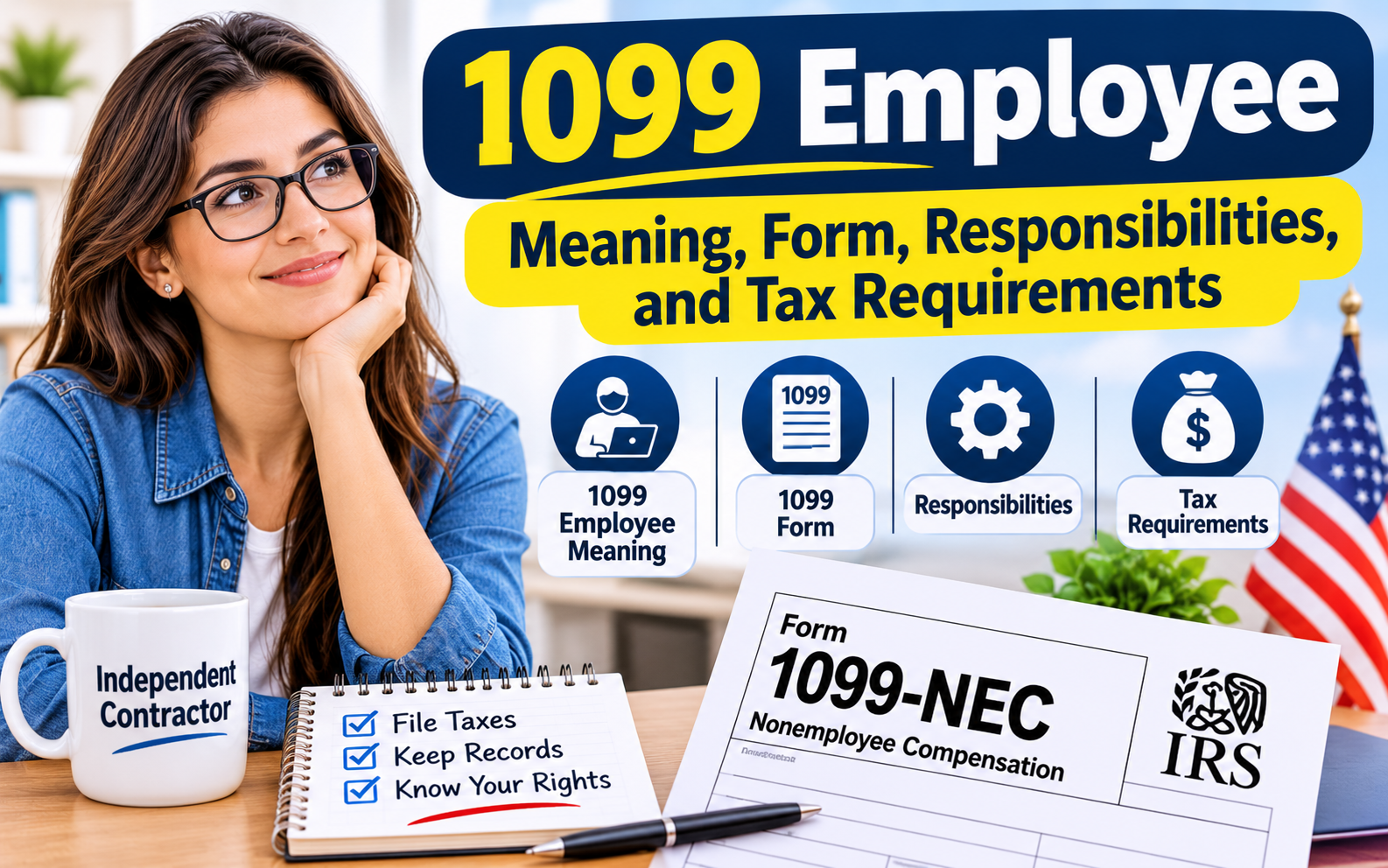
Independent contractors are frequently used by businesses in the U.S. to fill in for a specific project, to work as a professional service provider, or to assist with daily activities. The individuals who work the job are often referred to as 1099 workers. But it is crucial to understand what the 1099 employee meaning is as independent contractors are not considered traditional employees.
Typically, a 1099 worker is not treated as an employee and does not receive benefits from their clients, but is a person or entity who works on their own, handles their taxes, and receives payment from the client. The arrangement can cause some confusion for employers and employees regarding taxes, payments and employment obligations, so it is good to familiarize oneself with how it works.
What Is a 1099 Employee?
The term ‘1099 employee’ is commonly used to refer to an independent contractor working for a business. The phrase is derived from IRS Form 1099 that businesses should use to report certain payments to nonemployees.
Independent contractors typically do not have as many rigid constraints on how and when they do their work as do traditional employees, but he or she does have some constraints, depending on the terms of the worker’s service contract.
Some of the people who are considered 1099 workers are:
- Freelance writers and content writers.
- Graphic designers and web developers
- Advise from consultants/business advisors
- Independent delivery contractors
- Photographers and marketers alike will love this.
- People who work for themselves as repairers and maintenance workers
Keep in mind that a company cannot just label an individual “1099” and consider them an independent contractor. Whether a worker should be classified as an employee or an independent contractor will depend on the worker’s relationship with the person who employs them and the rules that the IRS follows.
What Is a 1099 Employee Form?
Typically the 1099 employee form will mean an IRS Form 1099 which is given to report payments made to independent contractors or other nonemployees.
Form 1099-NEC or Nonemployee Compensation is one of the versions that’s commonly used.
Generally businesses will report qualifying payments to nonemployees using Form 1099-NEC. Reporting thresholds and filing requirements may be dependent upon the payment date and rules of the IRS.
Important details include:
- Form 1099-NEC: Reports nonemployee compensation that meets the criteria.
- Form W-9: A contractor must complete form W-9 and provide it to the school.
- Form W-2: Is used to report wages paid to traditional employees.
- Form 1099-MISC: Reports certain other types of payments.
These are used to keep businesses’ finances accurate and to fulfill tax reporting obligations.
Tax Responsibilities of a 1099 Employee
Independent contractors usually will take care of their own income needs. But, for businesses, federal income tax, Social Security tax and Medicare tax are not typically withheld from payments made to contractors.
Common responsibilities include:
- Accurately reporting business income on the correct tax return.
- Self-Employed Taxes Paid: If applicable.
- Making estimates when necessary.
- Keeping records of income and eligible business expenses.
- Keeping receipts/invoices for monetary record.
In certain cases, independent contractors can take advantage of a number of business deductions, depending on their situation and tax law.
1099 Employee vs. W-2 Employee
The key distinction between independent contractors and regular employees is that there are several important differences.
| Feature | 1099 Contractor | W-2 Employee |
| Tax withholding | Generally self-managed | Employer withholds |
| Work arrangement | Greater independence | Employer-directed |
| Benefits | Generally not employer-provided | May receive benefits |
| Tax reporting | Form 1099-NEC, when applicable | Form W-2 |
| Expenses | May deduct eligible expenses | Different deduction rules |
Benefits and Challenges of Being a 1099 Worker
Benefits:
- More freedom of working time.
- Access to a variety of clients.
- Greater freedom of business decision making.
- Eligible business expenses that may be deductible.
Challenges:
- Personal tax affairs.
- No automatic benefits by the employer.
- Handling irregular income.
- Having independent books of business.
Final Thoughts
It’s crucial for independent contractors and employees who are paid in cash to understand the 1099 employee meaning, what it means to them, and what the 1099 employee form entails. Correctly categorising and detailing all financial items can aid you to avoid tax issues and manage your business effectively. Accountingbizz provides easy tutorials on accounting, business, crypto, tools and digital finance services to educate users about features, risks, and processes.