






Medical Adhesives Market Size, Share, Growth, Trends, Industry Analysis & Forecast 2026–2034
Medical Adhesives Market Overview
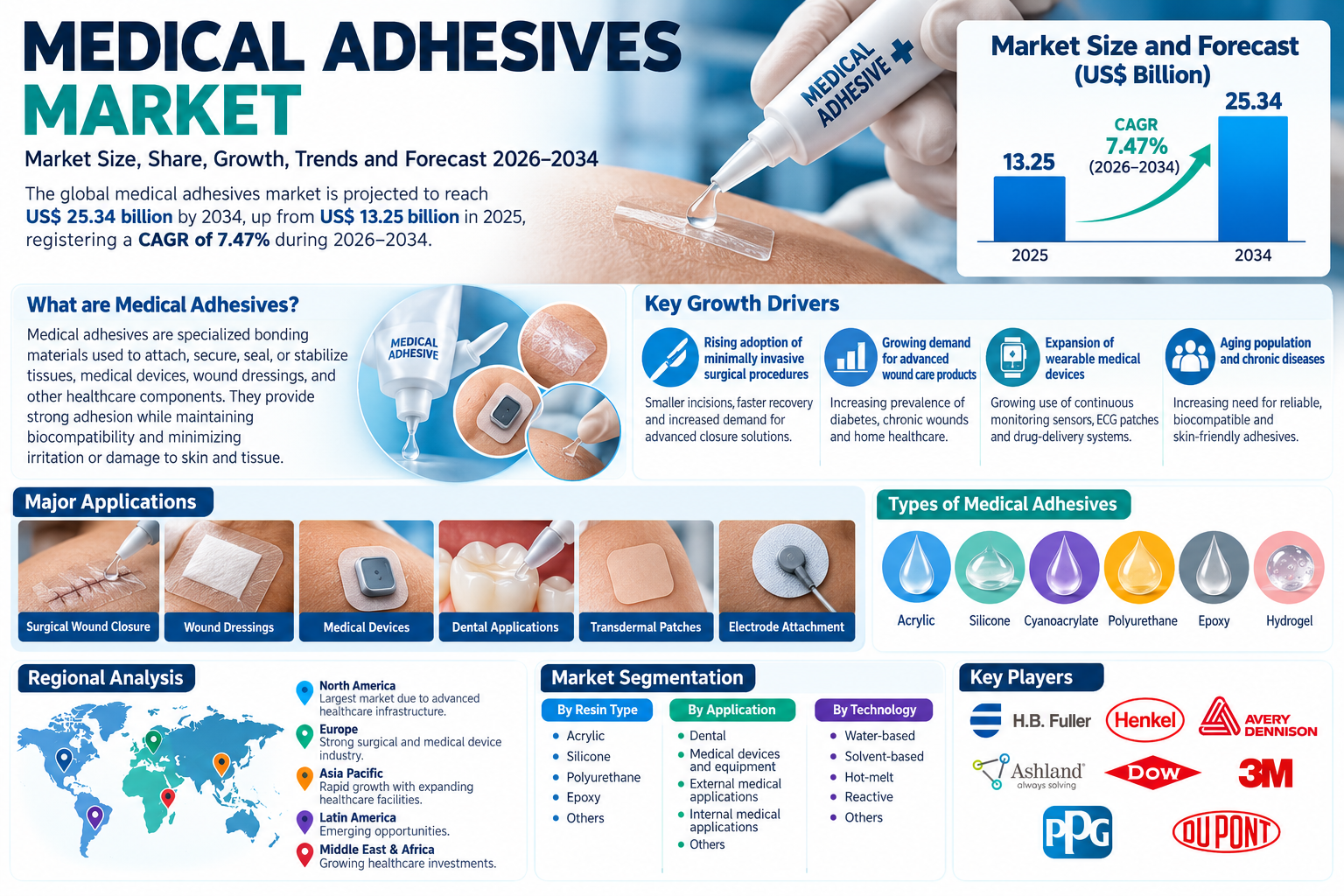
The global medical adhesives market is experiencing steady growth as healthcare providers increasingly adopt minimally invasive surgical procedures, advanced wound care products, and wearable medical technologies. The market is projected to reach US$ 25.34 billion by 2034, increasing from US$ 13.25 billion in 2025, at a compound annual growth rate (CAGR) of 7.47% during 2026–2034.
Medical adhesives are essential materials used in surgical wound closure, medical device assembly, wound dressings, dental restoration, transdermal patches, and wearable healthcare products. Their ability to provide reliable bonding while supporting biocompatibility, flexibility, and patient comfort makes them increasingly important in modern healthcare.
The rising prevalence of chronic diseases, an aging global population, and the expansion of remote patient monitoring are creating new opportunities for manufacturers. At the same time, technological advances in silicone, acrylic, polyurethane, and light-curable adhesives are encouraging the development of skin-friendly, durable, and application-specific solutions.
Explore the full report: Medical Adhesives Market — Renub Research.
What Are Medical Adhesives?
Medical adhesives are specialized materials designed to bond, secure, seal, or stabilize tissues, medical devices, wound dressings, and healthcare components. Depending on their intended application, they may be formulated for direct skin contact, internal medical use, surgical closure, or industrial medical-device assembly.
Common medical adhesive materials include acrylic, silicone, cyanoacrylate, polyurethane, epoxy, and hydrogel-based formulations. They are used in hospitals, clinics, dental practices, home healthcare, and medical-device manufacturing facilities.
Medical adhesives can provide alternatives or complementary solutions to traditional fixation methods, including sutures, staples, and mechanical fasteners. Their applications include surgical wound closure, catheter fixation, ECG electrodes, continuous glucose monitoring (CGM) sensors, drug-delivery patches, and advanced wound dressings.
Key Growth Drivers of the Medical Adhesives Market
1. Increasing Adoption of Minimally Invasive Surgical Procedures
The growing preference for minimally invasive surgery is a major driver of medical adhesive demand. These procedures often involve smaller incisions, reduced tissue disruption, and shorter recovery periods compared with conventional open surgery.
Medical adhesives are used in selected surgical applications to close wounds, secure medical devices, bond tissues, and support fixation. Cyanoacrylate-based tissue adhesives can offer an alternative to sutures or staples for appropriate wounds, helping simplify closure and potentially improve cosmetic outcomes.
The increasing use of outpatient procedures and ambulatory surgical centers is also creating opportunities for adhesive-based technologies. Manufacturers are developing formulations that offer dependable bonding, flexibility, and improved tissue compatibility across surgical specialties.
2. Rising Demand for Advanced Wound Care
The growing burden of diabetes, vascular disease, pressure injuries, and other chronic conditions is increasing the need for effective wound-management products.
According to the International Diabetes Federation, approximately 589 million adults aged 20–79 were living with diabetes worldwide in 2024. This population creates substantial demand for wound dressings, skin barriers, fixation products, and other medical supplies used in chronic wound management.
Silicone adhesives, hydrogel systems, and skin-friendly pressure-sensitive adhesives are gaining importance because they can support comfortable application and atraumatic removal when appropriately designed. The expansion of home healthcare is further increasing demand for products that patients and caregivers can apply conveniently outside hospitals.
3. Expansion of Wearable Medical Devices
Wearable healthcare technologies represent an important growth opportunity for the medical adhesives industry. Continuous glucose monitors, ECG patches, wearable sensors, temperature monitors, and drug-delivery patches require reliable skin attachment to function effectively.
These applications require adhesives that balance secure bonding with breathability, flexibility, moisture resistance, and skin compatibility. Prolonged wear also increases the importance of minimizing irritation and adhesive residue.
As remote patient monitoring and digital healthcare expand, manufacturers are investing in specialized adhesives for long-wear medical devices. Products designed for sensitive skin and repeated use are expected to gain importance across home healthcare, elderly care, cardiac monitoring, and chronic disease management.
Major Challenges in the Medical Adhesives Industry
Skin Irritation and Biocompatibility Requirements
Medical adhesives can remain in contact with skin or tissue for extended periods, creating potential risks of irritation, dermatitis, and allergic reactions. These concerns are particularly important for patients with sensitive or fragile skin and individuals who need frequent dressing changes or long-term wearable devices.
Manufacturers must balance strong adhesion with patient comfort and safe removal. Developing hypoallergenic, breathable, and low-trauma formulations can require extensive testing and investment in material research.
Regulatory Compliance and Development Costs
Medical adhesive products must meet applicable safety, quality, performance, and biocompatibility requirements based on their intended use. Requirements can vary according to the formulation, duration of contact, and whether the adhesive is incorporated into a medical device.
The ISO 10993 series provides guidance for the biological evaluation of medical devices. Compliance, product validation, quality assurance, and regulatory submissions can increase development costs and extend commercialization timelines. These expenses may create particular challenges for smaller manufacturers entering specialized medical adhesive categories.
Emerging Trends Shaping the Medical Adhesives Market
Growth of Acrylic Medical Adhesives
Acrylic adhesives are widely used in medical tapes, wound dressings, transdermal patches, electrodes, and wearable devices. Their bonding strength and ability to maintain adhesion under different environmental conditions make them suitable for numerous medical applications.
Manufacturers are developing acrylic pressure-sensitive adhesives with improved breathability, flexibility, repositionability, and residue-free removal. Demand is expected to benefit from the growing use of continuous monitoring systems and skin-attached healthcare products.
Increasing Demand for Dental Adhesives
Dental adhesives are essential for restorative, orthodontic, preventive, and cosmetic dentistry. They help bond crowns, veneers, fillings, orthodontic brackets, and composite restorative materials.
The World Health Organization estimates that oral diseases affect approximately 3.5 billion people worldwide. The need for restorative treatments, combined with increasing interest in cosmetic dentistry, supports demand for improved dental bonding technologies.
Product development is focusing on reliable bonding, moisture tolerance, biocompatibility, and simplified clinical application.
Shift Toward Water-Based and Skin-Friendly Formulations
Healthcare manufacturers are exploring water-based and lower-emission adhesive technologies to reduce reliance on solvent-intensive formulations in suitable applications. Water-based adhesives can be used in selected medical tapes, wound dressings, surgical drapes, and fixation systems.
Advances in polymer chemistry are helping manufacturers improve bonding performance, flexibility, drying characteristics, and moisture resistance. However, suitability depends on the specific medical application and required performance standards.
Recent Medical Adhesive Product Launches
Innovation and product development remain important competitive strategies in the medical adhesives market. Notable launches and introductions identified in the source material include:
- Henkel (2025): LOCTITE AA 3951, AA 3953, AA 3961, and AA 3963, a range of light-curable medical adhesives designed for medical-device assembly.
- DELO (2025): PHOTOBOND MG4047, an IBOA-free light-curing adhesive developed for continuous glucose monitoring sensors and other wearable devices.
- Henkel (2025): LOCTITE AA 3952 and LOCTITE SI 5057, designed for bonding thermoplastic elastomers in medical-device assemblies.
- Hoenle Adhesives (2025): Vitralit E-7041 T and Vitralit E-4050, UV-curable medical adhesive products developed for selected medical applications.
- Solventum (2024): 2487 Hi-Tack Silicone Tape, combining silicone and acrylate adhesive technologies for wearable medical devices and sensitive-skin applications.
- Resivant Medical (2024): Cutiva Topical Skin Adhesive and Cutiva PLUS Skin Closure System, developed as options for surgical skin closure.
- TELA Bio (2024): LIQUIFIX FIX8 and LIQUIFIX Precision, liquid adhesive-based hernia mesh fixation systems.
These developments highlight the industry’s focus on biocompatibility, light-curing technology, skin compatibility, device assembly, and alternatives to conventional fixation methods.
Regional Analysis of the Medical Adhesives Market
United States
The United States benefits from its advanced healthcare infrastructure, established medical-device industry, and adoption of innovative surgical and wearable technologies. Medical adhesives are used in wound dressings, catheter securement, surgical closure products, medical electrodes, and continuous glucose monitoring systems.
Demand is supported by medical-device innovation, advanced wound care, and the growing use of remote monitoring. Compliance with applicable U.S. Food and Drug Administration requirements remains an important consideration for manufacturers.
Germany
Germany is an important European market due to its developed healthcare system, medical-technology expertise, and extensive surgical activity. Medical adhesives are used in wound management, surgical closure, diagnostic devices, catheter fixation, and medical-device manufacturing.
The country’s aging population and demand for chronic wound management create further opportunities for specialized adhesive products.
China
China’s expanding healthcare infrastructure, domestic medical-device manufacturing capabilities, and growing demand for surgical and chronic wound-care products support market development.
Medical adhesives are used in surgical supplies, medical tapes, diagnostic equipment, wearable monitors, and infusion devices. Continued investment in healthcare modernization and medical technology is creating opportunities for both domestic and international suppliers.
Saudi Arabia
Saudi Arabia presents opportunities as healthcare infrastructure expands under Vision 2030. Medical adhesives are relevant to advanced wound care, surgical closure, medical tapes, wearable monitoring, and medical-device assembly.
The country’s substantial diabetes burden also supports demand for chronic disease monitoring and wound-management products. Healthcare investment and the development of local medical-device capabilities may further support market growth.
Medical Adhesives Market Segmentation
The market can be analyzed across the following categories.
By Resin Type
- Acrylic
- Silicone
- Polyurethane
- Epoxy
- Others
By Application
- Dental
- Medical devices and equipment
- External medical applications
- Internal medical applications
- Others
By Technology
- Water-based
- Solvent-based
- Hot-melt
- Reactive
- Others
By Geography
- North America: United States and Canada
- Europe: France, Germany, Italy, Spain, United Kingdom, Belgium, Netherlands, and Turkey
- Asia Pacific: China, Japan, India, South Korea, Thailand, Malaysia, Indonesia, Australia, and New Zealand
- Latin America: Brazil, Mexico, and Argentina
- Middle East and Africa: Saudi Arabia, UAE, and South Africa
- Rest of World
Competitive Landscape and Key Companies
Competition in the medical adhesives market centers on product innovation, material performance, biocompatibility, manufacturing reliability, regulatory compliance, and application-specific solutions.
Major companies identified in the source material include:
- H.B. Fuller Company
- Henkel AG & Co. KGaA
- Avery Dennison Corporation
- Ashland Global Holdings Inc.
- The Dow Chemical Company
- 3M Company
- PPG Industries
- DuPont de Nemours, Inc.
Company analysis can cover corporate overviews, key personnel, recent developments, SWOT analysis, and revenue analysis. Product launches targeting wearable devices, sensitive skin, medical-device assembly, and surgical applications illustrate the importance of research and development in this competitive market.
Future Outlook
The medical adhesives market is expected to benefit from the continued adoption of minimally invasive procedures, rising demand for advanced wound care, and the expansion of wearable healthcare devices. Acrylic, silicone, and other specialized adhesive technologies will remain important as manufacturers seek to improve bonding performance, skin compatibility, and ease of removal.
Regulatory requirements, biocompatibility testing, and development costs will continue to influence innovation and commercialization. Nevertheless, the growing need for home-based healthcare, chronic disease monitoring, and advanced medical-device manufacturing is creating opportunities for suppliers that can deliver reliable, application-specific solutions.
With the market projected to reach US$ 25.34 billion by 2034, medical adhesives are positioned to remain an important component of modern healthcare and medical technology.
Frequently Asked Questions (FAQs)
1. What is the global medical adhesives market size?
The global medical adhesives market was valued at US$ 13.25 billion in 2025, according to the supplied market forecast.
2. What is the projected medical adhesives market size by 2034?
The market is projected to reach US$ 25.34 billion by 2034.
3. What is the expected CAGR of the medical adhesives market?
The market is expected to grow at a CAGR of 7.47% during 2026–2034.
4. What are the major growth drivers of the medical adhesives market?
Key drivers include minimally invasive surgery, advanced wound care, the growing prevalence of chronic diseases, an aging population, and increasing use of wearable medical devices.
5. What are the main types of medical adhesives?
Major types include acrylic, silicone, polyurethane, cyanoacrylate, epoxy, and hydrogel-based adhesives. The supplied market segmentation specifically identifies acrylic, silicone, polyurethane, epoxy, and other resin types.
6. Which applications use medical adhesives?
Applications include surgical wound closure, wound dressings, dental restoration, medical-device assembly, catheter fixation, transdermal patches, electrodes, and wearable monitoring devices.
7. What challenges affect the medical adhesives industry?
Important challenges include skin irritation, allergic reactions, biocompatibility requirements, regulatory compliance, product testing, and research and development costs.
8. Which companies are key players in the medical adhesives market?
Key companies identified in the source include H.B. Fuller, Henkel, Avery Dennison, Ashland, Dow, 3M, PPG Industries, and DuPont.
9. What are the major trends in the medical adhesives market?
Important trends include skin-friendly formulations, long-wear adhesives for wearable devices, light-curable medical adhesives, advanced wound-care solutions, and improvements in dental bonding technologies.
10. Which regions are covered in the medical adhesives market analysis?
The market analysis covers North America, Europe, Asia Pacific, Latin America, the Middle East and Africa, and the rest of the world.
Conclusion
The global medical adhesives market is entering a period of sustained development as healthcare systems prioritize efficient surgical techniques, advanced wound management, and connected medical technologies. Demand for skin-compatible, biocompatible, and high-performance bonding solutions is creating opportunities across medical devices, surgical products, dental care, and home healthcare.
Although regulatory complexity and skin-sensitivity concerns remain significant challenges, continued material innovation and application-specific product development are expected to support industry expansion through 2034.