






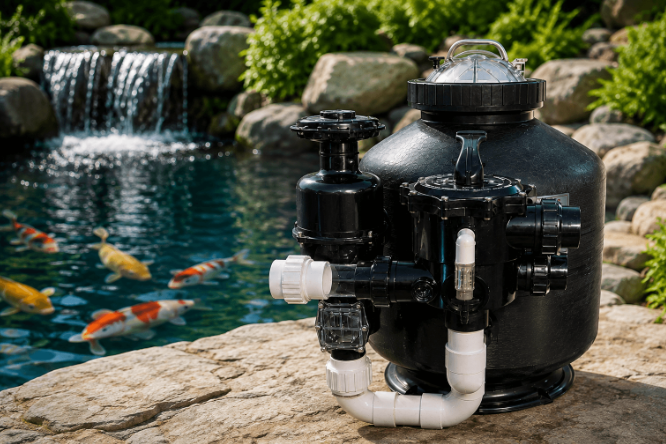
A healthy koi pond depends on much more than water that simply looks clean. Koi constantly introduce waste into their environment through feeding, digestion, and normal biological activity. Uneaten food, leaves, algae, and other organic material can add even more waste to the pond. Without effective filtration, these materials can accumulate and make maintaining stable water conditions increasingly difficult. This is why choosing the best koi pond filter involves understanding more than filter size or water flow. An effective filtration system needs to address two different parts of pond maintenance: removing physical waste and supporting the biological processes that help manage dissolved waste.
Mechanical and biological filtration perform different jobs, but they work together as part of the same filtration process. Understanding the role of each can help pond owners make better decisions when designing, maintaining, or upgrading a koi pond filtration system.
Why Koi Ponds Need Effective Filtration
Koi ponds place considerable demands on filtration systems. As koi grow, their feeding requirements and waste production can increase. A pond with several mature koi may therefore require significantly more filtration than a decorative water garden of a similar size. Visible debris is only one part of the problem. Leaves, leftover food, fish waste, and suspended particles can affect water clarity, but dissolved waste also needs to be managed. Simply removing particles from the water does not address every aspect of pond water quality.
An effective koi pond filtration system therefore needs to perform multiple functions. It should capture physical waste before it continues to break down, while also providing suitable conditions for beneficial microorganisms involved in biological filtration.
This is where mechanical and biological filtration complement one another.
What Is Mechanical Filtration?
Mechanical filtration is the physical removal of solid material from pond water. As water moves through the filtration system, suspended debris is captured or separated before the water returns to the pond. Depending on the pond, this material can include:
- Fish waste
- Uneaten food
- Leaves and plant debris
- Algae particles
- Other suspended organic matter
Removing these materials helps improve water clarity and prevents excessive solid waste from remaining within the pond. Mechanical filtration is particularly important in koi ponds because of the amount of waste the fish can produce. The greater the fish population and feeding rate, the greater the potential demand placed on the filtration system. However, clear-looking water does not necessarily mean that all waste-related water quality concerns have been addressed. That is why mechanical filtration needs to work alongside biological filtration.
What Is Biological Filtration?
Biological filtration deals with waste at a different level. Fish continuously release nitrogenous waste into their environment. Organic materials can also contribute additional waste as they decompose. Beneficial bacteria within a biological filtration system help process compounds produced through these processes. The biological filter provides surface area where these beneficial bacteria can establish themselves. As pond water passes through the filtration media, bacterial communities participate in the nitrogen cycle, converting ammonia into nitrite and then into nitrate. Both ammonia and nitrite can be harmful to fish at elevated concentrations, making an established biological filtration process an important part of koi pond management.
Unlike mechanical filtration, biological filtration is not primarily about capturing visible particles. Its purpose is to support the microorganisms responsible for processing dissolved nitrogen compounds.
Mechanical and Biological Filtration Perform Different Jobs
It can be helpful to think of mechanical and biological filtration as two separate but connected stages of waste management. Each addresses a different type of waste, and both are important for maintaining suitable conditions in a koi pond. Mechanical filtration deals primarily with physical waste. Fish waste, uneaten food, leaves, algae, and other suspended debris are captured or separated from the water before they can continue circulating through the pond. Removing these solids also helps limit the amount of organic material left in the system to break down over time.
Biological filtration, on the other hand, focuses on dissolved nitrogenous waste through microbial activity. Beneficial bacteria living on filter media help process ammonia produced by fish and decomposing organic matter. Through the nitrogen cycle, ammonia is converted into nitrite and then into nitrate. This makes biological filtration particularly important in koi ponds where regular feeding and higher fish loads can place greater demands on water quality.
One type of filtration cannot completely replace the other. A system focused only on mechanical filtration may produce visually clearer water, but clear water alone does not indicate that dissolved waste is being adequately processed. Without sufficient biological filtration, the system may lack the bacterial capacity needed to manage the waste generated by the fish.
Conversely, relying heavily on biological filtration without effective solid-waste removal can allow debris to accumulate within the pond and filtration system. As organic material continues to break down, it can place additional demands on the biological filter and make routine pond maintenance more difficult.
How Mechanical Filtration Supports Biological Filtration
The relationship between the two filtration processes is also important. Removing solid organic material before it continues breaking down can reduce the amount of decomposing waste circulating through the system. This allows the biological component of the filtration system to focus on its primary role rather than operating in an environment overloaded with accumulated debris. Good mechanical filtration can also help keep filtration media cleaner. Excessive solid material collecting around biological media can interfere with water movement and make maintenance more difficult.
For this reason, mechanical filtration should not be viewed simply as a way to make pond water look better. It is part of maintaining an environment in which the overall filtration system can function effectively.
Why Filter Media Matters
Biological filtration depends heavily on the environment provided for beneficial bacteria. Filter media provides surface area where bacterial colonies can develop. The amount and design of that media can therefore influence the biological capacity of a filtration system. Water must also be able to move effectively through the media so that the bacterial community remains exposed to the pond water it is helping to process. Proper circulation and oxygen availability are important considerations for biological activity.
The greater the usable surface area of the media, the more space there is for beneficial bacteria to establish colonies. Choosing appropriate filter media can therefore help the biological filter handle the waste produced by koi more effectively. Keeping the media functioning properly through appropriate maintenance is also important for consistent filtration.
For koi keepers, this means filter selection should not focus exclusively on how effectively a system captures visible debris. The biological component deserves equal consideration.
The Importance of Proper Water Flow
Even a well-designed filtration system depends on appropriate water movement.
Pond water needs to reach the filter consistently for waste to be removed and processed. If circulation is inadequate, areas of the pond may not receive the same level of filtration, and debris may settle before reaching the filtration system. At the same time, filter and pump performance need to be compatible. A filtration system should be selected with consideration for the pond’s volume, plumbing configuration, fish population, and required flow. This is one reason pond owners should avoid selecting a filter based solely on a single specification. The filter operates as part of a larger pond system.
Fish Load Changes Filtration Requirements
Two ponds containing the same number of gallons can have very different filtration requirements. A lightly stocked ornamental pond with a few small fish does not create the same waste load as a koi pond containing several mature fish that are fed regularly. Feeding levels, fish size, stocking density, and organic debris all influence how much work the filtration system needs to perform. As koi grow, filtration requirements can also change.
A filtration system that was sufficient when the fish were small may face greater demands several years later. Pond owners should therefore consider both present conditions and expected fish growth when evaluating filtration capacity.
Maintenance Is Part of Effective Filtration
Even a high-quality filtration system requires routine maintenance. Mechanical filtration components eventually collect waste, which needs to be removed from the system. If collected material remains in the filter for too long, it can begin to break down rather than being fully removed from the pond environment. Biological filtration requires a different approach. Because the media supports beneficial bacterial colonies, maintenance should preserve biological activity while keeping the system operating effectively.
Understanding which parts of a filter perform mechanical and biological functions can help pond owners maintain the system appropriately instead of treating every component in the same way.
Where Bead Filters Fit Into Koi Pond Filtration
Bead filtration systems are commonly used in koi ponds because they can incorporate both mechanical and biological functions within a compact filtration setup. As pond water moves through the filter, the media helps capture suspended solids while also providing surface area that can support beneficial bacteria. The collected material can then be removed during the filter’s cleaning or backwashing process. This combination can make bead filtration particularly useful where pond owners want effective waste management without relying on multiple large filtration chambers. The suitability of any bead filter, however, still depends on factors such as pond volume, fish load, flow requirements, feeding habits, and the overall design of the pond system.
What Should Pond Owners Look for in a Koi Pond Filter?
Rather than judging a filtration system by a single feature, pond owners should consider how effectively the complete system addresses their pond’s needs. A suitable koi pond filter should provide effective solid-waste removal, adequate biological media, appropriate flow capacity, manageable cleaning requirements, and sufficient capacity for the expected fish load. Durability and ease of maintenance are also important. A filter may perform well when clean, but if routine cleaning is overly complicated, maintaining consistent filtration can become difficult over time. Correct sizing is equally important. An undersized filter may struggle as fish grow or stocking levels increase, while selecting a system based on realistic pond conditions provides a stronger foundation for long-term filtration.
A Balanced Approach to Koi Pond Water Quality
There is no single filtration process that addresses every aspect of koi pond waste. Mechanical filtration helps remove the solids that affect clarity and contribute to organic buildup. Biological filtration supports the bacterial processes that manage nitrogenous waste. Water circulation connects these functions by continually moving pond water through the filtration system. When these elements are properly matched, they work together rather than independently. For koi pond owners, understanding this relationship is one of the most important steps toward selecting and maintaining an effective filtration system. The goal is not simply clear-looking water, but a filtration environment capable of handling both the visible and less visible waste produced within the pond.
Final Thoughts
The best koi pond filtration setup is one that addresses the complete waste cycle rather than focusing on a single type of filtration. Mechanical filtration removes suspended solids before they continue to accumulate, while biological filtration provides the environment beneficial bacteria need to process dissolved nitrogenous waste. Neither process should be considered a substitute for the other. Together with appropriate circulation, correct filter sizing, and regular maintenance, mechanical and biological filtration provide the foundation for clearer water and more stable conditions for koi.
When evaluating a filtration system, pond owners should therefore look beyond water clarity alone and consider how effectively the system manages physical waste, supports biological activity, matches the pond’s fish load, and fits into the overall circulation system. AquaBead filtration systems are designed with these important filtration needs in mind, combining mechanical and biological filtration to support effective koi pond management. With different filter models available for varying pond sizes and fish loads, AquaBead gives pond owners options for building a filtration setup suited to their pond’s requirements.