





Choosing an engagement ring is a personal decision that often involves balancing beauty, quality, budget, and long-term wearability. Round cut engagement rings remain a popular choice because of their brilliant sparkle, versatile design, and ability to complement different personal styles. Whether you prefer a classic solitaire or a detailed halo setting, a round-cut diamond offers a look that can be worn for years without feeling outdated.
However, selecting the right ring involves more than choosing a beautiful diamond. Cut quality, carat weight, colour, clarity, metal type, and setting design should all be considered before making a purchase. Understanding these factors can help you find a ring that reflects your relationship while offering lasting value.
Why Are Round Cut Engagement Rings So Popular?
Round diamonds are recognised for their balanced shape and impressive light performance. Their symmetrical design allows light to reflect through the diamond, creating the bright flashes and sparkle that many buyers associate with traditional engagement jewellery.
The modern round brilliant cut typically features 57 or 58 facets, depending on whether the culet is included in the count. These facets are carefully arranged to maximise brightness, fire, and scintillation when the diamond is properly cut.
Several qualities contribute to the lasting appeal of this diamond shape:
- Timeless appearance: Round diamonds complement both traditional and contemporary jewellery designs.
- Versatile styling: They work well with yellow gold, white gold, platinum, and rose gold.
- Brilliant sparkle: Their facet arrangement is designed to produce impressive light reflection.
- Flexible setting options: Round diamonds can be paired with solitaire, halo, pavé, and three-stone settings.
- Everyday practicality: Their lack of sharp corners makes them a convenient option for many daily-wear designs.
These characteristics make round diamonds suitable for buyers who want a ring that feels elegant without depending on short-lived jewellery trends.
Understanding the Four Cs Before Buying a Diamond
The Four Cs are among the most important considerations when comparing engagement diamonds. They refer to cut, colour, clarity, and carat weight. Each factor affects the diamond’s appearance, while the combination influences its price.
Diamond Cut: The Key to Brilliant Sparkle
Diamond cut describes how well a diamond’s proportions, symmetry, and polish allow it to interact with light. It should not be confused with the diamond’s shape.
For round brilliant diamonds, cut quality is particularly important because much of their appeal comes from their ability to return light to the viewer. A poorly cut diamond may appear dull or show undesirable light leakage, even if it has a high carat weight.
When comparing diamonds, look for reliable grading information and examine the stone under suitable lighting. For GIA-graded round brilliant diamonds, the cut grade is assessed on a scale ranging from Excellent to Poor.
A well-cut diamond can appear more lively and attractive than a heavier stone with weaker light performance. Therefore, cut quality should be prioritised before paying extra for size alone.
Diamond Colour: Finding the Right Balance
Diamond colour grades measure how much colour is visible in a diamond, with the conventional scale ranging from D, which is colourless, to Z, which shows increasing colour.
Colourless diamonds are often priced higher, but a lower colour grade may still provide an attractive appearance depending on the setting, lighting, and individual preferences.
Consider the following when comparing colour grades:
- D to F grades are classified as colourless.
- G to J grades fall within the near-colourless range.
- Yellow gold settings can complement slightly warmer diamond tones.
- White metals may make subtle colour differences easier to notice.
The best choice depends on the look you prefer and the amount you want to spend. A diamond should be evaluated in person or through trustworthy imagery rather than selected solely on its grading letter.
Diamond Clarity: What Should You Look For?
Clarity refers to internal characteristics called inclusions and external features called blemishes. These characteristics form naturally during the diamond’s development or may occur during cutting and handling.
Higher clarity grades generally indicate fewer or less noticeable characteristics. However, not every inclusion is visible without magnification.
For many buyers, a diamond that appears clean to the naked eye can be a sensible option. This is sometimes described as an eye-clean diamond, although the term does not represent a formal grading category.
Before choosing a clarity grade, consider:
- Whether inclusions can be seen without magnification.
- The location and type of any inclusions.
- Whether the diamond’s structural integrity could be affected.
- How the stone looks under different lighting conditions.
A lower clarity grade may provide better value when inclusions are difficult to see and do not compromise the diamond’s durability.
Carat Weight: Choosing the Right Size
Carat measures a diamond’s weight, not its exact visual size. Two diamonds with the same carat weight can look different because of their proportions, depth, and table dimensions.
When shopping for round cut engagement rings, avoid assuming that the highest carat weight automatically represents the best purchase. A well-proportioned diamond may offer an attractive face-up appearance without requiring a larger budget.
It is also worth comparing stones just below popular weight thresholds. For example, a diamond weighing 0.90 carats may cost less than a comparable 1.00-carat diamond, although actual prices depend on several grading and market factors.
The goal is to find a diamond that suits your preferences while leaving room in the budget for a quality setting and reliable craftsmanship.
Which Engagement Ring Setting Suits Your Style?
The setting influences how a diamond looks, how securely it is held, and how comfortable the ring feels during daily activities. Round diamonds are versatile enough to work with several popular designs.
Solitaire Settings for Classic Elegance
A solitaire setting features one centre diamond without additional stones surrounding it. This design keeps attention on the round diamond and creates a clean, understated appearance.
Solitaire rings are particularly suitable for buyers who appreciate traditional jewellery or want a design that can be paired easily with different wedding bands.
Popular variations include:
- Four-prong settings that allow substantial light to reach the diamond.
- Six-prong settings that provide a distinctive traditional look.
- Bezel settings that surround the diamond’s edge with metal.
- Cathedral settings that raise the centre stone through elegant arches.
Prong settings should be inspected periodically because the small metal tips can wear over time. Bezel settings offer more edge coverage, although the final appearance depends on the design and craftsmanship.
Halo Settings for Extra Visual Impact
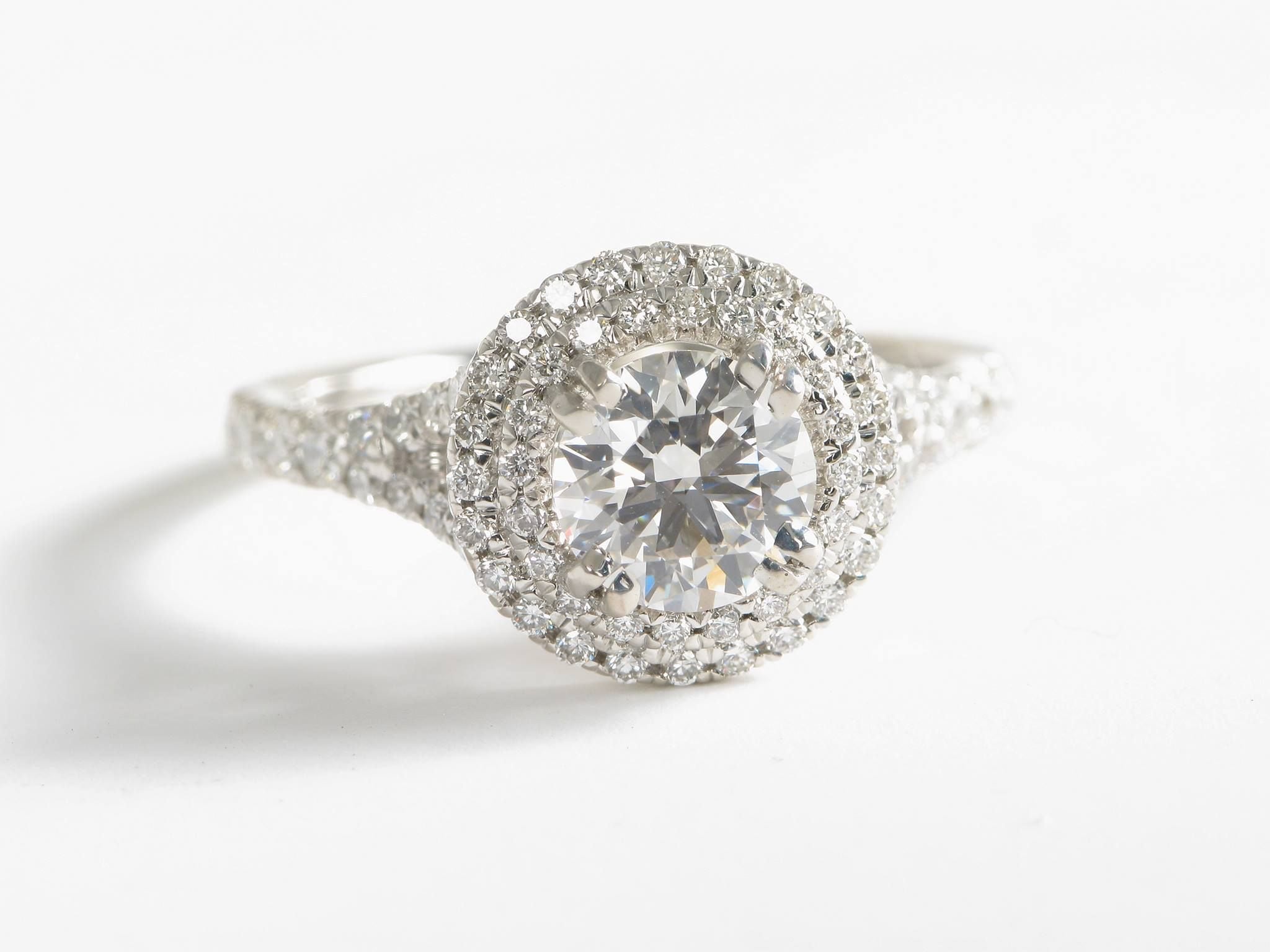
A halo setting places smaller diamonds around the centre stone. This arrangement creates additional sparkle and may make the centre diamond appear larger from a distance.
Halo rings can be an attractive choice for people who prefer detailed jewellery rather than a minimal design. They are available in traditional round halos, hidden halos, and double-halo arrangements.
However, the additional stones create more areas that require cleaning and inspection. The small diamonds should be checked regularly to ensure they remain secure.
Pavé Settings for Additional Sparkle
Pavé settings feature small diamonds set closely together along part of the band. The result is a continuous appearance of sparkle that complements the centre stone.
A pavé band can add visual detail without changing the round diamond’s central position. It can also be combined with a solitaire or halo design.
When selecting this style, examine the band’s construction and consider how it will feel against adjacent rings. A well-made setting should balance appearance, comfort, and durability.
Three-Stone Settings with Personal Meaning
Three-stone engagement rings feature a central diamond accompanied by two side stones. These stones may be smaller round diamonds or other shapes selected to create contrast.
Some couples associate the three stones with their past, present, and future. While this symbolism is a personal interpretation rather than a universal rule, it can add meaning to the design.
The side stones should complement the centre diamond in colour, proportion, and overall appearance. Their settings should also be designed to minimise snagging during regular wear.
How Do You Choose the Best Metal for Your Ring?
The metal affects a ring’s colour, maintenance requirements, and overall appearance. It should be chosen according to personal preference, lifestyle, and budget.
White Gold
White gold offers a bright, silvery appearance that pairs naturally with colourless diamonds. Many white gold rings are rhodium-plated to maintain their bright finish.
The plating may wear away over time and require renewal. Buyers should ask about maintenance requirements before making a purchase.
Yellow Gold
Yellow gold creates a warm, traditional look. It can provide an attractive contrast with a round diamond and may complement near-colourless stones particularly well.
Its colour also makes it suitable for vintage-inspired designs and classic solitaire settings.
Rose Gold
Rose gold has a pinkish tone created by its metal alloy composition. It offers a distinctive appearance for buyers who want something different from traditional white or yellow gold.
The colour is usually produced through copper in the alloy, so the exact tone depends on the composition.
Platinum
Platinum is valued for its natural white appearance and durability. It is often selected for premium engagement rings, although its price and weight may be higher than those of some alternative metals.
Platinum can develop a surface patina through everyday wear. This is a normal characteristic of the metal rather than necessarily a sign of damage.
How Can You Buy a Quality Ring Within Your Budget?
A realistic budget helps narrow the available choices without sacrificing the features that matter most. The price of an engagement ring depends on the diamond’s grading characteristics, the setting, the metal, the brand, and the seller.
Before purchasing, decide which qualities are most important to you.
A practical buying checklist includes:
- Set a total budget for the complete ring, including taxes and any resizing costs.
- Prioritise diamond cut quality and overall appearance.
- Compare colour and clarity grades instead of automatically choosing the highest available grades.
- Review several diamonds with similar specifications.
- Check whether the centre stone comes with an independent grading report.
- Ask about warranties, return policies, resizing, and after-sales service.
- Confirm whether the advertised price includes the setting and any additional stones.
It is also sensible to request clear photographs or videos showing the diamond in different lighting conditions. Online images can be helpful, but lighting and camera settings may affect how a stone appears.
A grading report from a recognised independent laboratory provides useful information about the diamond’s characteristics. However, it should be considered alongside the stone’s visual appearance and the seller’s reputation.
Natural Diamonds or Lab-Grown Diamonds?
Another important decision involves choosing between a natural diamond and a laboratory-grown diamond. Both are diamonds, with essentially the same chemical composition and crystal structure, although their origins differ.
Natural diamonds form through geological processes over long periods. Lab-grown diamonds are produced using technological processes that recreate the conditions required for diamond growth.
Lab-grown diamonds may offer a larger stone or different grading characteristics at a lower initial purchase price than a comparable natural diamond. Natural diamonds, meanwhile, may appeal to buyers who value geological origin or prefer a traditionally mined gemstone.
When comparing the two options, consider:
- Your budget and preferred carat weight.
- Whether origin is important to you.
- The availability of reliable grading documentation.
- The seller’s disclosure and return policies.
- Long-term ownership expectations and potential resale considerations.
Neither option should be selected solely on assumptions about future value. Diamond resale prices can vary, and neither natural nor lab-grown diamonds should be treated as guaranteed investments.
How Should You Care for Your Engagement Ring?
Regular care helps preserve the appearance of a diamond and its setting. Although diamonds are highly resistant to scratching, they can still chip under certain impacts, and their metal settings can become worn.
A simple maintenance routine can help protect your purchase.
Clean the ring carefully. Use a suitable jewellery-cleaning solution or mild soapy water when recommended by the jeweller. A soft brush may be used to remove residue from accessible areas.
Avoid harsh chemicals. Household cleaning products and unsuitable treatments may damage certain metals, coatings, or gemstones used in the setting.
Remove the ring when appropriate. Heavy lifting, gardening, and activities involving impact can increase the risk of damage or loss.
Schedule professional inspections. Prongs, clasps, and other setting components should be examined periodically. Loose stones should be repaired before the ring is worn again.
Store it separately. Keeping the ring in a dedicated jewellery box can reduce contact with other jewellery and help prevent scratches to softer metals or accompanying gemstones.
Cleaning frequency depends on how often the ring is worn and the amount of residue it collects. Professional servicing should be performed according to the ring’s condition and the jeweller’s recommendations.
Final Thoughts on Choosing the Right Engagement Ring
Round cut engagement rings continue to appeal to couples because they combine brilliant sparkle, versatile styling, and a classic appearance that works across different generations. From a simple solitaire to an elaborate halo design, the right ring can reflect individual taste without compromising everyday comfort.
Before making a final decision, compare diamond cut quality, colour, clarity, carat weight, setting security, and metal type. Review the grading documentation, understand the seller’s policies, and choose a design that fits your lifestyle and budget. By focusing on verified quality and personal preference rather than trends alone, you can select an engagement ring that feels meaningful today and remains enjoyable to wear for years to come.