




Key Takeaways
- Improve efficiency: Automated build, test and deployment pipelines remove manual release steps, so teams ship smaller changes more often.
- Enhance user experience: Monitoring and autoscaling help catch playback, login and payment problems before audiences notice them.
- Control costs: Infrastructure as code and cost-per-stream tracking keep cloud spending tied to real demand.
- Connect your systems: Well-governed APIs link streaming, payments, content management and analytics into one journey.
- Build for Dubai: Arabic-English experiences, regional CDN coverage and UAE compliance belong in the design from day one.
- Stay competitive: Track deployment frequency, change failure rate and recovery time, not just whether DevOps tools are installed.
Picture a streaming service on the night of a long-awaited season finale. The marketing campaign worked. Subscribers arrive in the same few minutes. Then the login service slows, the payment gateway times out, and the support inbox fills up before the first episode finishes buffering. Nothing was wrong with the content. The platform behind it simply wasn’t ready for the moment.
That’s why DevOps in media and entertainment has moved from an IT preference to a business priority. Dubai’s audiences stream, game, buy tickets and follow live events on their phones, and they judge a platform by how fast it loads and how rarely it fails. Content gets people through the door. Performance keeps them.
Yet much media and entertainment software development still happens in pieces: one team on the website, another on the app, a third on payments, and a manual release process holding it all together. The result is familiar. Disconnected systems, unpredictable traffic, slow releases and rising infrastructure bills.
DevOps-first development changes the workflow, not just the code. It joins development, deployment, monitoring and improvement into a single loop. In this guide, we’ll explain how DevOps, cloud-native architecture, APIs, web applications and mobile apps work together to build scalable entertainment platforms for Dubai and the wider UAE.
Why Dubai’s Media & Entertainment Platforms Need a New Development Approach
Entertainment businesses rarely fail because of one broken feature. They struggle because the whole experience, from sign-up to payment to playback to support, has to work as one product. Isolated applications can’t deliver that. Dubai’s ambitions for its digital economy raise the bar further, because audiences here compare local platforms with the best global services every day.
The Growth of Streaming, Gaming and Interactive Entertainment
Streaming subscriptions, mobile games, digital ticketing, live streams and creator monetization all depend on software that has to stay available under pressure. Dubai has made gaming a stated priority. In November 2023, Sheikh Hamdan bin Mohammed approved the Dubai Program for Gaming 2033, which aims to place Dubai among the top 10 cities in the global gaming industry and create 30,000 new jobs, with talent, content and technology as its focus areas (Dubai Media Office, November 2023). The Dubai Future Foundation adds a target of roughly $1 billion in additional GDP contribution by 2033.
Spending data points the same way. A study released in February 2026 estimated that UAE consumers spent about $421 million on video games in 2024, compared with $246 million on video-on-demand services (reported by Khaleej Times, citing Orient Planet Group). Different business models, from subscriptions to in-game purchases to ticketing, put very different demands on the software underneath.
The Technology Challenges Behind Audience Growth
Three problems come up again and again:
- Traffic spikes during concerts, esports finals, sports fixtures and content launches.
- Fragmented systems for payments, content management, analytics and customer records that don’t share data cleanly.
- Slow, opaque releases, with inconsistent experiences across devices and little visibility into what breaks in production.
Why Traditional Development Workflows Fall Short
Manual deployments and siloed teams worked when a platform changed twice a year. They don’t work when audiences expect weekly improvements. A developer finishes a feature, hands it to operations, waits for a release window, and hopes nothing breaks. When something does, nobody can say quickly which change caused it.
Entertainment platforms need automation, measurable performance targets and a habit of continuous improvement. Those are the core DevOps benefits for entertainment platforms: faster delivery, fewer failed releases and a much shorter path from “something’s wrong” to “it’s fixed.” Audience expectations make that business impact visible in churn and support tickets, not just in engineering dashboards.
How DevOps-First Development Improves Entertainment Platform Performance
Start with the business definition. DevOps is a way of working in which the people who build software and the people who run it share responsibility for the result, supported by automation. Each practice below solves a specific entertainment problem.
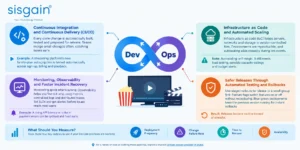
Continuous Integration and Continuous Delivery (CI/CD)
CI/CD means every code change is automatically built, tested and prepared for release. Teams merge small changes often instead of stacking up one risky release. For CI/CD for media and entertainment applications, the payoff is practical. Imagine a streaming platform adding a new family-plan subscription. An automated pipeline runs regression tests on sign-up, billing and playback every time a developer commits, so a broken checkout is caught in minutes rather than after launch.
Infrastructure as Code and Automated Scaling
Infrastructure as code (IaC) describes servers, networks and storage in version-controlled files. Environments become reproducible: the staging setup you tested is the production setup you deploy. Pair that with autoscaling and a platform can add capacity as a live event fills up, then release it afterwards.
One honest caveat. Autoscaling isn’t magic. It still needs load testing before big events, sensible capacity ceilings and budget alerts, otherwise a traffic spike becomes a billing spike.
Monitoring, Observability and Faster Incident Recovery
Monitoring tells you something is wrong. Observability helps you find out why, using metrics, centralized logs and distributed traces together. Teams set service-level objectives, such as a target playback start time or payment success rate, and alert when the platform drifts toward them. A rising API latency or a spike in payment errors can be spotted and fixed before it reaches most users.
Safer Releases Through Automated Testing and Rollbacks
Releases don’t have to be all-or-nothing. Staged rollouts send a new version to a small share of users first. Feature flags switch functionality on or off without redeploying. Blue-green deployments keep the previous version running so teams can roll back in moments. Together they make releases routine instead of stressful.
What should you measure? Don’t ask whether your team “does DevOps.” Track deployment frequency, change failure rate, time to recover and availability. These four numbers show whether the practices are actually working, and they’re what a serious technology partner should help you improve. For a hands-on look at building these pipelines, explore a trusted DevOps service provider in Dubai.
Quick Queston: “What does DevOps mean for a streaming or gaming platform?”— It’s the practice of automating how software is built, tested, released and monitored so entertainment platforms can ship features frequently, handle traffic surges and fix problems quickly, without sacrificing stability during live events or major launches.
Cloud-Native Development for Scalable Media Platforms
Cloud-native design builds applications to run on flexible cloud infrastructure. It supports growth, but no single architecture solves every scaling problem, and the right choice depends on your workload.
Microservices, Containers and Orchestration
In a microservices setup, accounts, subscriptions, content discovery and notifications run as separate services that teams can update independently. Containers package each service with everything it needs, and orchestration tools such as Kubernetes manage them at scale. That’s valuable when workload complexity justifies it. It also adds operational overhead. A small platform with one product team may do better with a well-structured monolith first, and split services as demand grows.
Building Reliable Cloud Infrastructure for OTT Platforms
Reliable cloud infrastructure for OTT platforms is a stack of cooperating parts: content delivery networks (CDNs) to serve video close to viewers, caching to protect backend services, object storage for media libraries, transcoding pipelines that prepare each title for different devices and bandwidths, and regional infrastructure to reduce latency. Add redundancy, tested disaster-recovery plans and strong access controls, because downtime and leaks both cost trust.
Balancing Performance with Infrastructure Costs
Streaming and gaming workloads can get expensive fast. Caching, workload scheduling, right-sized capacity and observability all help keep spending in check. Measure cost per stream, per active user or per transaction, so engineering decisions connect to unit economics. Teams that adopt cloud-native development for media platforms without that discipline often discover the savings only existed on slides.
A note on evidence: these are architectural recommendations, not guaranteed outcomes. Any claimed percentage saving should be verified against your own workload and billing data.
API Development: Connecting the Modern Entertainment Ecosystem
APIs are the connective tissue of a modern platform. They let the app, the website, the payment provider, the content catalogue and the analytics tool exchange information reliably, without custom wiring for every pair.
Connecting Streaming, Payments and Content Management
Think of a viewer who signs up on mobile, pays through a local card, and resumes the same series on a smart TV. That journey crosses identity, subscription management, payment gateways, content catalogues, advertising and analytics. Strong API integration for streaming platforms keeps those handoffs consistent, so users don’t hit a dead end between systems. Dependable API development services in Dubai are what make that connected experience possible.
Supporting Real-Time Gaming and Live Experiences
Leaderboards, live chat, event updates and ticket validation need information to move quickly. REST APIs suit most standard requests, such as fetching a profile or a catalogue. WebSockets suit continuous two-way updates, like live chat. Event-driven messaging works well when many services must react to the same event, such as a purchase triggering a receipt, an unlock and an analytics record.
Securing APIs Across Entertainment Applications
Every API is also a doorway. Protect it with authentication and authorization, rate limiting against abuse, encryption in transit, and monitoring for unusual patterns. Add versioning and governance rules so a change to one service doesn’t quietly break the mobile app. Subscription data and premium content workflows deserve the strictest controls.
Why Web and Mobile App Development Matter for Entertainment Businesses
Infrastructure is invisible to audiences. Interfaces aren’t. The web and mobile products are where your platform gets judged.
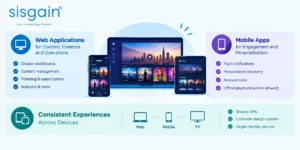
Web Applications for Content, Creators and Operations
Web applications run far more than a public homepage. They power creator dashboards, content management portals, ticketing sites, subscription management and internal analytics. Responsive layouts and accessible journeys, including keyboard navigation and readable contrast, widen your audience and cut support requests. Companies planning this work can review web application development solutions in UAE built around media operations. Cross-device and cross-browser testing belongs in the pipeline, not at the end.
Mobile Apps for Engagement and Personalization
Phones are where much of Dubai’s entertainment happens. Native or cross-platform Android and iOS apps support push notifications, personalized discovery, account sync and, where licensing allows, offline playback. Crash reporting, mobile CI/CD and performance monitoring keep mobile app development for entertainment industry projects reliable after launch, when store reviews can sink a product in days.
Delivering Consistent Experiences Across Devices
A viewer shouldn’t feel they’ve entered a different product on a tablet or connected TV. Shared APIs, a common design system and a single identity service keep web, mobile and TV experiences aligned. That consistency is also what makes scalable entertainment app development affordable: you build the shared foundation once and extend it per device.
Quick Question: “Is a microservices architecture required for a scalable entertainment app?”— No. Microservices help when separate teams need to release different features independently. Many platforms scale well with a modular monolith, strong CI/CD and good observability, then split services only where traffic or team size demands it.
Dubai-Specific Considerations for Building Entertainment Platforms
Generic software advice misses what makes this market distinct. Regional requirements shape product design, operations and risk.
Arabic-English Experiences and Multicultural Personalization
Dubai’s audience is multilingual by default. That means right-to-left interface support, accurate Arabic and English subtitles, language-aware search and discovery that respects different cultural tastes. A Niko Partners survey of 1,225 gamers across the GCC, run in December 2023, found that 41 percent either play only games with Arabic localization or are more likely to choose them, though the preference was weaker in the UAE and Kuwait because of larger non-Arabic-speaking populations. Evaluate recommendation engines for relevance and fairness, not just click-through.
Payments, Privacy and Content Protection
Offer payment options your audience actually uses, secure every transaction and protect content rights with appropriate digital rights management (DRM) and moderation. Compliance deserves a proper review rather than an assumption. Depending on your model, UAE privacy, cybersecurity, licensing and data-location rules may apply, so confirm requirements with legal advisers before launch.
Designing for Traffic Spikes and Regional Availability
Check CDN coverage in the region, test latency from real UAE networks, and plan capacity for peak nights like national events, sports fixtures and ticket releases. Needs differ by format. On-demand streaming tolerates a little buffering. A live broadcast or a multiplayer match often doesn’t. Resilience plans should reflect that difference.
Practical Use Cases of DevOps-First Entertainment Development
The following are illustrative scenarios, not documented client deployments. They show how the practices above combine, and what you’d measure in each.
An OTT Platform Preparing for a Major Content Launch
A streaming service expects its biggest premiere yet. The team runs load tests at several times normal traffic, configures CDN caching for the launch assets, deploys through an automated pipeline with a rollback plan, and watches playback start time and error rates live. Success looks like stable start times during the peak hour and a recovery time measured in minutes if anything fails.
A Gaming Platform Adding Real-Time Features
A studio wants leaderboards and live events in its mobile game. API services handle scores and account sync, automated releases push updates in small batches, and observability flags latency spikes in matchmaking. For the player-facing side, many studios turn to a custom mobile app development company in Dubai to keep the app fast across devices. Useful measures include session crashes, API response times and event participation.
A Digital Event Platform Connecting Ticketing and Streaming
An event organizer sells tickets online and streams the show to remote fans. APIs connect ticket validation, payments, attendee notifications and the stream itself, while DevOps keeps releases dependable in the days before the event. Here, scalable entertainment app development shows up as checkout success rate, entry-scan speed and stream stability. Because ticket releases cause sudden surges, the team rehearses them before going live.
Why Choose SISGAIN Technologies for Media & Entertainment Platform Development
An Integrated Approach to Entertainment Technology
Many businesses hire separate vendors for web, mobile, APIs and infrastructure, then spend months coordinating them. SISGAIN offers a connected alternative: web, mobile, API and DevOps capabilities under one delivery approach, so product development, system integration, deployment automation and ongoing improvement stay aligned. The result is fewer handoffs and clearer accountability across the platform lifecycle.
If you’re comparing an entertainment software development company in Dubai, look for a partner that can explain its services, technologies and experience in plain terms and back them up with evidence.
Development Services Aligned with Business Goals
SISGAIN’s relevant services include:
- DevOps implementation and CI/CD automation
- Custom web application development for media operations and digital experiences
- Mobile application development for streaming, gaming and engagement
- API development and integration across content, payments, analytics and third-party systems
Each engagement begins with discovery: understanding your audience, current architecture, release process and growth targets, so delivery matches real business priorities rather than a generic template.
A Clear Next Step for Your Project
Planning to build or modernize an entertainment platform? Bring your platform requirements, current infrastructure, integration challenges, scalability goals and development roadmap, and discuss them with the SISGAIN team. Book a project consultation to talk through your next step.
Conclusion: Building the Future of Dubai’s Digital Entertainment Industry
Turn Platform Complexity into a Competitive Advantage
Audiences in Dubai don’t separate the content from the platform. They remember whether the stream held, the payment cleared and the app opened quickly. DevOps, cloud-native architecture, APIs, web applications and mobile apps each solve part of that problem, and they work best as one coordinated system.
Technology choices alone won’t carry it. Continuous testing, security, monitoring, localization and performance tuning keep a platform healthy long after launch.
Start small. Review your current architecture, pick one release, one integration or one traffic risk, and measure it honestly. That first improvement is usually where the next one becomes obvious.
Frequently Asked Questions
1. What is DevOps in media and entertainment?
DevOps in media and entertainment is a way of working that automates how platforms are built, tested, released and monitored, so streaming, gaming and event businesses can ship updates faster.
2. Why do Dubai entertainment platforms need DevOps?
Dubai audiences expect fast, uninterrupted experiences. DevOps helps platforms handle traffic spikes during events and launches, release features frequently, and fix problems quickly, protecting subscriber loyalty and long-term revenue growth.
3. How does CI/CD help streaming platforms?
CI/CD automatically builds, tests and deploys every code change. Streaming teams catch broken sign-ups, billing or playback issues within minutes and release features reliably, more often, in small, lower-risk batches.
4. Can autoscaling handle traffic spikes on its own?
Autoscaling adds capacity as demand rises, but it isn’t automatic protection. Platforms still need load testing before big events, capacity limits and cost alerts so surges don’t become surprise bills.
5. Do entertainment apps need microservices?
Not always. Microservices suit teams releasing features independently. Smaller products often scale well with a modular monolith, strong CI/CD and observability, splitting services only when traffic or team size demands.
6. What role do APIs play in streaming platforms?
APIs connect subscriptions, identity, payments, content catalogues, advertising and analytics so data moves reliably between systems. Good integrations prevent frustrating, broken user journeys across devices, failed handoffs and abandoned checkouts.
7. When should you use WebSockets instead of REST APIs?
Use WebSockets for continuous two-way updates, such as live chat, leaderboards or event scores. REST APIs suit standard requests like loading profiles or catalogues. Event-driven messaging fits multi-service workflows too.
8. How can OTT platforms control cloud costs?
Use caching, CDNs, right-sized capacity and workload scheduling, then track cost per stream, active user or transaction. Observability shows where spending rises, so engineering decisions stay connected to unit economics.
9. What Dubai-specific factors affect entertainment app development?
Plan for Arabic-English interfaces with right-to-left support, regional CDN coverage, local payment options and content protection. Review applicable UAE privacy, cybersecurity, licensing and data-location requirements with legal advisers before launch.
10. Which metrics show whether DevOps is working?
Track deployment frequency, change failure rate, time to recover and availability. These four measures show whether releases are getting faster and safer, which matters more than simply adopting DevOps tools.