







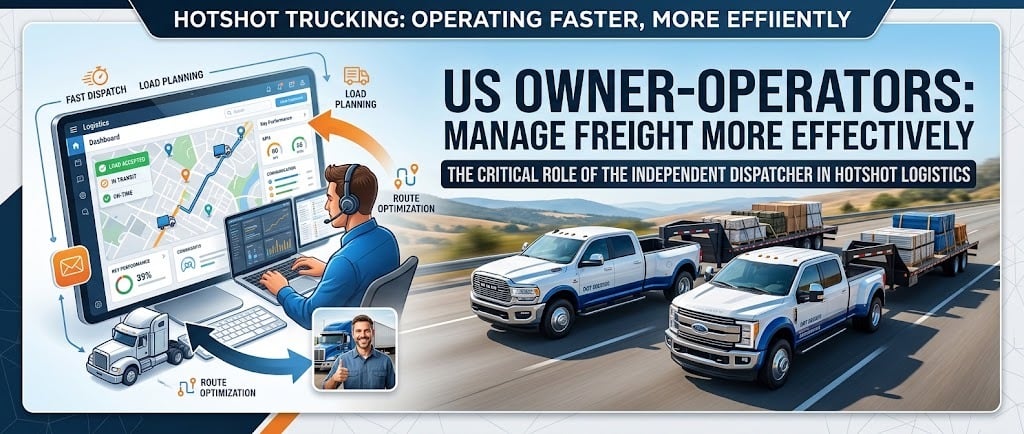
A dispatcher for hotshot trucking helps owner-operators and small carriers coordinate freight, communicate with brokers, negotiate rates, and organise pickup and delivery schedules. In the United States, where hotshot carriers often handle smaller shipments and time-sensitive equipment deliveries, effective dispatching can reduce administrative work and help drivers make more informed decisions about available loads.
Hotshot trucking commonly involves a pickup truck paired with a suitable commercial trailer to transport construction materials, machinery, agricultural equipment, and industrial parts. Although these shipments may offer flexible freight opportunities, running a successful operation requires more than finding a load and driving to its destination. Carriers must consider total mileage, fuel costs, equipment limitations, delivery deadlines, and regulatory requirements.
Understanding the responsibilities of a dispatcher can help owner-operators decide how to manage their freight operations, whether independently or with professional dispatch support.
What Does a Dispatcher for Hotshot Trucking Do?
A hot shot dispatch coordinates the administrative and logistical tasks involved in moving freight from one location to another. The exact responsibilities depend on the service agreement, but the primary objective is to help the carrier organise suitable shipments and manage communication throughout the transportation process.
One of the main duties is load research. Dispatchers review freight opportunities on load boards, communicate with brokers, and identify shipments that match the carrier’s equipment, location, and availability.
They may also handle rate discussions, confirm shipment details, arrange pickup appointments, and help organise the paperwork needed for transportation.
For example, an owner-operator based in Dallas may have a suitable trailer available for transporting industrial equipment to Oklahoma City. A dispatcher can identify a potential load, confirm the cargo’s weight and dimensions, discuss the offered rate, and coordinate the pickup window with the broker.
Before accepting the shipment, the carrier must verify that the truck and trailer can transport the cargo safely and legally. The carrier should also review the rate confirmation and ensure that the pickup and delivery instructions are clear.
Dispatchers may provide updates during transit and assist with delivery documentation, depending on the agreed services. However, they do not replace the driver’s responsibility for vehicle operation, cargo securement, or compliance with applicable transportation laws.
How Hot Shot Dispatch Helps Carriers Find Suitable Loads
Finding freight is an ongoing challenge for many independent hotshot operators. Load availability changes by location, season, industry demand, and the number of carriers competing for the same shipments.
Hot shot dispatch can help organise the search process by focusing on loads that fit the carrier’s business requirements rather than reviewing every available listing.
A dispatcher typically considers several factors before recommending a shipment:
- Equipment compatibility: The truck and trailer must meet the shipment’s weight, dimension, and securement requirements.
- Pickup location: A load requiring extensive empty travel may be less attractive than one located near the carrier.
- Delivery destination: The destination can influence the availability of return freight and the driver’s next operating route.
- Schedule requirements: Loading appointments, delivery deadlines, and expected waiting times affect the driver’s working day.
- Payment terms: The carrier needs to understand the agreed rate, applicable accessorial charges, and payment conditions.
Consider a carrier operating near Houston that receives two load offers. One pays $950 but requires 130 empty miles to reach the pickup location. Another pays $850 and is available only 20 miles away. Depending on the loaded mileage, destination, and other expenses, the second shipment could offer a better overall return.
This is why experienced dispatching involves evaluating the complete journey, not simply selecting the highest advertised rate.
Load boards are one source of freight, but broker relationships, direct shipper contacts, and industry referrals may also provide opportunities. Carriers should verify shipment details and the legitimacy of the parties involved before committing their equipment.
Understanding Rates, Deadhead Miles, and Operating Costs
A carrier’s financial performance depends on the money remaining after operating expenses, not just the gross amount paid for a shipment.
Deadhead miles are miles travelled without revenue-generating freight. These miles may occur when a driver travels to a pickup location or leaves a delivery destination without another load. Fuel consumption, vehicle wear, and maintenance costs continue during these journeys.
Suppose a hotshot carrier accepts a $1,200 load covering 400 loaded miles and must travel another 100 miles to reach the pickup. The total journey is 500 miles, making the gross rate $2.40 per total mile before expenses.
Although the shipment pays $3 per loaded mile, that figure excludes the empty travel required to collect the cargo. The carrier must also account for fuel, insurance, maintenance, tyres, tolls, and other business expenses.
Waiting time matters, too. A shipment that requires several hours at a loading facility can reduce the driver’s ability to complete another job that day. A dispatcher who considers appointment schedules and delivery requirements can help carriers assess these trade-offs before accepting freight.
Carriers should maintain their own records of revenue, fuel expenses, total mileage, maintenance, and dispatch fees. Comparing these figures over several weeks can reveal which routes and shipment types produce better results.
No dispatch arrangement can guarantee profitable loads. Freight rates fluctuate, and unexpected delays, cancellations, or changes in demand can affect a carrier’s earnings.
What to Expect From Dispatch Services for Hotshot
Dispatch services for hotshot carriers can cover several stages of the freight process, from finding an opportunity to organising delivery paperwork. Understanding these stages helps owner-operators know what support they are receiving.
Load identification and review: The dispatcher searches for freight that matches the carrier’s operating preferences and equipment. Shipment details should be reviewed carefully before the load is presented for acceptance.
Broker communication and rate negotiation: The dispatcher may discuss compensation, pickup schedules, delivery requirements, and other terms with the broker. The final agreement should be documented clearly, and the carrier should review the rate confirmation.
Pickup coordination: Drivers need accurate information about the collection location, appointment time, cargo specifications, and any loading restrictions. Missing details can lead to avoidable delays.
Transit updates: Depending on the agreement, dispatchers may communicate estimated arrival times, report delays, and provide status updates to the broker or customer.
Delivery and paperwork: After the shipment is completed, the carrier may need to provide a signed bill of lading, proof of delivery, or other documents required for invoicing.
For example, a carrier transporting replacement parts to a manufacturing facility may encounter an unexpected delay at pickup. Prompt communication allows the receiving facility to adjust its schedule and helps the broker understand the revised arrival time.
These administrative tasks may seem routine, but accurate information and timely communication can make a significant difference to daily operations.
Choosing a Reliable Hotshot Dispatch Provider in the USA
The right dispatch arrangement depends on a carrier’s experience, operating area, available time, and business goals. Some owner-operators prefer to search load boards and negotiate directly with brokers. Others use an independent provider to reduce administrative work while they focus on driving and maintaining their equipment.
Before entering an agreement, carriers should understand the provider’s responsibilities and fee structure. Questions worth asking include whether fees are charged as a percentage of the load or at a fixed rate, which services are included, and whether the contract contains exclusivity or cancellation provisions.
It is also important to clarify who reviews rate confirmations, communicates with brokers, handles paperwork, and follows up on missing delivery documents. Carriers should retain access to their own records and understand who has authority to accept loads on their behalf.
EverMark Dispatchers is one company in the US dispatching market. When evaluating EverMark Dispatchers or any other provider, carriers should consider the scope of the agreement, communication practices, transparency of fees, and the ability to explain load decisions clearly. Promises of guaranteed freight or specific earnings should be treated cautiously because market conditions and individual operating costs vary.
A useful way to evaluate a provider is to review actual business performance over time. Relevant measures include total revenue, deadhead mileage, time spent searching for freight, dispatch fees, and the quality of available shipments.
The aim is not simply to book more loads. It is to organise freight in a way that supports the carrier’s operational and financial objectives.
Compliance and Equipment Requirements for Hotshot Carriers
Freight selection must always account for equipment suitability and applicable transportation regulations. A shipment should not be accepted until the carrier has confirmed that the vehicle, trailer, driver, and operating authority meet the requirements for that particular movement.
Depending on the operation, requirements may involve USDOT registration, operating authority, insurance, driver qualifications, commercial driver’s licence rules, and hours-of-service regulations. Applicability depends on factors such as vehicle and combination ratings, actual weight, cargo, and whether the operation is interstate or intrastate.
The truck’s towing capacity alone does not establish the legal payload. Trailer ratings, axle limits, hitch capacity, cargo dimensions, and weight distribution also matter. Appropriate cargo securement equipment must be used, and oversized shipments may require permits or route planning.
A dispatcher can help organise shipment information and identify questions that need further review, but the carrier remains responsible for compliance. Regulatory requirements should be checked against the specific operation rather than assumptions based on the size of the truck.
Good dispatching combines freight coordination with realistic planning. When load selection, cost calculations, communication, and compliance are considered together, carriers are better positioned to manage the demands of the US hotshot market.
Conclusion
A dispatch services for hotshot can help US owner-operators coordinate freight searches, negotiate rates, manage broker communication, and organise delivery schedules. Effective dispatching focuses on suitable loads, total operating costs, equipment requirements, and reliable documentation rather than simply increasing the number of shipments booked.
For independent carriers, the most useful dispatch arrangement is one that provides clear responsibilities, transparent fees, and practical support while preserving the carrier’s control over business decisions. Careful load evaluation, accurate expense tracking, and consistent compliance remain essential to building a well-managed hotshot trucking operation.