






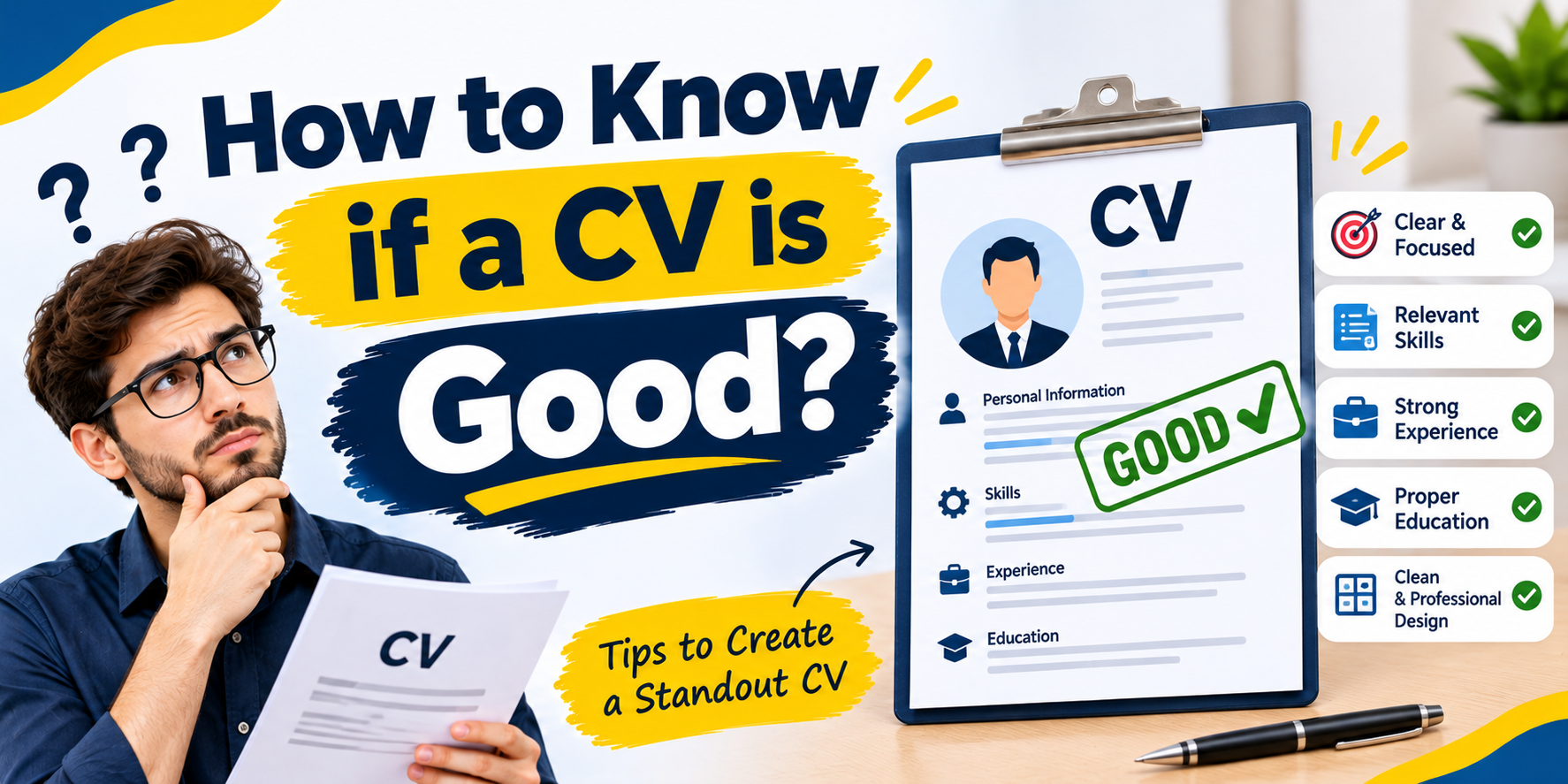
An effective CV can make all the difference for the candidate in obtaining a job interview. It provides an overview of the candidate’s abilities, experiences, achievements, and work skills. However, a CV that contains just personal and professional information may not be a successful CV. A CV should have relevance to the job, be readable, be professionally written, and be convincing enough to catch the eye of the employer. Candidates can find out how to evaluate for these traits and improve their application prior to submitting it.
It leaves a favorable first impression.
Many recruitment specialists get numerous applications for just one position and could possibly spend just a few seconds per application form. Therefore, a CV worth it should create a positive impression within a couple of seconds. Neat, well-proportioned, and businesslike. Headings should stand out, and important information should be in prominent places.
Employers will not read your CV if it’s longer than required. Likewise, too many colors, fancy fonts, graphics, and extraneous design features can detract from the candidate’s qualifications. The basic and professional format is generally the most suitable unless the applicant has a particular interest in a very creative position.
The CV is written strongly and professionally.
The quality of the language may be used to gauge a CV’s preparation. CVs are effective when the use of action words like “managed,” “developed,” “coordinated,” “improved,” “delivered,” “supported,” and “achieved” is present. These words make it easier to communicate a sense of responsibility and contribution, rather than weakness or passivity.
Sentences should be brief and contain no technical jargon. The repetition should also be avoided, particularly if there are duplicate workloads presented for different occupations. If it is hard to put your experience into a clear and effective application, it is advisable to use the services of an expert CV writing service in Abu Dhabi to improve your application with respect to structure, content, and relevance.
Information is clear and relevant.
The best CVs contain material that is relevant to the job for which they are applying. Each section should aid in establishing the candidate’s suitability for the position. Important qualifications, responsibilities, achievements, certifications, and technical skills are to be emphasized. Generally, avoid including personal details that are not relevant to the application.
Candidates are not to send out a generic CV to any opening. There are also varying requirements for even jobs with the same titles. A good CV will be relevant to the job description and highlight the most relevant experience to the employer’s needs. A good CV will clearly demonstrate the applicant’s suitability for the advertised position if he or she can easily see how the job and CV correspond.
The professional summary is convincing.
The first section of the CV is the professional summary, which introduces the candidate to the employer. It should succinctly outline the applicant’s professional position, experience, top abilities, and career interests. A good summary will give a recruiting manager a good reason to read further.
Some of the weak words in the weak summaries are vague, such as “hardworking,” “honest,” and “motivated.” They’re great traits, but many candidates profess to have them, and there’s no distinction. Specific strengths in the professional area and experience will also be included in a good summary. It needs to be short; it needs to be believable for the position, and it needs to be specific to the position.
Achievements Are Included
The best way to determine whether a CV is good or not is if they’ve included measurable achievements. Job duties highlight what the candidate was expected to do, whereas job achievements illustrate the effectiveness of the candidate’s performance of the duties. Employers are more interested in results than in tasks.
If a salesperson assisted customers, for example, it does not provide that much about the salesperson’s actions. It’s better to show that the employee fulfilled his monthly goals, helped retain more customers, and boosted sales in reality. Achievements that can be substantiated with numbers, percentages, awards, promotions, completed projects, and recognized improvements can make achievements more credible. But every claim should be substantiated and have a story to tell in the interview.
It does not have any defects.
Errors such as misspellings, grammatical and punctuation errors can detract from the overall quality of the application. Such mistakes can be seen as a lack of attention to detail or communication skills by employers. It’s also important to spell the names of companies, institutions, qualifications, and professional certifications properly.
Proofreading shouldn’t be limited to an automatic spelling checker. The software has the ability to not recognize misspelled words that are spelled correctly but used in an incorrect manner. It may be reviewed by reading it slowly, line by line, and by reading it aloud to someone else. It is also important to check the final version after it is converted to PDF, as spacing or formatting could change.
It’s suitable for applicant tracking systems.
Some companies utilize applicant tracking systems to filter applications prior to the recruiter going through them. The CV should then be stuffed with the appropriate keywords used in the job offer in the proper order. Job roles, skills, computer programming, technical skills, and field/industry-specific skills should be clearly defined.
Complex tables, text boxes, unusual characters, and important information in headers and footers may not be understood by some systems. The simple design makes it easier for software and human recruiters to read the code. Candidates would be unlikely to reproduce the keywords falsely and would not be expected to claim abilities that they don’t have because they completed a computer-based screening test.
The length is suitable.
The length of the CV isn’t always the right length for all CVs. The proper length is dependent on the candidate’s experience, profession, and the requirements of the position. A recent graduate may need 1 or 2 pages to present relevant information, and an experienced professional may need more.
Each sentence must have a function. Usually, duplicate tasks and irrelevant short courses can be eliminated, as can long personal descriptions. The candidate’s CV will provide enough proof to let the reader know that the candidate is acceptable without overwhelming him/her. Quality, relevance, clarity > filling pages.
Creates Desired Outcome.
The CV’s aim is to land the candidate an interview. If the document doesn’t come back to a qualified applicant, the document may need improvement. You might have weak targeting, unclear achievements, missing keywords, bad formatting, or an unconvincing summary.
Advice given by someone who recruits, has a career adviser, is a trusted professional, or is a hiring manager can be helpful. Candidates need to check if they are applying for the right jobs. A stellar CV will not make up for a significant lack of skills and experience in the job.
Conclusion
A good CV is clear, relevant, accurate, and professional, and focuses on the needs of the employer. It should also be free from errors and should be ATS-friendly as well. Most importantly, it should show how the candidate’s experience and skills are going to benefit the organization. When these points are considered and the CV is adjusted accordingly, applicants may send a CV that will demonstrate their worth as professionals and will have a higher probability of being called for an interview.