







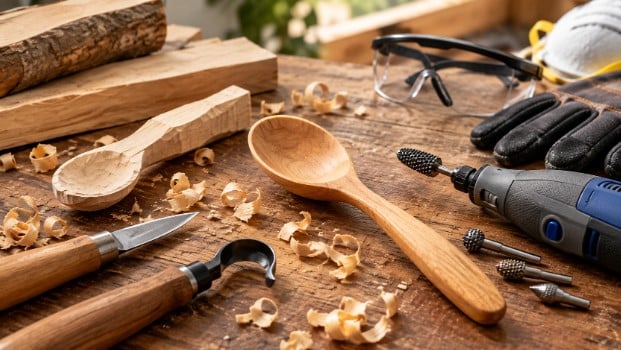
Spoon carving is a traditional woodworking craft that combines practical function with careful shaping and an understanding of wood grain. Unlike many decorative carving projects, a spoon has to be comfortable to hold, balanced in the hand, and shaped well enough to perform its intended purpose. For beginners, the process may seem complicated at first, but understanding the material, choosing suitable tools, and following the grain can make the work much more manageable.
At its core, Spoon Carving involves removing material gradually to create the bowl, handle, and transitions that define a finished utensil. The process can be performed entirely with hand tools, although power carving equipment can also be useful for specific shaping and material-removal stages. The important factor is maintaining control over the cut rather than simply removing wood as quickly as possible.
Choosing the Right Wood for Spoon Carving
Wood selection has a major effect on both the carving process and the finished spoon. Freshly cut, or green, wood is often preferred because its higher moisture content makes it easier to cut than seasoned timber. Birch, alder, lime, basswood, cherry, apple, pear, and other fine-grained species are commonly used for spoon carving projects.
Grain direction is just as important as species. A blank with relatively straight grain running through the handle can provide better structural continuity. Knots, severe grain changes, and cracks can make a project more difficult, particularly for someone learning basic carving techniques.
What Tools Are Needed?
A basic spoon-carving setup does not need to contain a large collection of specialized equipment. A straight carving knife is useful for shaping the exterior profile and refining the handle, while a hook knife or spoon gouge can remove material from the bowl.
Power Spoon Carving can be another option when substantial amounts of material need to be removed. Rotary carving tools and suitable burrs can help hollow bowls, refine curves, and remove excess material before hand finishing. Power carving is particularly useful when the goal is controlled material removal while retaining the ability to refine the final shape manually.
A Practical Spoon Carving Process
The first stage is rough shaping, where excess material is removed from around the handle and bowl.
The spoon carving process usually begins by preparing a suitable blank and marking the approximate outline of the spoon. Once the general silhouette is established, the bowl can be hollowed. A hook knife is traditionally useful for this stage, while a rotary carving tool can also assist with controlled material removal.
The final stage involves smoothing and refining the surface. Some carvers prefer a knife-finished surface, while others use controlled sanding to achieve a different texture. The appropriate approach depends on the desired appearance and the type of wood being used.
Safety During Spoon Carving
Sharp tools require deliberate handling. Carving should be performed with the workpiece secured in a way that keeps hands away from the cutting path. Protective equipment is especially important when using power tools because material removal can produce chips and airborne dust. Dremel’s Spoon Carving guidance, for example, lists safety glasses, gloves, and a dust mask among the equipment for its project.
Conclusion
Successful spoon making depends less on having a large tool collection and more on understanding wood, grain direction, cutting technique, and proportion. Beginners can make the process easier by starting with workable wood, keeping cutting edges sharp, removing material gradually, and paying close attention to the shape of the bowl and handle. Choosing the right woodturning texture tools can also be useful when a project involves additional shaping or surface-texturing work beyond traditional knife carving. With practice, carving becomes an exercise in reading the material rather than simply cutting it. Each piece of wood behaves differently, and learning to recognize those differences is what allows a rough blank to develop into a functional, balanced, and carefully crafted spoon.