



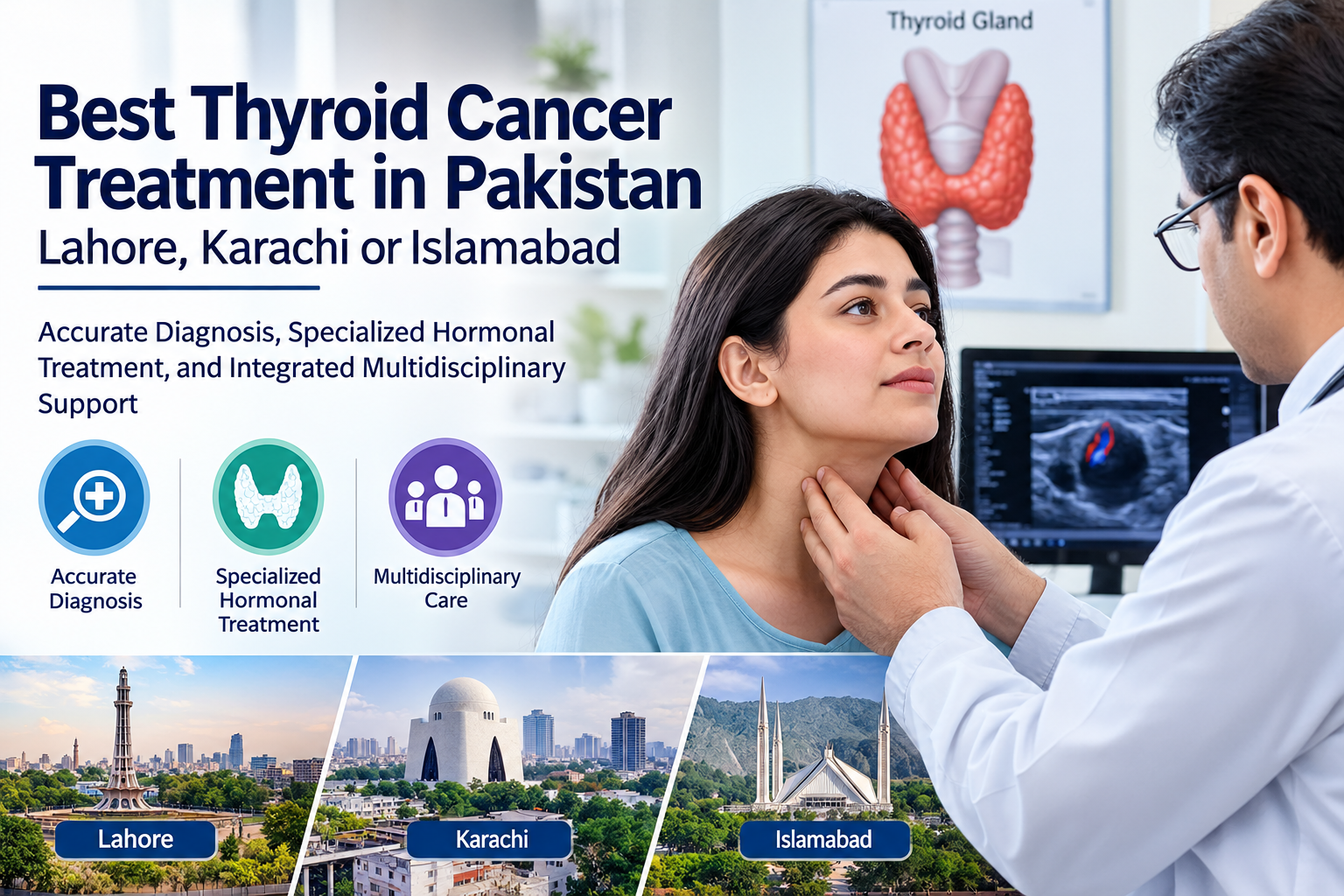
Finding the Best Thyroid Cancer Treatment in Lahore, Karachi, Islamabad, Pakistan involves identifying a qualified cancer specialist, obtaining an accurate diagnosis, and understanding the treatment options available for the specific type and stage of thyroid cancer. Pakistan’s major cities offer a range of specialist healthcare services, but the right treatment plan depends on the patient’s medical condition, tumour characteristics, and overall health.
A thyroid cancer diagnosis can create uncertainty for patients and their families. Understanding the diagnostic process, treatment choices, and follow-up requirements can make it easier to prepare for consultations and participate in informed medical decisions.
Understanding Thyroid Cancer and Its Types
Thyroid cancer develops when abnormal cells grow in the thyroid gland, a hormone-producing organ located at the front of the neck.
Papillary thyroid cancer is the most common type and often has a favourable outlook when diagnosed and treated appropriately. Follicular thyroid cancer is another differentiated type that requires assessment of its specific characteristics and potential spread. Are you looking for Best Thyroid Cancer Treatment in Lahore, Karachi, Islamabad, Pakistan?
Medullary thyroid cancer develops from parafollicular C cells and may require additional genetic assessment in selected patients. Anaplastic thyroid cancer is a rare, aggressive form that generally requires urgent specialist evaluation and coordinated treatment.
Identifying the cancer type through appropriate diagnostic investigations is essential because treatment recommendations vary considerably between these conditions.
Best Thyroid Cancer Treatment in Lahore
Lahore offers access to hospitals, cancer services, surgical departments, and specialist consultations. Patients searching for the best thyroid cancer treatment in Lahore should assess whether a healthcare facility can coordinate the investigations and treatments required for their diagnosis.
Care may involve an endocrinologist, a head and neck or endocrine surgeon, a nuclear medicine specialist, an oncologist, and a pathologist. The appropriate team depends on the cancer type and stage.
Before choosing a facility, patients should ask about surgical experience, pathology services, access to radioactive iodine treatment when indicated, and arrangements for long-term surveillance. Reviewing medical records and obtaining a specialist opinion can also help clarify whether the proposed treatment is suitable.
Best Thyroid Cancer Treatment in Karachi
Karachi provides access to a broad range of healthcare institutions and specialist services. When comparing thyroid cancer treatment in Karachi, patients should consider the availability of experienced surgical teams, reliable diagnostic testing, and coordinated oncology care.
Patients should also discuss practical matters, including treatment costs, expected recovery time, access to prescribed medicines, and the availability of follow-up appointments. These factors can help patients choose a care pathway that is medically appropriate and manageable over time.
Best Thyroid Cancer Treatment in Islamabad
Islamabad offers specialist consultations, hospital-based cancer care, and diagnostic facilities for patients living in the capital and surrounding regions. Those looking for the best thyroid cancer treatment in Islamabad should confirm that their chosen centre can address both the immediate treatment requirements and ongoing surveillance.
Patients with complex or advanced disease may benefit from multidisciplinary review, in which specialists assess the diagnosis and discuss the relative benefits and risks of different approaches. Access to molecular testing, nuclear medicine, and targeted therapies may also be relevant in selected cases.
Before beginning treatment, confirm the credentials of the medical professionals involved and ask which services are available at the selected facility or through referral arrangements.
Diagnostic Tests Used to Confirm Thyroid Cancer
Accurate diagnosis helps determine the cancer type, extent of disease, and most suitable treatment strategy. A specialist may recommend several investigations depending on the patient’s symptoms and initial findings.
Common assessments include:
- Thyroid ultrasound. Evaluates the thyroid gland and identifies suspicious nodules or enlarged neck lymph nodes.
- Fine-needle aspiration biopsy. Collects cells from a suspicious nodule for cytological examination when indicated.
- Histopathology. Examines tissue obtained during surgery to establish the tumour’s characteristics.
- Blood tests. Assess thyroid function and, in selected circumstances, measure markers such as calcitonin or thyroglobulin.
- Additional imaging. CT, MRI, or other scans may be required to assess disease extent in particular cases.
- Molecular and genetic testing. May help guide decisions for certain cancer types, especially when inherited risk or advanced disease is suspected.
Modern Treatment Options for Thyroid Cancer
The best treatment for thyroid cancer is determined by the diagnosis, risk of recurrence, disease extent, and individual patient circumstances. Current clinical guidance increasingly emphasizes personalized decisions rather than applying the same treatment to every patient.
Thyroid Surgery
Surgery is a major treatment option for many thyroid cancers. Depending on the tumour’s characteristics, the surgeon may remove one thyroid lobe through a procedure called a lobectomy or remove the entire gland through total thyroidectomy.
Removal of nearby lymph nodes may be necessary when cancer has spread to these areas. The extent of surgery should be based on clinical findings, cancer risk, and discussion of potential complications, including changes in voice and reduced calcium levels.
Selected patients with small, low-risk tumours may be eligible for a less extensive approach. Not every thyroid cancer requires the same operation.
Radioactive Iodine Therapy
Radioactive iodine may be recommended for certain differentiated thyroid cancers following surgery. It helps target thyroid cells that absorb iodine and is used selectively according to recurrence risk and other clinical factors.
It is not suitable for every thyroid cancer type, and the decision should be made by the treating team after considering expected benefits, possible side effects, and the patient’s individual needs.
Thyroid Hormone Therapy
After thyroid surgery, some patients need levothyroxine to replace thyroid hormones. In certain cases, the dose is also adjusted to influence thyroid-stimulating hormone (TSH) levels and help manage recurrence risk.
Targeted Therapy and Advanced Cancer Care
For selected patients with advanced or progressive thyroid cancer, molecular testing may identify changes that help guide targeted treatment. Other systemic therapies may be considered when the disease requires them.
Treatment decisions should account for disease progression, likely benefits, side effects, and quality of life. For certain cases of recurrent or radioactive iodine-refractory disease, local treatments may also be considered before or alongside systemic therapy, depending on the clinical situation.
Follow-Up Care After Thyroid Cancer Treatment
Treatment does not always end after surgery or radioactive iodine therapy. Follow-up helps clinicians assess recovery, monitor thyroid hormone levels, and identify possible persistent or recurrent disease.
Depending on the cancer type and treatment history, surveillance may include neck ultrasound, thyroglobulin testing for appropriate differentiated cancers, other blood tests, and additional imaging when indicated.
Current guidance supports adjusting monitoring intensity to the patient’s response to treatment and estimated risk. Patients with low-risk thyroid cancer and positive follow-up results may require less intensive monitoring than those with higher-risk disease or evidence of persistent cancer.
Patients should keep copies of pathology reports, operative notes, scan results, and medication records. These documents can support continuity of care when consultations take place at different hospitals.
How to Choose the Right Thyroid Cancer Specialist in Pakistan
When evaluating thyroid cancer treatment facilities in Lahore, Karachi, and Islamabad, take the following factors into account:
- Relevant qualifications. Verify specialist training, professional registration, and experience in thyroid cancer care.
- Multidisciplinary support. Determine whether surgical, endocrine, pathology, nuclear medicine, and oncology services can be coordinated when necessary.
- Clear communication. Choose a team that explains the diagnosis, treatment alternatives, risks, and expected recovery.
- Evidence-based recommendations. Ask how the proposed plan relates to the cancer’s type, stage, and recurrence risk.
- Follow-up arrangements. Confirm access to hormone monitoring, surveillance imaging, and additional treatment if required.
- Practical considerations. Compare costs, travel requirements, appointment availability, and access to essential services.
Conclusion
Finding the Best Thyroid Cancer Treatment in Lahore, Karachi, Islamabad, Pakistan requires careful evaluation of specialist expertise, diagnostic accuracy, treatment facilities, and long-term follow-up services. Although all three cities offer healthcare options, the most suitable centre is the one equipped to manage the patient’s particular diagnosis and clinical needs.
Patients should seek advice from qualified specialists, understand the purpose of each recommended treatment, and discuss the expected benefits and risks before making decisions. With an individualized care plan and appropriate monitoring, patients can make better-informed choices throughout their thyroid cancer treatment journey