







Asia Pacific Non-Lethal Weapons Market Size, Share, Growth, Trends & Forecast 2026–2034
Market Overview
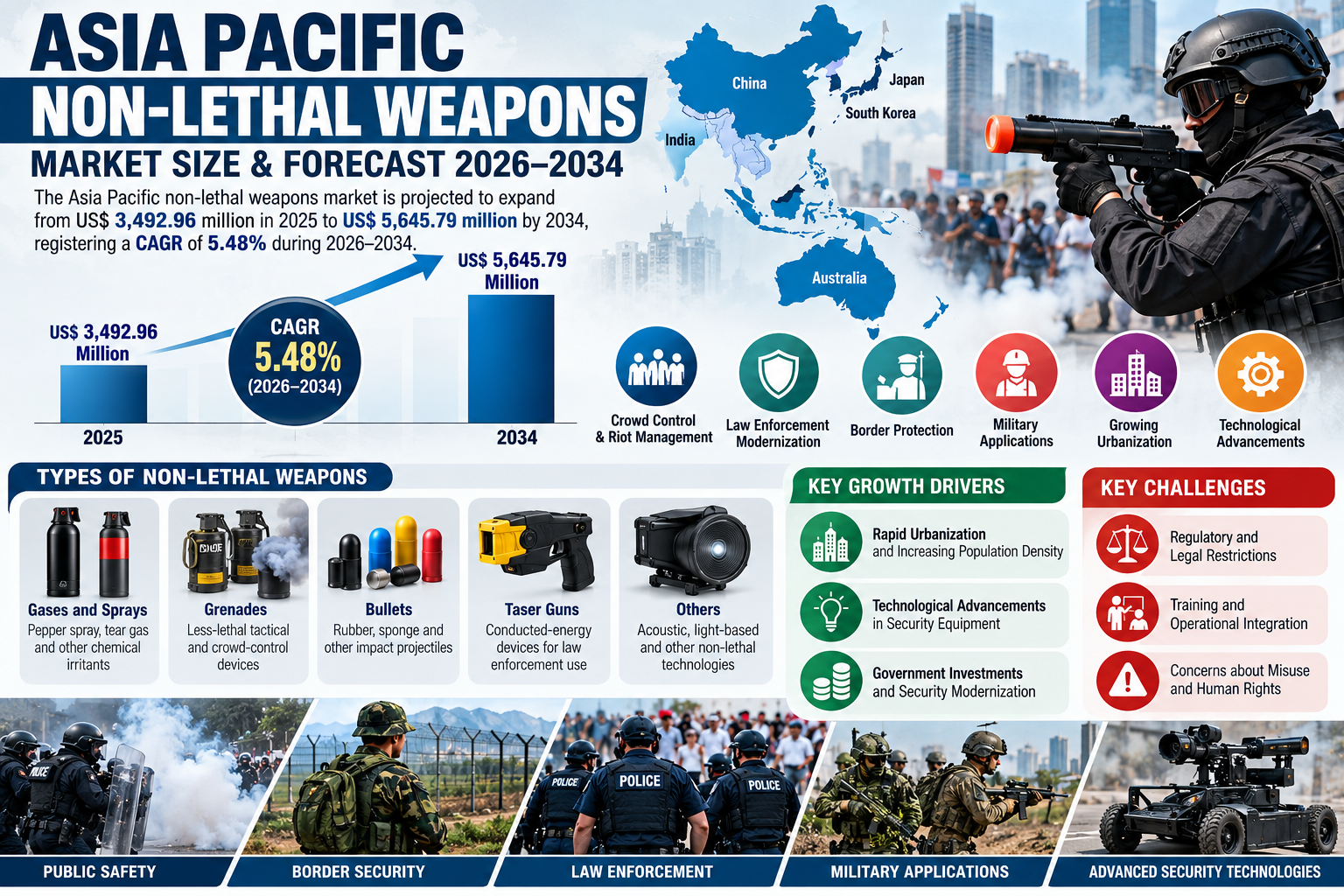
The Asia Pacific non-lethal weapons market is projected to grow from US$ 3,492.96 million in 2025 to US$ 5,645.79 million by 2034, registering a compound annual growth rate (CAGR) of 5.48% during 2026–2034. Market expansion is supported by increasing government expenditure on public safety, law enforcement modernization, border protection, and defense capabilities across China, India, Japan, South Korea, and Australia.
Non-lethal weapons are designed to deter, temporarily incapacitate, or control individuals while seeking to minimize the risk of death or permanent injury. These systems are increasingly incorporated into security strategies for crowd management, riot control, suspect apprehension, and selected military and border security operations.
Growing urban populations, changing public security requirements, and technological advancements are contributing to demand for less-lethal alternatives to conventional force. However, concerns about misuse, human rights, regulatory compliance, and training requirements continue to influence market development.
What Are Non-Lethal Weapons?
Non-lethal weapons are security devices intended to control or deter individuals without relying primarily on lethal force. They include electroshock devices, chemical sprays, tear gas, selected impact projectiles, acoustic or light-based systems, and mechanical crowd-control equipment.
Law enforcement agencies and other authorized security organizations use these technologies in situations where they require additional response options. Their intended purpose is to support proportionate responses to threats and potentially reduce fatalities.
However, non-lethal does not mean harmless. Injuries can occur depending on the device, circumstances, and manner of deployment. Appropriate training, legal authorization, accountability, and medical safeguards are essential considerations in their use.
Key Market Growth Drivers
1. Rapid Urbanization and Increasing Population Density
Urbanization is a major factor influencing the Asia Pacific non-lethal weapons market. Population growth and expanding metropolitan areas create increasingly complex public safety requirements for police departments and security agencies.
Large public gatherings, demonstrations, sporting events, and emergency situations can require coordinated crowd management. Authorities are therefore evaluating a range of less-lethal technologies to improve response capabilities while seeking to minimize injuries and prevent confrontations from escalating.
Countries such as India, China, and Indonesia have substantial urban populations and diverse public security requirements. Continued investment in policing infrastructure and emergency response capabilities is expected to support demand for non-lethal security equipment.
2. Technological Advancements in Security Equipment
Technology is changing the development of non-lethal weapons and related public safety systems. Manufacturers are investing in improved device design, electronic monitoring, remote operation, and systems intended to enhance situational awareness.
Emerging technology areas include directed-energy concepts, acoustic deterrent systems, connected public safety platforms, and remotely operated security equipment. Robotics and other automated platforms are also attracting attention as security organizations explore ways to manage certain high-risk situations while limiting direct personnel exposure.
In April 2025, an Indian startup presented an indigenous non-lethal tactical pistol at Milipol India, according to the supplied market material. Such developments illustrate growing interest in domestic innovation and specialized security technology.
Nevertheless, technology adoption depends on practical performance, regulatory approval, affordability, operator training, and appropriate safeguards.
3. Government Investments and Security Modernization
Government spending on law enforcement, border security, and defense modernization represents another important growth driver.
Across Asia Pacific, security organizations are seeking to improve operational readiness and expand their response capabilities. Procurement programs may include crowd-control equipment, electroshock devices, protective systems, and other less-lethal technologies.
Modernization initiatives can create opportunities for established defense contractors, specialist equipment manufacturers, and regional technology providers. Domestic manufacturing and research partnerships may also support market development.
However, government procurement decisions depend on national budgets, competing security priorities, regulatory requirements, and assessments of operational effectiveness.
Major Challenges Facing the Market
1. Regulatory and Legal Restrictions
Regulatory compliance remains a significant challenge for manufacturers and security agencies. Countries across Asia Pacific apply different laws, procurement procedures, and operational standards to weapons and law enforcement equipment.
Although non-lethal weapons are intended to reduce the need for deadly force, improper deployment can cause serious injuries and raise human rights concerns. Such incidents may result in legal proceedings, reputational damage, or tighter restrictions.
Manufacturers entering multiple national markets must therefore account for differences in product approval, import controls, certification, and end-user requirements.
2. Training and Operational Integration
Effective deployment requires appropriate training, clear procedures, and ongoing supervision. Agencies may need to invest in operator education, equipment maintenance, incident reporting, and revised operational policies.
These requirements can be particularly challenging for organizations with limited budgets or inadequate training infrastructure. Integrating new technologies into existing command and response systems may also increase implementation costs.
Consequently, purchasing decisions are influenced not only by equipment prices but also by training, maintenance, compliance, and long-term operating expenses.
Asia Pacific Non-Lethal Weapons Market Segmentation
The market can be analyzed across product type, technology, end use, and geography.
By Product Type
- Gases and sprays: Includes pepper spray, tear gas, and other chemical irritant products used in authorized security operations.
- Grenades: Covers selected devices intended for less-lethal tactical or crowd-management applications.
- Bullets: Includes rubber, sponge, and other impact projectiles designed for specific law enforcement applications.
- Taser guns: Includes conducted-energy devices used by authorized personnel.
- Others: Covers additional non-lethal security products and emerging equipment categories.
Demand across these segments depends on procurement priorities, legal restrictions, application requirements, and training capabilities.
By Technology
The market is divided into chemical, electroshock, mechanical and kinetic, acoustic and light-based, and other technologies.
Chemical systems include sprays and irritants. Electroshock technologies use electrical effects, while mechanical and kinetic systems rely on physical mechanisms or impact. Acoustic and light-based technologies represent another category of security equipment.
Each segment has different operational limitations, safety considerations, regulatory requirements, and acquisition costs.
By End Use
Law enforcement represents a major application area because police agencies require options for public safety, crowd management, and suspect apprehension.
Military applications may include selected security, protection, and operational scenarios in which less-lethal capabilities are appropriate.
The others category includes additional authorized security applications, depending on the market research classification.
Country-Wise Market Analysis
India Non-Lethal Weapons Market
India’s market is supported by police modernization, urbanization, border security requirements, and the need to manage large public gatherings. Security agencies are evaluating various less-lethal technologies to expand response options and improve operational readiness.
Opportunities may arise from domestic manufacturing, specialist security equipment, and government procurement. However, budget constraints, training requirements, regulatory oversight, and procurement procedures can affect adoption rates.
China Non-Lethal Weapons Market
China’s market is influenced by government investment in security infrastructure, policing capabilities, and advanced technologies. Demand for crowd-management equipment and modern security systems may support market development.
Research into advanced electromagnetic and other non-lethal technologies also reflects the broader interest in specialized security equipment. Regulatory controls, public accountability, and safety considerations remain important factors affecting deployment.
Japan Non-Lethal Weapons Market
Japan’s market is shaped by public safety requirements, police preparedness, and the management of major public events. Authorities place importance on operational standards, safety, and compliance when considering security technologies.
High acquisition costs, specialized training, and strict regulatory requirements may influence procurement decisions. Nevertheless, continued modernization could create opportunities for selected equipment categories.
Other Asia Pacific Markets
Australia and South Korea are relevant markets for law enforcement modernization and security technology. Indonesia, Malaysia, Thailand, New Zealand, and other regional countries also contribute to the broader market opportunity.
Market conditions differ according to national budgets, security priorities, local regulations, and the maturity of procurement systems.
Emerging Trends in the Asia Pacific Non-Lethal Weapons Market
Several trends are shaping the competitive landscape:
- Advanced public safety systems: Greater interest in connected technologies and improved situational awareness.
- Domestic manufacturing: Regional innovation may expand supplier participation and reduce reliance on imported equipment in selected categories.
- Robotics and remote operation: Security organizations are exploring remotely operated platforms for certain high-risk environments.
- Training and accountability: Agencies increasingly need documented procedures, operator education, and oversight mechanisms.
- Integrated security procurement: Buyers may evaluate equipment alongside communications, protective systems, maintenance, and training services.
These trends create opportunities for suppliers that can demonstrate reliability, compliance, responsible deployment, and lifecycle value.
Competitive Landscape and Key Companies
The Asia Pacific non-lethal weapons market includes defense contractors and specialist equipment manufacturers serving different security applications.
Key companies identified in the supplied market research include:
- Byrna Technologies Inc.
- General Dynamics Corporation
- Moog Inc.
- Raytheon Technologies Corporation
- Rheinmetall AG
- Textron Inc.
- Combined Systems Inc.
Competition is influenced by product portfolios, technological capabilities, procurement relationships, regulatory compliance, and research and development investment.
A detailed competitive assessment can examine company overviews, key personnel, recent developments, SWOT analysis, and revenue performance. Individual company participation and market share should be assessed using verified company disclosures and market-specific evidence.
Market Outlook Through 2034
The Asia Pacific non-lethal weapons market is expected to expand steadily as governments continue investing in public safety, security infrastructure, and law enforcement modernization.
Growth opportunities are likely to depend on urban security requirements, technological innovation, domestic manufacturing, and the availability of equipment suited to national regulatory frameworks.
At the same time, responsible deployment will remain central to long-term adoption. Safety testing, appropriate training, human rights protections, and transparent accountability mechanisms are essential to ensuring that these technologies serve legitimate security purposes.
With the market forecast to reach US$ 5,645.79 million by 2034, manufacturers and investors can evaluate opportunities across product categories, end-user segments, and individual Asia Pacific countries.
Conclusion
The Asia Pacific non-lethal weapons market is positioned for continued growth, increasing from US$ 3,492.96 million in 2025 to a projected US$ 5,645.79 million by 2034. Government security spending, urbanization, technological developments, and modernization programs are the principal growth drivers.
However, regulatory restrictions, training costs, and concerns about misuse remain significant challenges. Companies that prioritize product reliability, compliance, responsible use, and effective support services may be better positioned to address evolving market requirements.
For businesses evaluating this industry, understanding national regulations, procurement patterns, technology trends, and competitive positioning will be important to identifying sustainable opportunities.
Frequently Asked Questions (FAQs)
1. What is the size of the Asia Pacific non-lethal weapons market?
The Asia Pacific non-lethal weapons market is valued at US$ 3,492.96 million in 2025 and is projected to reach US$ 5,645.79 million by 2034.
2. What is the projected CAGR of the Asia Pacific non-lethal weapons market?
The market is expected to register a CAGR of 5.48% during the forecast period from 2026 to 2034.
3. What are the major factors driving market growth?
Key drivers include government spending on public safety, law enforcement modernization, urbanization, border security requirements, and technological advancements in security equipment.
4. Which product categories are included in the market?
The market includes gases and sprays, grenades, bullets, Taser guns, and other non-lethal weapon categories.
5. Which technologies are covered in the market?
The major technology segments are chemical, electroshock, mechanical and kinetic, acoustic and light-based, and other technologies.
6. Which countries are covered in the Asia Pacific non-lethal weapons market?
The market covers China, Japan, India, Australia, South Korea, Thailand, Malaysia, Indonesia, New Zealand, and the rest of Asia Pacific.
7. What are the major challenges affecting market growth?
Major challenges include regulatory and legal restrictions, human rights concerns, training requirements, procurement costs, and difficulties integrating new equipment into existing security systems.
8. Who are the key companies in the Asia Pacific non-lethal weapons market?
Key companies identified in the market research include Byrna Technologies Inc., General Dynamics Corporation, Moog Inc., Raytheon Technologies Corporation, Rheinmetall AG, Textron Inc., and Combined Systems Inc.
9. What is the outlook for the Asia Pacific non-lethal weapons market through 2034?
The market is expected to expand steadily, supported by security modernization and technology investment, although growth will depend on regulatory compliance, government procurement, affordability, and responsible deployment.
About the Market Report
The Asia Pacific Non-Lethal Weapons Market report from Renub Research examines market size and forecasts, growth drivers, challenges, product types, technologies, end-use applications, country-level markets, and competitive positioning.
Explore the full report: https://www.renub.com/asia-pacific-non-lethal-weapons-market-p.php