





By now you have probably seen plenty of opinions about cms vs headless cms, and many of them sound convincing. The challenge is turning information into a decision. This guide from Xcentric Services gives you a practical framework you can use in a planning meeting. Instead of arguing about trends, you will answer a short list of questions about your team, content, budget, and goals. The answers will point clearly toward a Traditional CMS vs Headless CMS choice, or toward a hybrid path, and you will understand the reasoning behind it.
Question One: Where Will Your Content Appear?
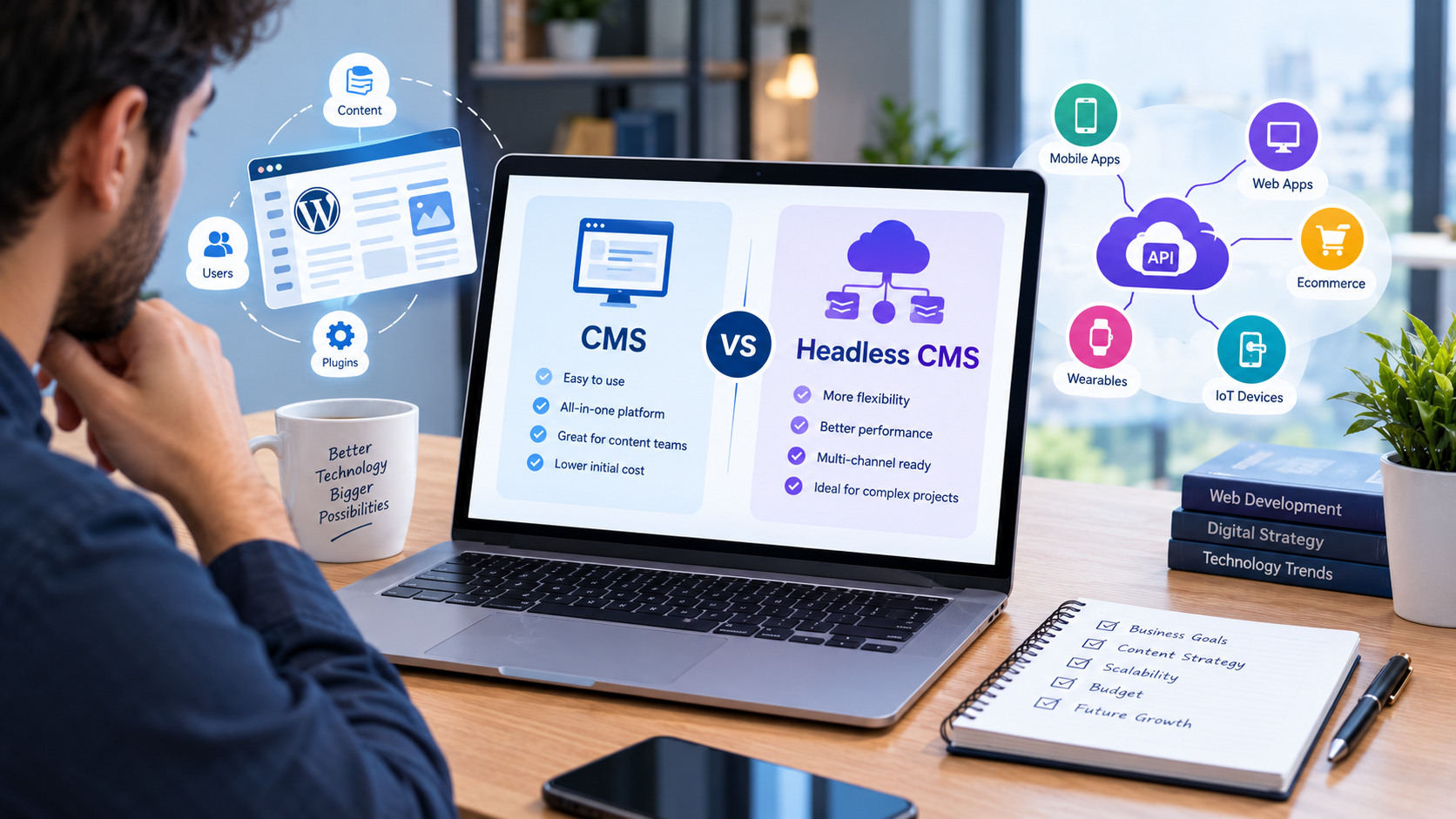
Start with channels. If your content lives only on a website, a traditional CMS covers your needs well. If you plan to publish the same content to a website, a mobile app, digital signage, voice assistants, or partner platforms, a headless CMS is built for that purpose. Write down every place your content might appear in the next three years, even if some are uncertain. Future channels are one of the strongest arguments in any Headless CMS vs CMS Comparison.
Question Two: Who Will Build and Maintain It?
Look honestly at your team. Do you have front-end developers who know React, Vue, Next.js, or Nuxt.js? Do you have someone who can manage deployment and APIs? If not, a traditional CMS or an agency partnership is more realistic. Headless projects succeed when technical skills exist, either in house or through a partner. Choosing a platform your team cannot maintain leads to stalled updates and growing frustration.
Question Three: How Important Is Performance?
If your business depends on search visibility and conversions, speed matters. Both models can be fast, but headless gives more control and a higher ceiling. If your audience is local and your traffic modest, a well-optimized traditional site is usually fast enough. Test your current site with PageSpeed Insights and note where it fails. If problems come from deep platform limits rather than fixable issues, headless deserves serious attention.
Question Four: What Are Your Budget and Timeline?
Traditional platforms offer faster launches and lower initial costs. Headless platforms need more planning and development time. If you must launch within weeks on a modest budget, traditional is the practical choice. If you can invest more and view the website as a long-term product, headless may deliver better value. Consider total cost across several years, not just the first invoice, as these CMS vs Headless CMS Differences affect every budget conversation.
Question Five: How Much Will Your Content Grow?
A small site with a few dozen pages is easy to manage anywhere. A large catalog, multiple brands, or many languages benefits from structured content and reuse. If you expect content volume to grow quickly or to be shared across projects, structured models in a headless CMS prevent duplication and inconsistency. If your content will stay compact, simplicity should win.
Matching Priorities to Platforms
Use these shortcuts when time is limited:
- Need to launch fast with low cost: traditional CMS.
- Need non-technical editing with visual control: traditional CMS.
- Need multi-channel publishing: headless CMS.
- Need maximum performance and design freedom: headless CMS.
- Need familiar editing plus a modern front end: hybrid or decoupled setup.
Mistakes to Avoid
Avoid choosing a platform because it is popular or because a competitor uses it. Do not ignore editor feedback, since a system that editors dislike will not be used well. Do not underestimate planning for SEO, redirects, previews, and integrations. Finally, avoid assuming that Headless CMS vs Traditional CMS for Websites is a permanent decision. Platforms can evolve, and phased adoption often reduces risk.
Working With Xcentric Services
Xcentric Services is a Lahore-based web development and digital marketing agency that supports businesses through every stage of this decision. We run discovery sessions, review your content and goals, build proof-of-concept prototypes, and deliver complete websites on both traditional and headless stacks. Our SEO team ensures your new platform supports visibility from day one.
Popular Platforms to Consider
Knowing the market helps you shortlist. Traditional and hybrid options include WordPress, Drupal, Joomla, Wix, Squarespace, and Adobe Experience Manager. Headless options include Contentful, Strapi, Sanity, Storyblok, Directus, and Hygraph. Shopify and BigCommerce also offer headless commerce capabilities for online stores. Rather than copying a competitor, pick two or three platforms that match your answers to the five questions above and test each with a small prototype using your real content.
A Simple Scoring Method
Turn the framework into numbers to guide your meeting. List your top seven criteria, such as speed, editing ease, cost, channels, security, growth, and team skills. Give each a weight from one to five, then score each platform from one to five against every criterion. Multiply and add the results. The totals will not make the decision for you, but they reveal trade-offs clearly and keep discussions focused on evidence instead of personal preference.
Real Scenarios and Recommended Paths
Imagine a local restaurant group with five branches: a traditional CMS with location pages and online ordering plugins fits well. Picture a fintech startup with a website, app, and help center: headless gives it a single content source and fast pages. Think of a university with dozens of departments: a traditional or hybrid system with strong role controls often works best. Examples like these show that context matters more than trends, and your own scenario will have its own best fit.
What Happens After You Decide
Once the decision is made, create a roadmap. Define the scope, assign owners, and set milestones for design, development, content migration, testing, and launch. Build a content model or theme plan early, and schedule training sessions for editors. Plan SEO tasks alongside development, including redirects, metadata, and analytics. Review results after launch, gather feedback, and improve continuously. A clear roadmap turns a technology choice into real business results.
Final Thoughts
The right CMS is the one that fits your channels, team, budget, and growth plans. Answer the five questions honestly, compare the results with your priorities, and choose the architecture that supports your business rather than the one that simply sounds modern. Xcentric Services is ready to guide you from decision to final launch.
Frequently Asked Questions
How do I know if I need a headless CMS?
You likely need one if you publish to multiple channels, require top performance, have front-end developers, or want complete control over design and user experience.
Is a traditional CMS outdated?
No. Traditional platforms like WordPress remain reliable, secure when maintained, and ideal for many websites. They are simply built for different needs.
What is a hybrid CMS?
A hybrid CMS combines a familiar editing interface with API delivery, so teams can use built-in templates for some pages and a custom front end for others.
Can I try a headless CMS before committing?
Yes. Many platforms offer free tiers or trials, and a small proof of concept with real content is a smart way to test the approach.
Which CMS should I choose for long-term growth?
Choose the one that fits your channels and team today but does not block future expansion. For many growing businesses, that means starting simple and planning a clear path to headless.
How long should the decision process take?
For most businesses, two to four weeks is enough to gather requirements, review options, and test a prototype. Large organizations may need longer for approvals.