


Businesses need accurate information to manage operations and respond to unexpected problems. A small production delay, equipment failure, or supply shortage can affect an entire operation.
Digital twin technology gives businesses a practical way to understand these situations. It creates a virtual representation of a physical object, system, or process. This virtual model uses real-world data to reflect the condition and performance of its physical counterpart.
For example, a manufacturing company can create a digital version of its production equipment. Managers can monitor machine performance, identify unusual behaviour, and test possible changes before applying them.
Digital twins are now finding applications across manufacturing, construction, healthcare, logistics, and other industries. They help teams understand operational conditions without relying entirely on physical inspections or assumptions.
This article explains how digital twin technology works, where businesses use it, and what companies should consider before adopting it.
What Is Digital Twin Technology?
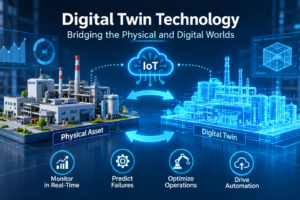
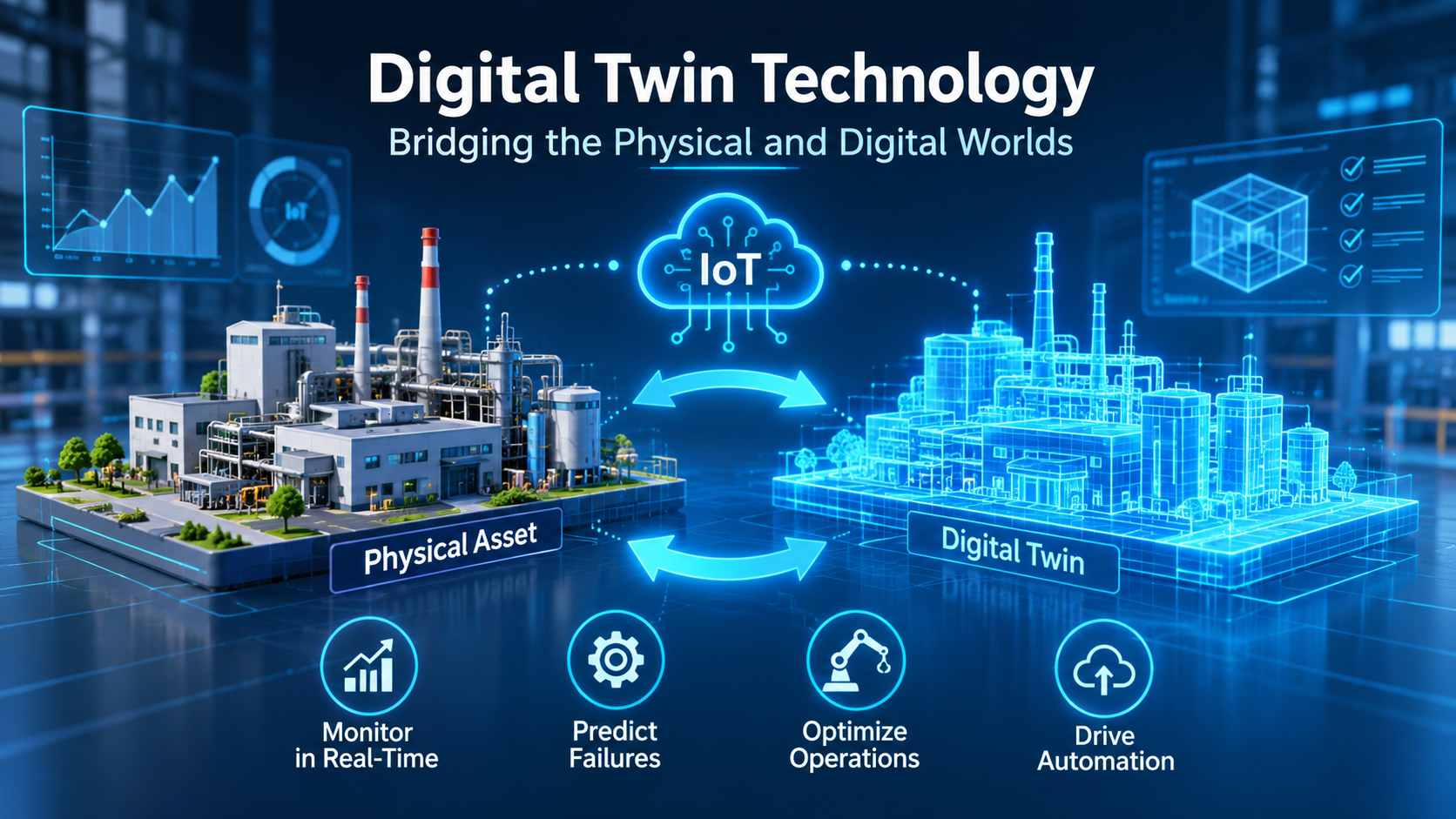
A digital twin is a virtual representation of a physical asset, process, or system. It receives information from its real-world counterpart through connected technologies such as sensors, Internet of Things (IoT) devices, and industrial software.
The digital model uses this information to represent the physical system’s current condition. Depending on its design, it can also help users simulate different situations and estimate possible outcomes.
Consider a factory that operates several industrial machines. Each machine produces information about temperature, vibration, energy consumption, and operating speed.
A digital twin can collect this information and display it through a connected platform. Engineers can monitor equipment conditions and investigate unusual readings.
The technology does more than display a static 3D model. Its value comes from connecting the virtual representation with information from the physical system.
How Do Digital Twins Work?
Digital twins combine physical equipment, connected devices, software, and data processing. These components work together to keep the virtual model aligned with the real-world system.
Here is how the process generally works.
1. Data Collection From Physical Assets
The process begins with collecting information from the physical object or system.
Sensors and connected devices can measure different operating conditions, including:
- Temperature and pressure
- Machine vibration
- Equipment speed
- Energy consumption
- Location and movement
- Production output
The type of information depends on the asset being monitored.
For example, a construction company may collect information about building materials, structural conditions, equipment usage, and site progress.
2. Data Transmission Through Connected Systems
Collected information needs to reach the digital platform. IoT devices, industrial networks, gateways, and cloud systems can transfer this data.
Some systems process information locally through edge computing. Others send it to cloud platforms for storage and analysis.
Reliable data transmission is important. Delayed or incomplete information can make the digital model less useful.
3. Creating the Virtual Model
The collected information supports the creation of a digital representation.
Depending on the project, this model may include a 3D structure, equipment specifications, operating conditions, or connected process information.
A digital twin of a building, for instance, may represent its layout, electrical systems, ventilation equipment, and maintenance requirements.
The model becomes more useful when it reflects actual operating conditions.
4. Analysis and Simulation
Businesses can use analytics and simulation tools to understand how a system behaves.
Engineers may test different operating conditions and examine their possible effects. They can also compare expected performance with actual results.
For example, a production manager may test whether changing machine operating speeds could increase output without exceeding equipment limits.
Simulation results support planning, but they do not guarantee that real-world outcomes will match every prediction.
5. Monitoring and Continuous Updates
A digital twin can receive updated information throughout its operating life.
This allows the model to reflect changes in the physical system. Teams can monitor performance, investigate problems, and review maintenance requirements using current information.
The quality of the digital twin depends on accurate data, suitable software, and regular system maintenance.
Digital Twin vs Traditional Simulation
Digital twins and traditional simulations both help businesses understand how systems may behave. However, they serve different purposes.
| Comparison | Digital Twin | Traditional Simulation |
|---|---|---|
| Main purpose | Represents a physical asset or system | Models a particular scenario |
| Data source | Can use live operational data | Often uses predefined inputs |
| Updates | Can update continuously | Usually requires new inputs |
| Monitoring | Supports ongoing monitoring | Mainly supports planned analysis |
| Application | Asset and process management | Testing and scenario planning |
| Connection | Linked to a real-world counterpart | May operate independently |
A traditional simulation can help engineers test a design before production. A digital twin can continue monitoring the physical asset after deployment.
Businesses may use both technologies within the same project.
Major Applications of Digital Twins Across Industries
Digital twin technology has practical uses in several industries. Its value depends on the type of operation, available data, and business objectives.
1. Manufacturing and Industrial Operations
Manufacturing is one of the most established areas for digital twin applications.
Factories use machines, production lines, sensors, and automated systems. A problem with one machine can affect the output of an entire production process.
Digital twins help manufacturers monitor equipment and understand how production systems perform.
Common applications include:
- Monitoring machine operating conditions
- Identifying unusual equipment behaviour
- Testing production line changes
- Reviewing energy consumption
- Planning equipment maintenance
- Studying production bottlenecks
For example, a manufacturer can create a digital twin of a production line. Engineers can examine how changes in machine speed affect output and identify possible bottlenecks.
This gives teams more information before they modify physical equipment.
2. Construction and Building Management
Construction projects involve several connected activities. Architects, engineers, contractors, and property managers need accurate information throughout a building’s lifecycle.
Digital twins can combine building models with information from sensors and connected systems.
A building digital twin may include:
- Structural information
- Electrical and plumbing systems
- Heating and ventilation equipment
- Energy consumption
- Equipment maintenance records
- Building occupancy information
Facility managers can use this information to monitor building conditions and plan maintenance.
For construction teams, digital twin technology can complement Building Information Modelling (BIM). BIM supports the creation and management of building information, while a digital twin can connect that model with operational data after construction.
Companies exploring digital tools for construction can also review renovation software for builders and contractors. Such tools support project planning and coordination, although they do not automatically provide full digital twin functionality.
3. Healthcare and Medical Equipment
Healthcare organisations manage complex facilities, medical equipment, and patient care processes.
Digital twins can help hospitals monitor equipment, understand facility operations, and support engineering research.
For example, a hospital may create a digital representation of its ventilation system. Facility teams can monitor airflow, equipment conditions, and energy usage.
Digital twin research also includes models of human organs and physiological systems. These models may help researchers study how biological systems respond to different conditions.
However, medical applications require careful validation. A digital model should not replace clinical judgement or be treated as a guaranteed prediction of an individual patient’s condition.
Healthcare providers can explore connected technologies alongside other developments in AI in healthcare and its impact on patient care.
4. Logistics and Supply Chain Management
Supply chains depend on the movement of goods, inventory availability, transport networks, and supplier coordination.
A digital twin can represent parts of this network and help businesses understand how operational changes may affect deliveries.
For example, a logistics company can model a warehouse and its distribution process. Managers can examine inventory movement, storage capacity, and delivery schedules.
Potential applications include:
- Warehouse layout planning
- Inventory monitoring
- Transport route analysis
- Shipment tracking
- Supply disruption planning
- Demand and capacity analysis
A company may use a digital twin to examine what happens when a supplier delays a shipment. Managers can compare alternative routes or review available inventory before making operational decisions.
Technology already plays an important role in supply chain coordination. Read more about how technology supports a more efficient supply chain.
5. Energy and Utilities
Energy companies manage power generation, distribution networks, equipment, and maintenance schedules.
Digital twins can represent turbines, electrical systems, pipelines, and other infrastructure.
Operators can use connected information to monitor performance and investigate unusual operating conditions.
For example, a power generation company may create a digital twin of a turbine. The model can receive information about temperature, vibration, and operating speed.
Engineers can use these readings to assess equipment conditions and plan inspections.
Digital twins can also support energy efficiency projects. Businesses can examine consumption patterns and test possible operational improvements.
6. Automotive and Transportation
Vehicle manufacturers use digital models throughout product design and development.
Digital twin technology can extend this work by connecting a vehicle or component model with real-world operating information.
Possible applications include:
- Vehicle component testing
- Manufacturing process monitoring
- Fleet performance analysis
- Maintenance planning
- Battery performance monitoring
- Design improvement
For fleet operators, connected vehicle data can help identify maintenance requirements and monitor vehicle performance.
Automotive manufacturers can also use digital models to evaluate components under different conditions before making physical design changes.
Key Benefits of Digital Twin Technology for Businesses
Digital twins can support better operational decisions when businesses have reliable data and clearly defined objectives.
Better Visibility Into Operations
Managers often work with information spread across different systems. A digital twin can bring relevant asset and process information into a connected view.
This makes it easier to understand operating conditions and identify areas that need attention.
Reduced Equipment Downtime
Unexpected equipment failures can interrupt production and increase maintenance costs.
Digital twins can help teams monitor operating conditions and identify unusual patterns. These findings may support predictive maintenance planning.
However, the technology cannot prevent every failure. Its effectiveness depends on sensor quality, data coverage, and the accuracy of analytical models.
Improved Product and Process Testing
Physical testing can require time, materials, and specialised equipment.
Digital models allow teams to examine selected scenarios before making physical changes.
For example, an engineering team can test different component designs using simulation software. This helps narrow down options before moving to physical prototypes.
More Informed Business Decisions
Digital twins provide information about how assets and systems operate.
Managers can use this information to compare performance, review possible changes, and plan future activities.
The technology supports decision-making rather than replacing the experience and judgement of employees.
Better Resource Management
Businesses need to manage energy, equipment, materials, and labour carefully.
A digital twin can help identify inefficient operating conditions and areas where resources may be underused.
For example, a facility manager may review energy consumption across different areas of a building. The findings can help the team investigate unnecessary energy use.
Technologies That Support Digital Twins
Digital twin technology depends on several connected technologies. Each component has a specific role in collecting, processing, and presenting information.
Internet of Things (IoT)
IoT sensors and connected devices collect information from physical assets.
They can measure temperature, pressure, vibration, movement, and other operating conditions.
Without reliable data collection, a digital twin cannot accurately represent its physical counterpart.
Artificial Intelligence and Machine Learning
AI and machine learning tools can analyse large datasets and identify patterns.
Businesses may use these technologies to detect unusual equipment behaviour, estimate maintenance requirements, or study operational trends.
The digital twin provides the connected representation, while AI can support analysis and predictions.
Cloud Computing
Cloud platforms provide computing resources and storage for digital twin applications.
They can help organisations manage information from multiple locations and allow authorised teams to access shared models.
Cloud infrastructure may also support collaboration between engineering, operations, and management teams.
Edge Computing
Some digital twin applications need information to be processed close to the physical equipment.
Edge computing allows devices or local systems to process selected data without sending everything to a remote server.
This can be useful in manufacturing facilities where certain monitoring tasks require quick responses.
3D Modelling and Simulation
3D modelling helps represent the physical structure of an asset or environment.
Simulation software allows engineers to examine selected conditions and study how a system may respond.
Not every digital twin needs a detailed 3D model. Some focus mainly on operational data and system behaviour.
Challenges Businesses Should Consider Before Implementation
Digital twin technology can support complex operations, but implementation requires planning.
Businesses should understand the technical and operational requirements before investing.
High Initial Investment
Creating a digital twin may require sensors, connected devices, software licences, data infrastructure, and specialist expertise.
The cost depends on the size and complexity of the project.
A small equipment monitoring project may need fewer resources than a digital twin covering an entire manufacturing facility.
Businesses should begin with a clearly defined operational problem instead of investing in a large system without a measurable objective.
Data Quality and Integration
Digital twins depend on accurate and consistent information.
Many organisations use older equipment and software that may not communicate easily with newer platforms.
Data gaps, incompatible formats, and incorrect readings can reduce the usefulness of the model.
Companies should review their existing systems and plan how information will move between them.
Cybersecurity and Data Privacy
Connected equipment and digital platforms create additional security requirements.
Unauthorised access could expose sensitive operational information or affect connected systems.
Businesses should apply suitable access controls, encryption, network security, and regular software updates.
They should also define who can view, change, and manage digital twin data.
Shortage of Skilled Professionals
Digital twin projects may require engineers, software developers, data analysts, and IoT specialists.
Businesses may struggle to find employees with experience across all these areas.
Training existing teams and working with experienced technology providers can help address this challenge.
Integration With Existing Operations
A digital twin must fit into the company’s existing workflows.
If employees cannot access or understand its information, the technology may deliver limited value.
Companies should involve operational teams during planning and testing. This helps ensure the system addresses real workplace requirements.
Businesses adopting new technology should also understand common AI implementation mistakes that can cost businesses money. Clear objectives, suitable infrastructure, and employee training matter when introducing connected systems.
How Businesses Can Start Using Digital Twin Technology
A company does not need to create a digital twin of its entire operation immediately.
A smaller project can help teams understand the technology and evaluate its business value.
Step 1: Identify a Specific Business Problem
Start by identifying an operational issue that requires better monitoring or analysis.
Examples include frequent machine failures, high energy consumption, production delays, or inefficient warehouse operations.
Choose a problem where improved information could support better decisions.
Step 2: Select the Right Asset or Process
Choose a physical asset or process that can be monitored using available data.
A single production machine, warehouse section, or building system can be a suitable starting point.
Keep the initial scope manageable.
Step 3: Review Existing Data Sources
Check which sensors, software platforms, and operational records are already available.
Determine whether the information is accurate, accessible, and suitable for the intended digital model.
Identify any additional sensors or integration work required.
Step 4: Choose Suitable Digital Twin Software
Compare platforms based on the project’s technical requirements.
Important considerations include:
- Compatibility with existing equipment
- Data collection and integration options
- Simulation capabilities
- Security controls
- Reporting and visualisation
- Scalability and support
The most expensive platform is not always the best choice. Businesses should select software that meets their actual operational needs.
Step 5: Build and Test the Initial Model
Create the digital representation and connect it with the required data sources.
Test whether the model reflects actual operating conditions. Compare its readings with physical measurements and correct any inconsistencies.
Step 6: Measure the Results
Define clear performance indicators before evaluating the project.
Depending on the application, these may include equipment downtime, energy consumption, maintenance costs, production output, or response time.
Compare the results with the original business problem.
Step 7: Expand Only When the Project Delivers Value
Once the initial model works reliably, consider expanding it to additional assets or processes.
Use feedback from employees and managers to improve the system.
A gradual approach helps businesses manage costs and reduce implementation risks.
The Future of Digital Twin Technology
Digital twin technology is expected to develop alongside improvements in IoT, AI, cloud infrastructure, and simulation software.
These developments may make connected models more accessible to businesses beyond large industrial organisations.
Several areas are worth watching.
Greater Use of AI-Based Analysis
AI can help digital twin platforms process large volumes of operational information.
Businesses may use these capabilities to identify patterns, detect unusual behaviour, and examine possible changes more efficiently.
The quality of these results will still depend on reliable data and suitable validation.
More Connected Business Operations
Digital twins may increasingly connect equipment, facilities, supply chains, and business software.
This could help organisations understand how changes in one area affect other parts of an operation.
For example, a manufacturer may examine how a production delay affects inventory levels and delivery schedules.
Wider Adoption in Smart Buildings
Building owners and facility managers can use digital twins to monitor connected systems.
As building automation and sensor technology become more common, digital models may support maintenance planning and energy management.
More Accessible Tools for Smaller Businesses
Digital twin projects have traditionally required specialist expertise and significant investment.
Cloud services and modular software may make selected applications easier to adopt.
Small businesses may begin with focused projects involving equipment monitoring, energy management, or facility operations.
Wider adoption will depend on affordability, integration options, and the availability of suitable technical support.
Frequently Asked Questions About Digital Twin Technology
1. What is a digital twin in simple terms?
A digital twin is a virtual representation of a physical object, process, or system. It uses real-world data to reflect the condition and performance of its physical counterpart.
2. How does digital twin technology work?
Digital twin technology collects information through sensors, IoT devices, and connected systems. Software uses this information to update a virtual model, monitor performance, and support analysis or simulation.
3. What industries use digital twins?
Manufacturing, construction, healthcare, automotive, logistics, energy, and utilities use digital twin technology. Its applications depend on the industry’s operational needs and available data.
4. What is the difference between a digital twin and a 3D model?
A 3D model represents the shape or structure of an object. A digital twin can connect a virtual representation with real-world data and ongoing operational information.
5. Do small businesses need digital twins?
Not every small business needs a digital twin. However, companies managing expensive equipment, complex facilities, or connected operations may benefit from selected applications.
6. Can digital twins use artificial intelligence?
Yes. AI and machine learning can analyse information collected by digital twin systems. They may help identify unusual patterns, estimate maintenance needs, and support operational planning.
7. Are digital twins expensive to implement?
Implementation costs vary according to the project’s size, equipment, software, and data requirements. Businesses can begin with a smaller project before expanding to more complex systems.
8. Are digital twins the same as the metaverse?
No. Digital twins represent real-world assets or systems using connected data. The metaverse generally refers to shared virtual environments. The two concepts may overlap in certain applications, but they serve different purposes.
Conclusion
Digital twin technology gives businesses a practical way to understand physical assets and operational processes through connected virtual models.
Companies can use it to monitor equipment, test selected scenarios, improve maintenance planning, and review resource usage. Its applications extend across manufacturing, construction, healthcare, logistics, and energy.
However, successful implementation requires reliable data, suitable software, cybersecurity controls, and trained employees.
Businesses should begin with a specific operational problem and measure the results before expanding the project.
As connected devices and analytical tools continue to develop, digital twins may become an increasingly useful part of business operations. The strongest results will come from using the technology to solve real problems rather than adopting it simply because it is new.
TechSolution Help | Your Tech Partner for Growth.