


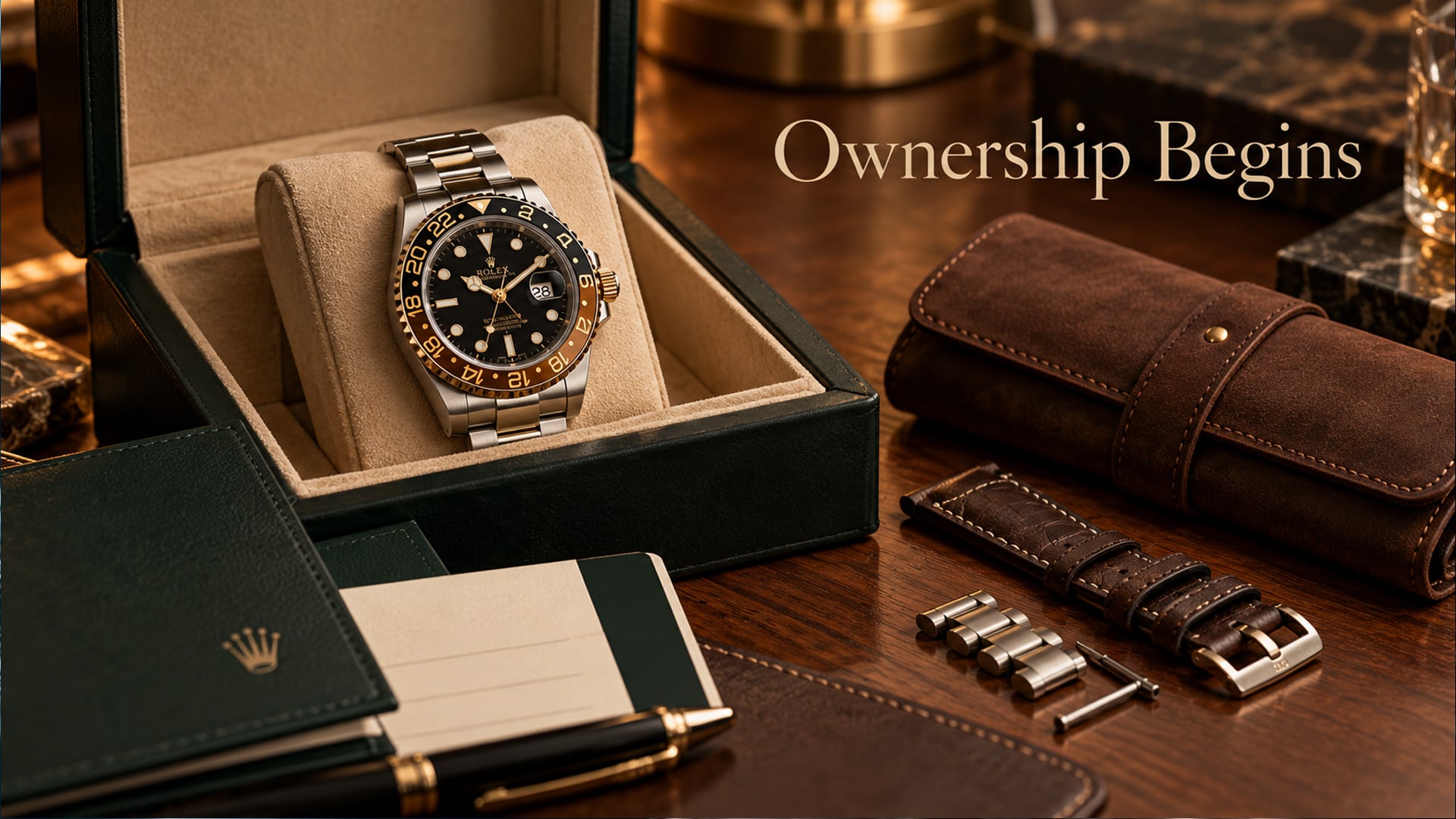
The moment a luxury watch arrives is easy to romanticize.
You open the box, remove the protective material, adjust the bracelet and finally see the watch you have been researching for weeks—or perhaps years—on your own wrist.
Then ordinary ownership begins.
The watch needs to fit correctly. It may eventually need servicing. Straps wear out. Water resistance needs to be treated as a current condition rather than a permanent promise. Insurance may become worth considering. And one day, even a watch you love today may become the watch you sell or trade for something else.
That does not make luxury-watch ownership unattractive.
It makes it more interesting than the purchase price alone suggests.
The Purchase Price Is the Entry Point, Not the Entire Cost
A buyer can spend so much time negotiating the purchase that everything afterwards becomes an afterthought.
This is especially common in the pre-owned market.
The better question is:
What will this specific watch require from me once I own it?
Different watches create very different ownership experiences.
A manually wound dress watch, automatic dive watch, flyback chronograph and perpetual calendar should not be viewed through the same maintenance expectations.
Start With Fit
A luxury watch that does not fit properly becomes surprisingly difficult to enjoy.
Before focusing on mechanical complexity or resale, establish whether the watch is physically right for you.
That means considering:
- case diameter;
- thickness;
- lug-to-lug presence;
- weight;
- bracelet flexibility;
- strap sizing;
- clasp adjustment.
A 40 mm square watch can wear differently from a 40 mm round one.
An integrated bracelet can make a watch feel larger than the case measurement suggests.
A heavy gold sports watch may look fantastic but be less comfortable for a person who spends all day typing.
Bracelet Links Are Part of Ownership
Pre-owned buyers should confirm that a bracelet actually fits.
Missing links are not an abstract detail.
They can become something you need to source immediately.
Extra links also matter if the watch may later go to another owner with a larger wrist.
Straps Are Consumable
Leather, rubber and composite straps wear.
That is normal.
A beautiful pre-owned watch on a tired strap may still be a good buy, but factor replacement into the real cost.
Also check whether the buckle or clasp is correct and whether unusual strap dimensions make replacements more difficult to source.
Mechanical Watches Need Maintenance
A mechanical movement contains components that operate continuously while the watch runs.
Lubricants age. Seals deteriorate. Parts eventually wear.
That does not mean every watch needs immediate service.
It means servicing belongs in the ownership conversation.
Manufacturer guidance varies by brand and movement, so a universal interval should not be applied to everything from a Rolex automatic to a minute repeater.
Complications Change the Maintenance Picture
A three-hand watch has one level of mechanical complexity.
Add a chronograph and more systems enter the equation.
Add an annual calendar, perpetual calendar, split-seconds chronograph or tourbillon and the service proposition becomes different again.
This is one reason buyers should understand what a complication actually does before buying it simply because it sounds impressive.
Service History Can Make the First Years Easier to Understand
A documented recent service can help explain the maintenance position of a pre-owned watch.
Ask:
- who performed the work;
- when it happened;
- what was replaced;
- whether the case was refinished;
- whether testing was performed.
No paperwork does not mean the watch has never been maintained.
It simply means the buyer has less evidence.
Water Resistance Is Not a Lifetime Guarantee
This is one ownership point that deserves particular care.
A watch may have been rated to a specific depth when new.
That original specification does not prove an older pre-owned example is currently ready for swimming.
Seals age and cases are opened for service.
If water use matters, current testing and condition matter.
Cosmetic Wear Is Part of Wearing the Watch
Luxury watches scratch.
Steel scratches.
Gold scratches.
Clasps collect desk marks.
Polished bezels show hairlines.
A buyer who expects a daily-worn watch to remain permanently flawless can turn ownership into anxiety.
Decide what level of normal wear you are comfortable with before buying.
Polishing Is a Choice, Not an Obligation
Not every scratch needs to disappear.
Some owners prefer periodic professional refinishing.
Others value preservation of original case geometry and avoid cosmetic work unless necessary.
Neither position has to be ideological.
The right approach depends on the reference, extent of wear and your own priorities.
Storage Matters
A watch does not need an elaborate vault to be treated responsibly, but high-value collections benefit from practical thinking.
Consider:
- secure storage;
- protection from unnecessary impact;
- humidity and environmental conditions;
- keeping accessories and documents together;
- maintaining a record of reference and serial information.
Insurance May Become Part of the Conversation
As watch values rise, some owners choose to investigate specialized insurance or appropriate scheduled coverage.
The correct solution depends on location, insurer, valuation requirements and how the watch is used.
The important point is not to assume an ordinary policy automatically provides the coverage you expect for a high-value watch.
Keep Your Documentation Organized
Even if you never intend to sell, keep:
- original warranty documents;
- purchase documentation;
- service invoices;
- spare links;
- accessories;
- manufacturer correspondence where relevant.
These records make ownership easier and may make a later transfer easier to explain.
The Watch You Love Today May Not Be the Watch You Want Forever
Collectors change.
A person starts with a dive watch and discovers dress watches.
A Rolex buyer moves toward Patek Philippe.
Someone who once loved 44 mm sports watches begins wearing 38 mm cases.
A collector interested in brand recognition becomes fascinated by movement finishing.
This evolution is normal.
It is one of the pleasures of collecting.
Think About the Exit Without Turning the Watch Into an Investment
It is reasonable to understand resale without pretending every watch is a guaranteed financial asset.
Questions worth considering include:
- How broad is the future buyer pool?
- Is the watch heavily personalized?
- Are original components retained?
- Will missing accessories matter?
- Is the reference relatively easy or difficult to trade?
None of this predicts a future price.
It simply helps you understand the ownership path.
Customization Can Change That Path
Aftermarket modifications can make a watch more personal.
They can also make it less interesting to buyers seeking factory configuration.
That does not mean customization is wrong.
It means the decision should be intentional.
If original components are removed, retaining them can sometimes preserve future flexibility.
Service Before Selling Is Not Automatically Necessary
Owners occasionally spend money preparing a watch for sale without first understanding what the next buyer values.
They may polish a watch whose original condition was desirable.
They may service a watch immediately before selling even when a professional buyer would rather evaluate it in its current state.
An evaluation before unnecessary work can prevent spending money that does not improve the transaction.
Trade-In Can Simplify the Ownership Cycle
When the goal is another watch rather than cash alone, trade can be practical.
Instead of managing a private sale and separate purchase, the owner evaluates one net question:
What is the difference between the watch I own and the watch I want?
For owners who reach that point, Platinum Times Company USA’s Sell/Trade process accepts details such as brand, model, reference, condition, papers, box, proof of purchase and images, allowing the individual watch to be considered rather than relying on a generic brand estimate.
Why the Ownership Cycle Matters Before You Buy
Thinking beyond checkout helps buyers make better decisions.
You may discover that you genuinely do not want the responsibility of a particularly complicated watch.
You may realize that a rubber-strap sports reference is better for your lifestyle than the integrated-bracelet icon you originally planned to buy.
Or you may decide that the extra mechanical complexity is exactly what makes the watch worth owning.
There is no correct answer.
The point is to choose intentionally.
Luxury Watch Ownership Should Still Be Enjoyable
None of these considerations should make owning a watch feel like managing industrial equipment.
The reason people buy mechanical watches is emotional as much as practical.
Design matters.
History matters.
Craft matters.
The feeling of looking at the wrist and still enjoying the watch years later matters.
Good ownership knowledge simply removes avoidable surprises around that experience.
Frequently Asked Questions
What costs come after buying a luxury watch?
Potential costs can include servicing, straps, bracelet links, repairs, insurance and other reference-specific maintenance. They vary widely by watch.
Does every pre-owned watch need servicing immediately?
No. Current condition, known service history and manufacturer guidance should inform the decision.
Can I swim with an older luxury watch if it was originally water resistant?
Original specifications do not prove current water resistance. Current condition and appropriate testing matter.
Should I polish a scratched watch?
Only if that is appropriate for the watch and your goals. Many collectors prefer to retain honest wear and original geometry.
Should I think about resale before buying?
It is reasonable to understand future transfer or trade options, but they should not replace buying a watch you genuinely want to own.
Final Thoughts
The purchase is the exciting part.
Ownership is where the relationship with the watch actually develops.
Choose a watch that fits your wrist, your lifestyle, your tolerance for maintenance and your idea of what makes mechanical watchmaking enjoyable.
Then the costs and responsibilities after checkout become part of ownership rather than unpleasant surprises.