




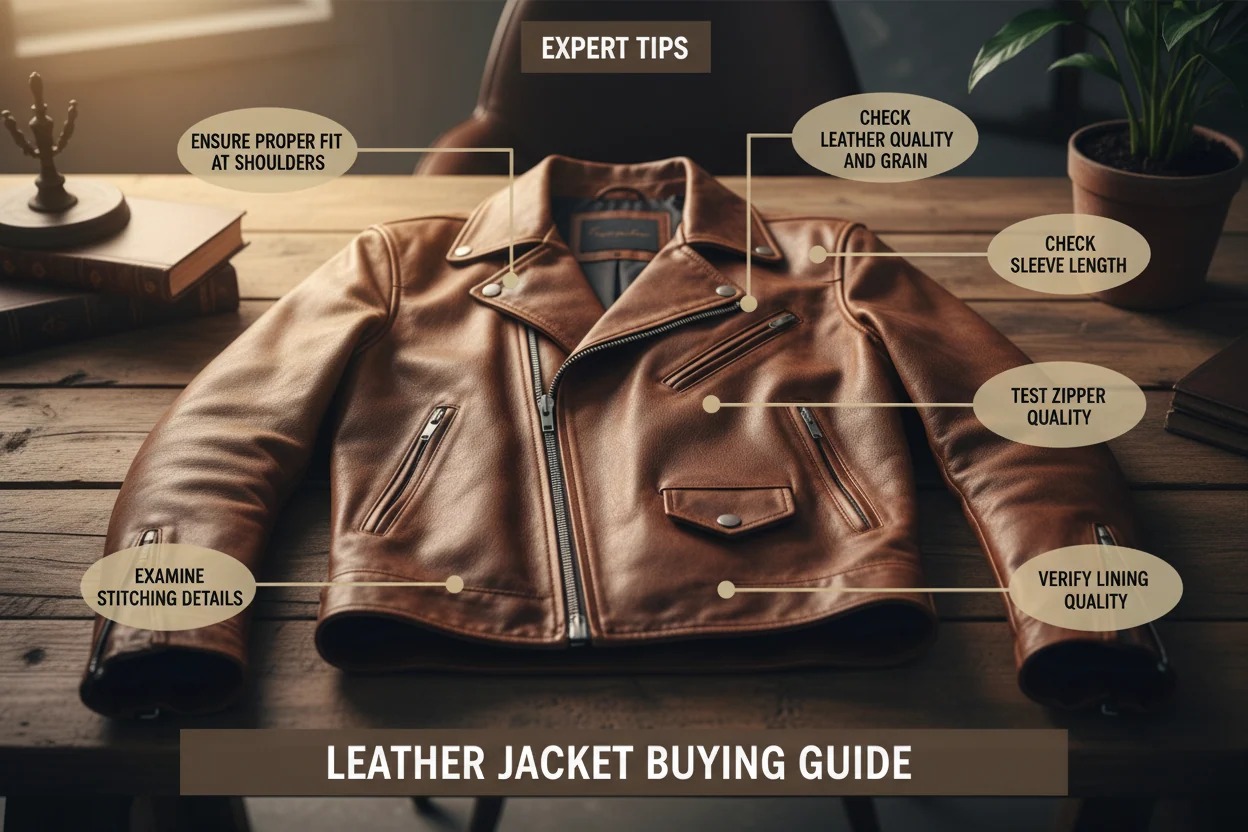
Two biker leather jackets can look almost identical in photos. One lasts fifteen years. The other starts peeling after two winters.
The difference is rarely visible at first glance. It sits in the leather itself, the stitching, the zips and the way the seller describes the product. This guide shows you what to check, whether you’re in a shop or scrolling through an online listing.
Start with the leather
Leather quality is the biggest factor in how long a jacket lasts.
Look at the surface. Real leather has small natural variations: tiny pores, slight differences in grain, a few faint marks. A surface that looks perfectly uniform, almost like plastic, often points to heavy coating or a synthetic material.
Feel it. Good leather feels warm and slightly flexible. When you press it, it wrinkles in fine lines. Synthetic material tends to feel cold and smooth, and it creases in sharper, more regular folds.
Smell it. Real leather has a natural, earthy smell. A strong chemical or plastic smell is a warning sign.
Check the edges. At a cut edge, such as inside a pocket or under the collar, real leather shows a fibrous texture. Faux leather often shows a fabric backing.
Read the description like a skeptic
Online, the words matter as much as the photos.
- Good signs: the exact leather type is named (cowhide, lambskin, goatskin), along with the grade where relevant, such as full-grain or top-grain.
- Vague signs: “premium leather,” “genuine leather” or “leather look” with nothing more.
- Red flags: “PU,” “vegan leather,” “bonded leather” or “leatherette” in a listing that is also using the word “leather” prominently in the title.
If the material isn’t clearly stated, message the seller and ask. A trustworthy store answers plainly.
Inspect the stitching
Stitching shows how much care went into the jacket.
- Lines should be straight and even, with no loose threads.
- Stress points, like the collar, armholes, pocket corners and cuffs, should have tight, sometimes doubled stitching.
- Seams should lie flat, without puckering or gaps.
In online photos, zoom into the collar and zipper areas. If the seller only shows wide shots and blurry close-ups, that’s worth noting.
Test the hardware
Zips, snaps and buckles take the most daily stress on a biker jacket.
- The main zip should run smoothly without catching.
- Zip teeth should feel solid, not thin or rough.
- Snaps should close with a firm click and stay shut.
- Metal parts should feel weighty rather than light and hollow.
- Pocket zips matter too, since you’ll use them constantly.
A well-known zip brand stamped on the pull is a good sign, though not a guarantee on its own.
Look inside the jacket
The lining is easy to overlook, but it affects comfort and lifespan.
- A smooth, well-attached lining is a good sign. Loose or bunched fabric is not.
- Check that the lining matches your climate: quilted for cold weather, thinner for mild.
- Look at the inside seams. Neat finishing inside usually means care outside too.
- Check that any inner pockets are properly stitched, not just glued or tacked.
Check the cut and shape
A well-made biker jacket keeps its shape when worn.
- Shoulders should sit cleanly without drooping or pinching.
- The asymmetrical zip line should run neatly, not wobble across the chest.
- Lapels should lie flat and snap down properly.
- Sleeves should have a slight curve at the elbow, so they bend naturally.
- The jacket should end at the waist without riding up when you lift your arms.
Poorly cut jackets often look fine on a hanger and awkward the moment you move.
Judge the price realistically
A very low price can be a clue, since real leather and careful construction cost money to produce. That doesn’t mean the most expensive jacket is the best, but an unusually cheap “genuine leather” jacket deserves extra questions.
Instead of focusing on the price alone, compare what you get: leather type, lining, hardware and return terms. Then work out the final cost including delivery.
Check the store, not just the jacket
For online purchases, the seller matters nearly as much as the product.
- Is there a clear return policy, with the number of days and who pays for shipping?
- Is there a size chart in centimeters?
- Are there real contact details, such as an email address or chat?
- Do product photos look original and consistent, rather than copied from elsewhere?
- Is the checkout page secure?
If several of these are missing, think twice before ordering.
A simple checklist before you buy
- Is the exact leather type named?
- Does the surface and edge look and feel like real leather?
- Is the stitching even, with reinforced stress points?
- Do the zips and snaps feel solid?
- Is the lining neat and suitable for your climate?
- Does the cut hold its shape when you move?
- Is the return policy clear?
If you can answer yes to most of these, you’re likely looking at a jacket that will last.
When to buy
Black Friday falls on November 27 this year, and many stores discount outerwear around it. Use the next two weeks to compare listings with this checklist, so you can recognise a good offer when it appears instead of rushing into a bad one.
The bottom line
A good biker leather jacket reveals itself through details: honest descriptions, real leather, clean stitching, solid hardware and a cut that moves with you. Check those before you pay, and your jacket should look better with every year of wear.