




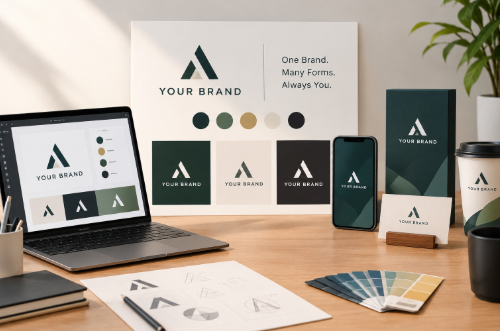
Your logo looks great on your website. But does it work as a tiny mobile icon, against a dark background, or on a promotional banner? If not, your brand may need more than a logo refresh.
Unlimited graphic design services can help you build an identity that adapts to different platforms while staying recognizable. The goal isn’t to change your brand constantly. It’s to make sure it works wherever customers see it. Confused? Let us explain.
Why Adaptive Branding Requires Graphic Design?
Your audience encounters your brand on websites, social media, emails, packaging, and advertisements. Each format has different requirements, so one fixed design won’t always work.
- Responsive Brand Design for Every Screen
A detailed logo might look impressive on your website but become unreadable on a mobile screen. Responsive brand design solves this with variations like:
- A full wordmark for websites
- A compact symbol for mobile
- A simplified favicon for browser tabs
Google’s mobile-first indexing guidance reinforces the importance of considering mobile experiences. Your brand’s visuals deserve the same attention.
- A Flexible Visual Identity That Stays Consistent
Adaptive branding doesn’t mean changing your colors every week. It means creating visual elements that work together in different combinations.
A graphic design subscription service in Santa Clara, or the Bay Area, can help you develop:
- Reusable layouts
- Icon sets
- Templates
For example, a retailer can keep typography and logo placement consistent across product launches while adjusting imagery for each collection.
- Dynamic Branding for Different Contexts
Seasonal campaigns, product launches, and dark-mode interfaces all present different design challenges.
For a local business, event graphic design in Santa Clara might include invitations, social media announcements, banners, and signage.
Phable’s guide to adaptive brand identity explores how brands can respond to different contexts while retaining recognizable elements. Moreover, Digital Silk’s 2026 digital trends report highlights that modern brand systems must use adaptive frameworks that shift seamlessly across light mode, dark mode, AR environments, and more without losing their core identity.
A Brand Design System Prevents Confusion
Without clear rules, flexibility can become inconsistent. One employee uses an outdated logo; another chooses an unrelated font, and a third creates a campaign that looks like it belongs to another business.
A practical brand design system should define:
- Approved logo variations and minimum sizes
- Brand colors and typography
- Image styles, spacing, and layouts
- Templates for common marketing materials
- Rules for adapting designs across platforms
These guidelines help employees and designers create connected materials.
Can a Graphic Design Subscription Help?
A brand refresh often involves more than a new logo. Your website graphics, presentations, advertisements, and social media templates may need updating, too.
An unlimited graphic design service in Santa Clara can provide ongoing creative support without a full in-house design team. For example, Copa Design’s subscription model offers recurring design requests, a dedicated creative team, and revision support. This approach can help businesses apply their updated identity across multiple assets.
Before choosing a provider, check turnaround times, revision policies, project limits, and source file availability. Unlimited requests don’t necessarily mean unlimited simultaneous projects or instant delivery.
How Do You Know If Your Brand Needs an Update?
Ask yourself:
- Does your logo remain clear at different sizes?
If the text becomes unreadable on mobile screens, you may need simplified logo variations. - Can your team create new materials without guessing which fonts and colors to use?
If every campaign looks different, your brand guidelines may need clearer rules. - Does your brand look consistent across digital and physical touchpoints? Your website, social posts, packaging, and event banners should feel connected.
If these issues sound familiar, you may not need a complete rebrand. An adaptive update can involve:
- Simplifying your logo for smaller screens
- Adjusting colors for dark backgrounds
- Creating reusable templates
- Updating typography
- Developing graphics for different campaigns
It can also include clearer guidelines about how these elements should be used.
The aim is to improve how your existing identity works across different settings, not replace everything your customers already recognize.
Your brand should be recognizable without being rigid. Before investing in a complete rebrand, identify which elements need updating and which should stay. A thoughtful adaptive update can help your brand work better across platforms while preserving its established identity.
FAQs
- How many versions of my logo do I actually need?
Most brands benefit from 4 core variations:
- A primary full-color logo
- A secondary stacked or horizontal layout
- A simplified icon or app mark
- A monochrome or reversed version for dark backgrounds
- What is the difference between a responsive logo and a static logo?
A responsive logo dynamically scales, rearranges, or drops secondary details depending on the available display space. A static logo remains identical everywhere, which often leads to illegibility or awkward scaling when forced into cramped digital spaces like mobile app icons or social media avatars.
- How do I ensure my adaptive logo looks sharp on high-resolution mobile screens?
If you work with graphic design partners, like Copa Design, they will make sure to always export your logo variations in vector formats like SVG for web use. Vectors scale infinitely without losing quality, ensuring crisp lines and clear text whether viewed on a high-end smartphone retina display or a standard desktop monitor.