





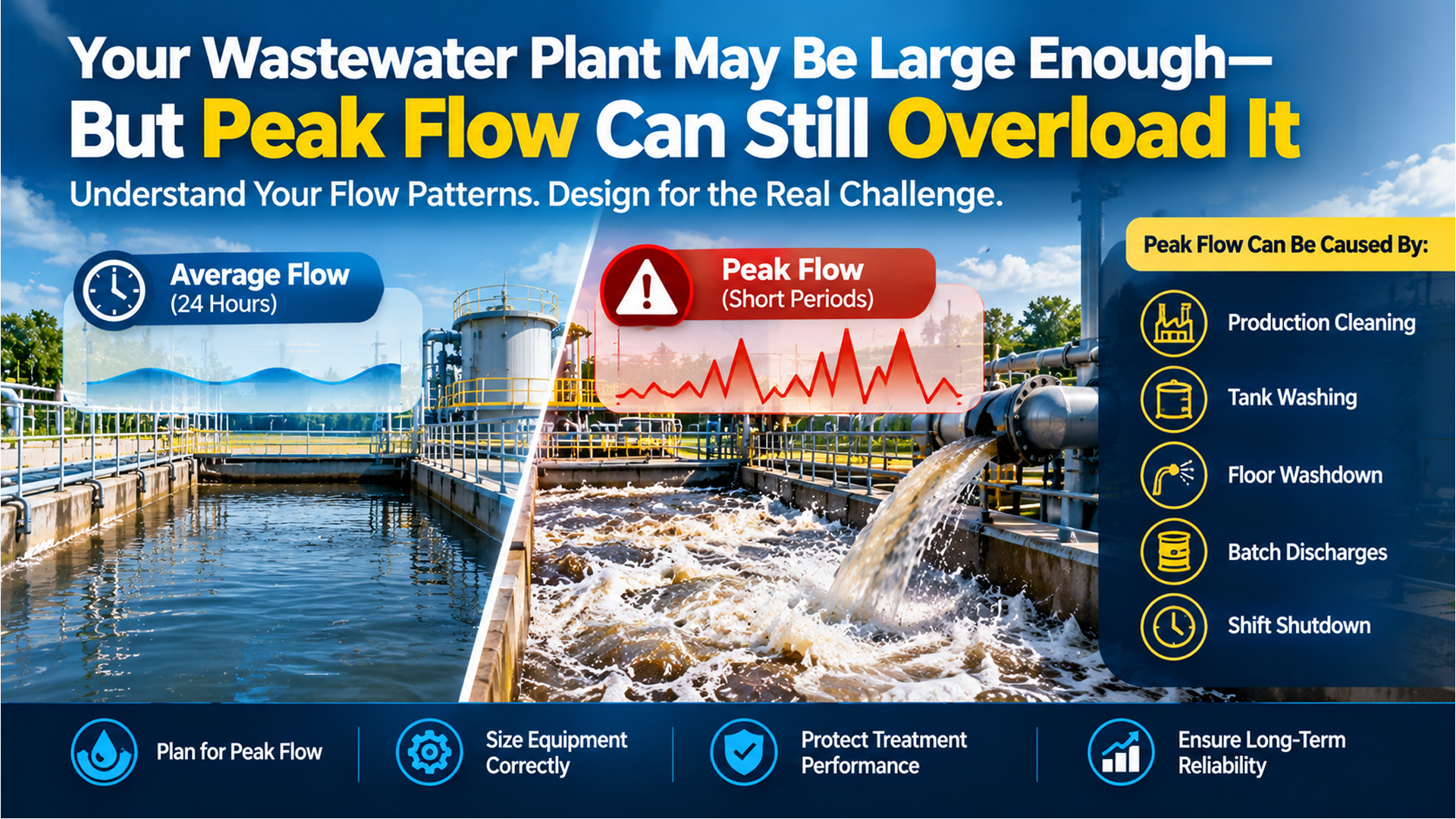
A plant sized for the correct daily volume can still struggle if wastewater arrives much faster during production, cleaning or batch-discharge periods.
Imagine two factories that each generate 100 cubic metres of wastewater every day.
The first releases it gradually over 24 hours.
The second generates most of its wastewater during an eight-hour production shift and sends a large cleaning discharge to the treatment plant near the end of the day.
Both facilities have the same daily wastewater volume. Operationally, however, they place very different demands on a treatment plant.
This is why peak wastewater flow deserves attention whenever an ETP, STP or industrial wastewater-treatment system is planned or expanded.
Daily Capacity Can Hide the Real Hydraulic Challenge
Treatment plants are commonly described using a daily capacity. It gives buyers and engineers a convenient indication of project scale.
But that figure does not show how quickly wastewater actually reaches the plant.
A practical capacity assessment also needs to consider:
- Average daily flow
- Peak hourly flow
- Batch discharges
- Production hours
- Cleaning schedules
- Wastewater strength
- Equalization
- Future expansion
What Creates Peak Wastewater Flow?
Industrial wastewater generation is rarely constant throughout the day.
Peak events commonly occur during:
- Production-line cleaning
- Tank washing
- Floor washdown
- Process-bath dumping
- Filter backwashing
- Product changeovers
- Shift shutdown
These events can create a large hydraulic load within a short period.
Peak Pollution Load Can Arrive at the Same Time
The problem may involve more than water volume.
A concentrated cleaning or process batch can also increase COD, BOD, suspended solids, pH variation, oil and grease or other contaminants.
This means the treatment plant may experience both a hydraulic shock and a pollution-load shock at the same time.
Equalization Helps Stabilize Downstream Treatment
Equalization can temporarily hold variable incoming wastewater and release it more consistently to downstream treatment.
This can help reduce sharp variations in hydraulic flow and wastewater strength.
For biological treatment, more consistent loading can make aeration and biomass control easier to manage.
For clarification, steadier flow can reduce sudden hydraulic loading.
Equalization does not increase the fundamental treatment capacity of an undersized plant, but it can make available capacity much easier to use effectively.
Clarifiers Can Become a Hidden Hydraulic Bottleneck
Clarifiers rely on controlled hydraulic conditions to separate solids from treated water.
If flow rises sharply, solids may have less opportunity to settle effectively and can carry over with the final effluent.
The operator may initially suspect a biological-treatment failure when the real issue is partly hydraulic.
Biological Treatment Has Both Hydraulic and Organic Limits
A biological treatment system can become overloaded in different ways.
Hydraulic overload occurs when too much water moves through the process too quickly.
Organic overload occurs when the amount of biodegradable pollution becomes too high for the available biological treatment capacity.
A plant can experience one condition, or both at the same time.
A Better Wastewater Project Brief Contains More Than Daily Flow
Instead of requesting a quotation using only “100 m³/day,” provide:
- Average daily wastewater volume
- Peak hourly flow where available
- Largest batch discharge
- Production schedule
- Cleaning schedule
- Recent wastewater analysis
- Required treated-water quality
- Reuse or discharge objective
- Expected future production
This gives the designer a much stronger basis for evaluating pumps, tanks, equalization and treatment processes.
Pollutant Load Matters as Much as Water Volume
Two factories can generate the same wastewater volume while producing completely different treatment loads.
Relevant parameters may include:
- BOD
- COD
- TSS
- Oil and grease
- pH
- Salinity
- Industry-specific contaminants
For this reason, a properly selected wastewater treatment system should be based on both hydraulic and wastewater-quality information.
Equalization Cannot Rescue a Fundamentally Undersized Plant
Equalization manages timing. It does not create extra biological, chemical or physical treatment capacity.
If average pollutant loading already exceeds the plant’s design capability, redistributing the wastewater across the day will not fully solve the problem.
A genuine process-capacity limitation may require expansion or modification.
Sludge Handling Also Has Capacity Limits
Higher wastewater loading can increase sludge production.
A capacity review should therefore consider:
- Sludge pumps
- Storage
- Thickening
- Dewatering
- Cake handling
- Return liquors
Increasing liquid-treatment capacity while ignoring sludge handling can simply move the bottleneck elsewhere.
Pumps and Pipework Need to Handle Peak Conditions
The treatment process is not the only part of the system exposed to peak flow.
Transfer pumps, pipework and control valves also need to operate under the required hydraulic conditions.
An existing plant may begin overflowing or cycling pumps excessively after production increases even before the biological process reaches its true capacity limit.
Peak-Flow Problems Can Appear After Years of Stable Operation
An ETP may work correctly for years and then begin struggling after a factory adds another production line or changes its cleaning routine.
The treatment equipment has not necessarily deteriorated.
The way wastewater reaches the plant may have changed.
Operational Records Make Capacity Problems Easier to Find
Useful records can include:
- Hourly wastewater flow
- Equalization-tank levels
- Pump operating periods
- BOD and COD trends
- TSS
- Sludge production
- Final treated-water results
Patterns in this information can reveal whether treatment instability follows production peaks or particular cleaning events.
Ask a Better Question Than “How Big Is the Plant?”
A more useful capacity discussion asks three things:
How much wastewater is produced each day?
How quickly can that wastewater arrive?
How strong is the wastewater during the busiest period?
Those questions give a far more realistic picture of the load a treatment plant must manage.
Plan Wastewater Capacity Around Real Operating Conditions
If you are planning a new wastewater plant or an existing system is struggling after production changes, collect flow records, wastewater analysis and batch-discharge information before requesting an engineering review.