



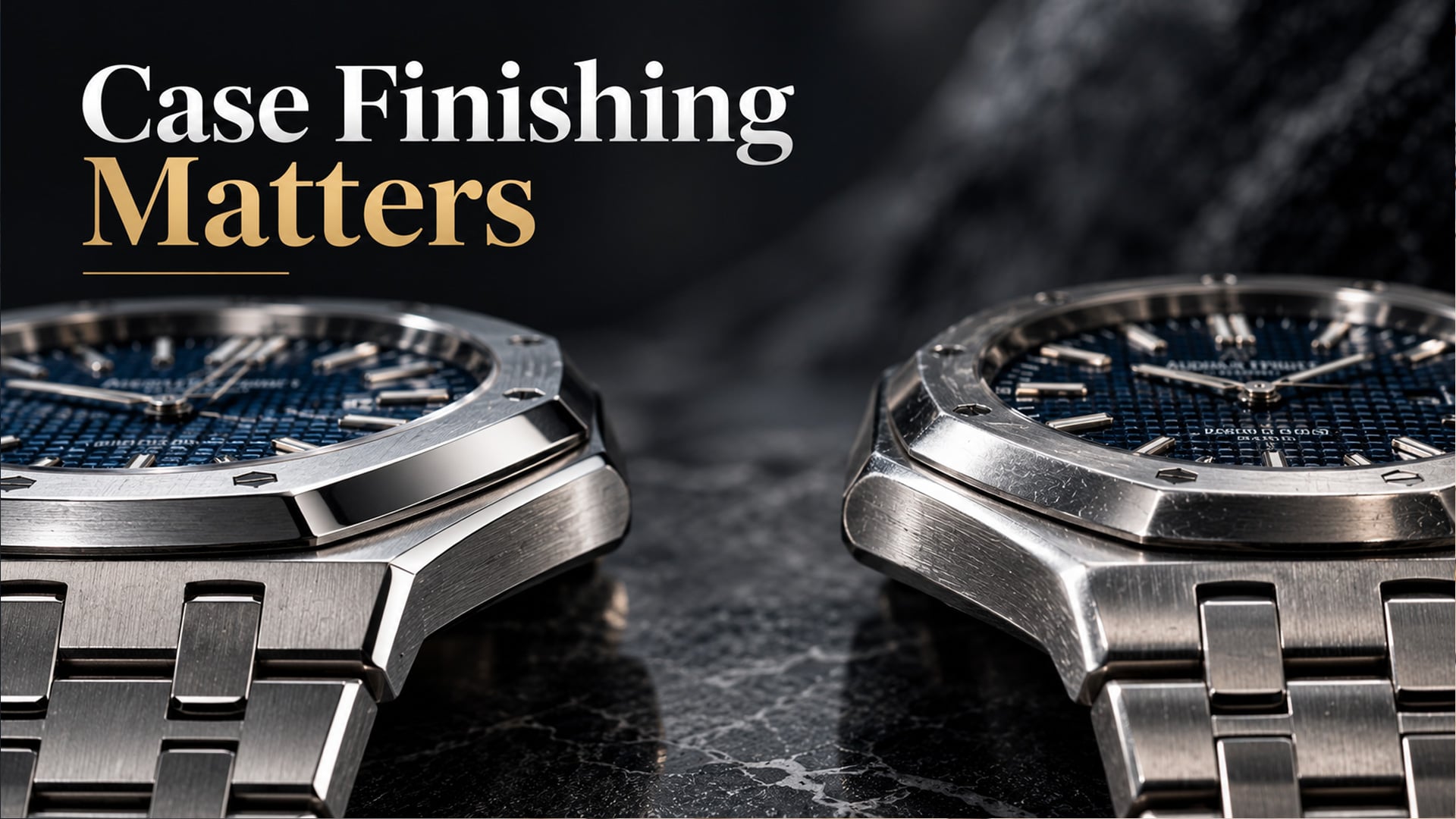
A Watch Can Look Brand New Yet Have Lost the Details That Made Its Case Special
When buyers compare two pre-owned luxury sports watches, the cleaner example often receives attention first. A polished case reflects more light, the bracelet appears fresh, and photographs may suggest that the watch has experienced little wear.
However, pre-owned watch case finishing involves more than shine. The shape of the lugs, definition of the edges and relationship between polished and satin-brushed surfaces can reveal meaningful differences in how a watch has been preserved.
This is particularly important for designs that depend on precise geometry, including many Rolex Professional watches and Audemars Piguet Royal Oak references.
Understanding the basics of case construction helps buyers interpret photographs more effectively, ask informed questions and avoid confusing cosmetic refurbishment with original preservation.
What Is Watch Case Finishing?
Watch case finishing refers to the techniques used to create the intended appearance and texture of the metal surfaces.
A luxury watch case may combine several finishing methods, each designed to produce a particular visual effect.
Some areas are polished to create reflections. Others receive directional brushing or satin finishing, producing a softer texture.
On certain designs, the transition between these surfaces is deliberately sharp and contributes substantially to the watch’s identity.
Common Finishing Techniques
Mirror polishing produces a highly reflective surface.
Satin brushing creates fine directional marks that reduce the appearance of mirror-like reflection.
Beveling creates a defined surface between adjoining case planes, sometimes finished differently from the surrounding metal.
These treatments are not interchangeable decorative choices. They form part of the manufacturer’s intended design.
1. Why Case Geometry Is More Important Than Surface Shine
Every watch case has a particular three-dimensional shape.
Its lugs, bezel, sides and transitions are designed with specific proportions.
When a case receives cosmetic refinishing, the professional performing the work may need to remove a small amount of surface material to reduce scratches or recreate a finish.
Done correctly, the procedure can improve appearance while respecting the original geometry.
Done carelessly or excessively, it can soften edges and change important proportions.
What Is an Overpolished Watch?
An overpolished luxury watch is commonly understood as a watch that has undergone refinishing to an extent that alters its original geometry or distinctive finishing details.
Possible signs include unusually rounded lugs, uneven bevels and poorly defined transitions between surface textures.
However, those observations should be interpreted carefully.
Different production generations may have different original case shapes, and photographs can make edges appear softer or sharper depending on lighting.
A reliable comparison should use reference-accurate information.
2. Why Lug Shape Deserves Particular Attention
The lugs connect the case to its bracelet or strap.
They influence both the appearance of the watch and the way it sits on the wrist.
On many steel sports watches, the lugs feature clearly defined upper surfaces, side profiles and edges.
When examining a used example, compare opposing lugs and look for unusual differences in shape or finishing.
Potential Warning Signs
- One lug appears more rounded than its opposite.
- Bevel widths vary without an apparent design reason.
- Brushing runs in inconsistent directions.
- Polished surfaces extend into areas that should have a satin finish.
- Case edges appear noticeably softer than documented reference examples.
None of these signs conclusively establishes excessive polishing without further examination.
They are reasons to request more photographs or inspect the watch in person.
3. Rolex Sports Watches: Brushed and Polished Surfaces Working Together
Many Rolex Professional watches use combinations of polished and satin-finished surfaces.
The precise treatment varies by collection and reference.
For example, a steel sports-watch case may have brushed upper lug surfaces and polished sides.
The distinction gives the case definition and creates a deliberate contrast.
Does Polishing Automatically Damage a Rolex?
No.
Rolex’s official servicing procedures include case and bracelet refinishing when requested as part of the appropriate service process.
The manufacturer explains that surfaces are polished or satin-finished according to their original appearance.
That is different from assuming every heavily polished watch has been handled correctly.
The important issue is whether the work preserved the original case shape and finishing.
A buyer should also avoid treating an unpolished claim as conclusive proof of excellent condition. An untouched case may still contain dents, corrosion or other concerns.
4. Audemars Piguet Royal Oak: Where Finishing Becomes Architecture
The Royal Oak is a particularly instructive example because its case and bracelet depend on multiple carefully defined surfaces.
Audemars Piguet describes the Royal Oak’s case and bracelet construction as involving numerous bevels, surfaces and distinct finishing treatments.
The eight-sided bezel, exposed screws and integrated bracelet create an unusually recognizable design.
Changes to the original edges can therefore affect the watch’s visual identity.
Why Repeated Refurbishment Deserves Attention
Audemars Piguet’s official service guidance recommends limiting aesthetic refinishing over the lifetime of a watch.
This reflects the fact that polishing is not an infinitely repeatable process without consequences.
Collectors should not interpret that guidance as a universal rule covering every watch brand or material.
Instead, it illustrates why preservation matters for a case with complex geometry.
5. Case Finishing and Bracelet Finishing Should Be Examined Together
On a steel sports watch with an integrated bracelet, the case and bracelet form one continuous visual design.
An otherwise attractive watch can appear inconsistent when the case has been refinished but the bracelet remains heavily worn.
The reverse can also occur.
A newly polished bracelet paired with a worn case may create differences in texture and reflectivity.
What to Look for on the Bracelet
Inspect the links near the case and compare them with those near the clasp.
Check whether the finishing follows the correct pattern.
Also examine:
- Scratches and dents on individual links.
- Unevenly polished edges.
- Signs of damaged or replaced components.
- Excessive looseness between links.
- Clasp security and surface condition.
- Missing bracelet links.
Cosmetic appearance should be assessed alongside mechanical integrity.
A bracelet can look attractive but still have damaged or poorly fitted links.
6. Polished, Unpolished and Professionally Restored: Three Different Descriptions
These terms appear frequently in pre-owned listings, but they should not be treated as interchangeable.
Unpolished
An unpolished watch is described as retaining its original case finishing without subsequent cosmetic refinishing.
However, proving that no polishing occurred throughout a watch’s entire history may be difficult, especially when documentation is incomplete.
Polished
A polished watch has undergone some form of surface refinishing.
That description alone provides limited information about the quality or extent of the work.
Professionally Restored
This description suggests that cosmetic work was performed with the aim of improving or restoring the original appearance.
Where a seller makes such a claim, ask what work was done, who performed it and whether supporting records exist.
Professional involvement does not automatically establish that the result is identical to the original factory finish.
7. How Lighting Can Mislead Buyers
Highly reflective watch cases are difficult to photograph consistently.
Direct lighting can reveal scratches that are nearly invisible under softer conditions.
Conversely, strong reflections can conceal small marks and make rounded edges appear sharper.
This is why one carefully prepared product image rarely provides enough information for a complete condition assessment.
Photographs Worth Requesting
- Direct front view of the case and bezel.
- Left-side profile.
- Right-side profile including the crown.
- Three-quarter views showing the lugs.
- Close-up photographs of polished and brushed transitions.
- Bracelet and clasp photographs.
- Images under both direct and diffused lighting.
These photographs should show the actual watch rather than generic manufacturer images.
If significant uncertainty remains, consider a physical inspection.
8. Does Original Finishing Always Produce a Higher Resale Price?
No universal price rule applies.
Some collectors prioritize case geometry and prefer watches with minimal refinishing.
Others may value a carefully refurbished appearance, depending on the reference and intended use.
Price is also affected by movement condition, documentation, bracelet completeness and the broader market.
A watch retaining its original case shape but requiring expensive mechanical repair is not necessarily a better purchase than every professionally refinished alternative.
Condition should be evaluated as a whole.
Collectors seeking a broader framework can consult a luxury watch condition grading guide that examines the case, bracelet, movement and documentation together.
9. A Practical Framework for Comparing Two Used Watches
Suppose two steel sports watches share the same reference and similar apparent condition.
The first has minor surface scratches but well-defined case edges. The second looks cleaner yet shows noticeably softened bevels.
Neither should be purchased solely on that description.
The next step is to establish whether the second watch has undergone previous refinishing and whether the first has any unresolved mechanical or structural concerns.
Review both watches’ service histories, original components and bracelet completeness.
Then compare asking prices in the context of the complete condition assessment.
10. Questions to Ask Before Making a Decision
- Has the case or bracelet been polished?
- Is the extent of the work known?
- Were repairs performed on the case or bezel?
- Are the bracelet and clasp original to the watch?
- Are photographs of the actual case edges available?
- Does the watch have a documented service history?
- Have the original surface finishes been preserved?
A knowledgeable seller should distinguish confirmed information from details that cannot be verified.
For a buyer, that transparency is more valuable than an unsupported description such as flawless or never touched.
Frequently Asked Questions
Can polishing remove scratches from a steel luxury watch?
Appropriate refinishing can reduce certain surface scratches, but it may involve removing material. Deep damage may not be correctable without affecting the original geometry.
Is an unpolished watch always in better condition?
No. An unpolished watch may retain its original finishes while still showing dents, wear or mechanical problems.
Why is Royal Oak case finishing important?
The Royal Oak relies on precisely defined bevels and contrasting surfaces. Excessive refinishing can change the geometry that contributes to its recognizable design.
Can photographs prove that a watch has never been polished?
Not conclusively. Photographs can reveal signs of refinishing, but lighting, image quality and incomplete history limit what can be established.
Should I reject every polished pre-owned watch?
No. The quality and extent of the work, overall condition and your preferences should guide the decision.
Final Thoughts: Good Finishing Is About Preserving Design
Understanding pre-owned watch case finishing helps buyers look beyond the most reflective watch in a display case.
Well-defined lugs, consistent surface treatments and preserved case geometry may be more informative than the absence of visible scratches.
A thoughtful comparison considers cosmetic condition alongside the movement, bracelet, documentation and maintenance history. The goal is not to insist that every watch remain untouched, but to understand what has happened to it before purchase.