





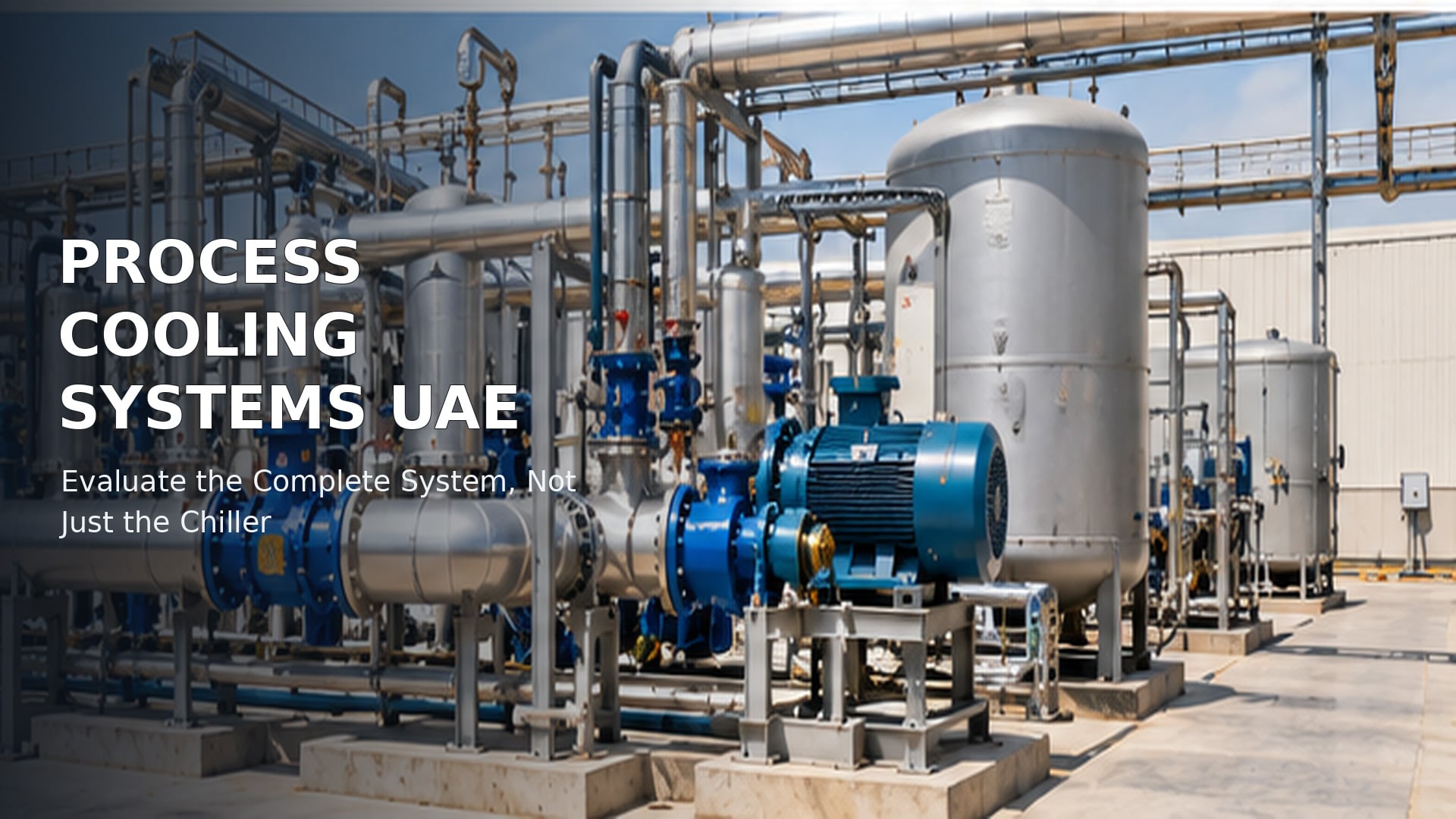
A Chiller Can Be Correctly Sized and the Cooling System Can Still Underperform
Industrial cooling projects often begin with the chiller because it is the most visible and expensive piece of equipment in the system.
But a chiller does not work alone.
For facilities planning Process Cooling Systems UAE, reliable performance depends on how the chiller interacts with pumps, piping, heat exchangers, process loads, water quality, controls and heat rejection.
This means a cooling problem cannot always be solved by simply installing a larger chiller.
The entire system needs to be considered.
Start With the Heat Source
The purpose of process cooling is to remove unwanted heat from an industrial process or piece of equipment.
Before selecting the chiller, project teams should establish:
- where the heat is generated;
- how much heat must be removed;
- whether the load is constant or variable;
- the required process temperature;
- operating hours;
- and the consequences of losing cooling.
This provides a technical basis for the complete cooling design.
The Chiller Is Only the Cooling Source
The chiller creates the required cooling effect, but that cooling still has to reach the process.
A complete system may include:
- chillers;
- primary pumps;
- secondary pumps;
- buffer tanks;
- heat exchangers;
- filters and strainers;
- piping;
- control valves;
- instrumentation;
- and monitoring systems.
If one part of this chain is poorly selected, overall performance can suffer.
Pump Selection Can Limit Cooling Performance
Pumps provide the flow required to move chilled fluid through the system.
If flow is too low, heat transfer may be inadequate.
If flow is excessive, the system may waste pumping energy and experience unnecessary pressure losses.
Pump selection should therefore consider:
- required flow;
- pipe length;
- fittings;
- valves;
- filters;
- heat exchangers;
- and elevation where relevant.
A properly sized chiller cannot compensate indefinitely for an incorrectly designed pumping system.
Required Temperature Should Be Based on the Process
Industrial facilities sometimes specify very low water temperatures as a safety margin.
That can increase refrigeration duty unnecessarily.
The design should establish the actual temperature required by the equipment or production process.
This includes both supply and return conditions.
The temperature difference then influences required flow and cooling-system behaviour.
Heat Exchangers Can Become the Bottleneck
Some process systems use a heat exchanger to separate the chiller circuit from the process circuit.
If the heat exchanger is undersized, fouled or operating under different conditions from those assumed in the design, cooling performance may be limited even when sufficient chiller capacity exists.
Heat-exchanger performance should therefore be evaluated as part of the complete system.
Water Quality Influences Heat Transfer
Water conditions can affect cooling-system reliability.
Scale, corrosion, fouling and contamination can reduce heat transfer or create maintenance problems.
Depending on the system, project teams may need to consider:
- filtration;
- water conditioning;
- chemical treatment;
- or another suitable water-management strategy.
Closed-loop and open-loop systems may also have different water-quality requirements.
Heat Rejection Deserves Equal Attention
Cooling systems work by moving heat from the process and rejecting it somewhere else.
For air-cooled chillers, that heat is rejected to outdoor air.
For water-cooled arrangements, the rejection process typically involves additional equipment and a condenser-water circuit.
If heat rejection is restricted, the entire cooling system can be affected.
Outdoor equipment placement, airflow, hot-air recirculation and maintenance clearance should therefore be part of the design review.
Controls Should Respond to Changing Process Demand
Industrial processes rarely operate under identical conditions every hour.
Production lines start and stop. Equipment loads change. Some processes operate continuously while others are batch-based.
Cooling controls should respond to these variations.
Depending on the project, useful functions may include:
- temperature control;
- pump sequencing;
- variable-speed operation;
- flow monitoring;
- pressure monitoring;
- tank-level controls;
- alarm functions;
- and chiller staging.
Part-Load Operation Can Affect Long-Term Efficiency
A cooling system designed only around maximum demand may operate below full load for much of its life.
This makes part-load performance important.
A project should understand how the chiller, pumps and controls behave when cooling demand falls.
The most efficient solution at peak load is not always the most efficient solution across the full operating year.
Buffer Volume Can Improve Stability in Some Systems
Process cooling loads can change quickly.
Where total system fluid volume is low, the cooling equipment may cycle frequently.
In suitable applications, a buffer tank can provide additional thermal mass and help stabilise operation.
The need for buffer capacity depends on the equipment, control strategy and process behaviour.
Redundancy Should Be Based on Production Risk
The appropriate redundancy strategy depends on what happens when cooling stops.
A non-critical application may tolerate temporary downtime.
A production process may not.
Where cooling is essential, buyers may consider:
- multiple chillers;
- standby pumps;
- modular capacity;
- or emergency operating strategies.
The decision should reflect operational risk rather than a generic specification.
Maintenance Access Can Affect Long-Term Reliability
Filters need cleaning. Pumps need servicing. Sensors may need replacement. Heat exchangers require inspection.
The equipment layout should therefore allow technicians to reach these components safely and efficiently.
A compact plant room is not a successful design if routine maintenance becomes difficult.
Compare Cooling Systems as Systems
When buyers review process cooling systems in the UAE, chiller capacity should be only one part of the comparison.
A stronger technical comparison includes:
Process Heat Load + Required Temperatures + Flow + Chiller + Pumps + Heat Exchangers + Water Quality + Heat Rejection + Controls + Part-Load Performance + Maintenance + Redundancy
This gives project teams a far clearer picture of whether the cooling solution will work as intended.
Final Thoughts
A process cooling system is only as strong as the way its components work together.
An oversized chiller will not correct poor flow. A powerful pump will not solve an inadequate heat exchanger. Sophisticated controls cannot fully compensate for poor heat rejection.
For UAE industrial facilities, the best cooling decisions come from evaluating the complete system from the process load outward.
Start with the heat. Then design the cooling system that removes it reliably.