




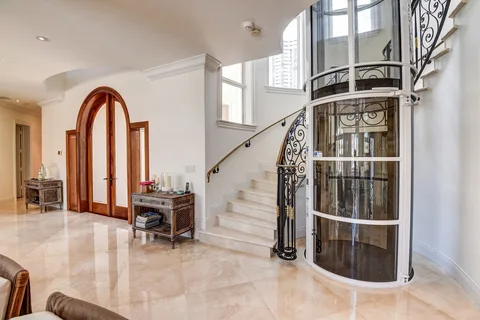
You’ve probably seen both terms while browsing. One brochure promises a sleek “home lift,” while another talks about a “residential elevator” with a glass cab and a full shaft. They both move you between floors, so it’s easy to assume they’re the same thing. Then the quotes arrive, the prices differ, and the installer starts talking about pits and hoistways. That’s when many homeowners ask the question that matters: what is the difference between a homelift and a residential elevator?
The short answer is that the words overlap, but the machines often don’t. Some homelifts are compact, open-cab units that travel through a floor opening. Some residential elevators are enclosed cabs riding inside a full shaft. Understanding where each one fits can save you from paying for the wrong system or building the wrong space. Let’s untangle the terms together.
Two Names, Overlapping Machines
Think of “homelift” and “residential elevator” like “sneakers” and “running shoes.” Everyone knows what a running shoe is, but “sneakers” can mean many things depending on who’s talking. The labels depend a lot on region, brand, and marketing.
That’s the first thing to accept. Shopping by name alone can be confusing. What you really need to compare is the structure: the cab type, the enclosure, the drive system, the safety code, and the space required. Once you look at those, the picture gets much clearer.
Where the Term “Homelift” Came From
The word “lift” is common in the UK, Australia, and many Commonwealth countries, while North Americans usually say “elevator.” Cambridge Elevating’s own glossary explains that “elevator” is standard in North America and appears in codes such as ASME A17.1/CSA B44, while “lift” is standard elsewhere. 1
In practice, though, the word “home lift” is used to describe several different products. Wikipedia describes a home lift as a lift designed for private homes that doesn’t need a shaft and usually has an open cab, making it generally more basic and lower cost than a home elevator. 2 Some North American sellers also use “home lift” as a generic term for any residential elevator. That overlap is why the same word can point to very different equipment.
What Makes a Residential Elevator a Residential Elevator
A traditional residential elevator is built more like a small commercial elevator adapted for a house. It usually travels inside a purpose-built enclosed shaft, called a hoistway, with landing doors on each floor. Depending on the model, it may need a pit below the lowest floor, overhead clearance above the top floor, dedicated machinery, and serious structural planning. 3
The enclosed cab is a big part of the appeal. It feels like a room that moves, with walls, a ceiling, and a sense of privacy. That’s why residential elevators are often the choice for multi-storey homes where people want a quiet, smooth ride that feels like the rest of the house.
Installation, Space, and Structure Compared
Here’s where the differences start to affect your house. A residential elevator asks more of the building. A homelift, particularly a through-floor model, asks less.
A compact through-floor lift can travel through a carefully prepared opening between floors instead of requiring a full elevator shaft. When it’s parked upstairs, the lower floor opening can be closed by an integrated floor cover. Many of these installations fit into a corner, beside a staircase, or somewhere a conventional shaft would be hard to place. 3
A full residential elevator, by contrast, may need a hoistway framed into the house, a pit, and headroom above the top landing. Suite Additions describes the construction needs of a home elevator as major, because of the shaft, while platform-style lifts usually need less. 4
Space planning reflects that difference. One industry comparison lists a vertical platform lift at roughly 4 by 4 to 5 by 5 feet at each landing, with about 240-volt power and wall or tower mounting. A home elevator, in the same comparison, needs a hoistway, a pit or zero-clearance pit, and dedicated power. 5
Table 1: Quick Comparison of Homelift and Residential Elevator
| Feature | Homelift (Through-Floor or Platform) | Residential Elevator |
|---|---|---|
| Cab style | Often open or partly enclosed | Usually fully enclosed |
| Shaft needed | Often no full shaft | Yes, a purpose-built hoistway |
| Pit and overhead | Usually minimal or none | Often required |
| Typical use | Short trips, accessibility, tight spaces | Multi-storey homes, everyday family use |
| Governing code (North America) | Platform lifts under ASME A18.1 | Private residence elevators under ASME A17.1 |
Safety Codes Are the Real Dividing Line
If you want to know what really separates these systems, look at the safety codes. Names on a brochure can be inconsistent, but codes are specific and enforceable.
In North America, residential elevators fall under ASME A17.1, and Section 5.3 covers private residence elevators. 6 Platform lifts and stairway chairlifts fall under ASME A18.1. 7 The current residential elevator code is ASME A17.1/CSA B44, and manufacturers are expected to build to it and have it certified by an accredited third party. 8
Here’s a quick example of how the rules differ. ASME A18.1 includes headroom requirements for platform lifts, with an 80-inch minimum listed in U.S. Access Board guidance. 9 Residential elevators follow A17.1 instead, which sets its own requirements for cab area, speed, and construction. One guide notes that A17.1 limits the pace of home elevators to 40 feet per minute. 10
In the UK, the rules change again. BASE describes a residential elevator as built to BS EN 81-20, a small passenger lift standard, and positions the home lift as the mid-market option for accessibility retrofits. 11
The takeaway is simple. Ask every seller which code their product follows, and whether it’s certified. That one question cuts through a lot of confusion.
Cost and Time: What to Expect
Money matters, so let’s talk ballpark numbers. Price guides vary, and the figures below come from different companies and years, so treat them as general signals rather than quotes.
One comparison lists a vertical platform lift at about $15,000 to $30,000 installed and a home elevator at about $30,000 to $60,000-plus. 5 Another puts platform lifts at roughly $10,000 to $30,000 and home elevators at $30,000 to $60,000-plus. 4 The gap is real, but the exact number depends on travel distance, finishes, and how much structural work your house needs.
Installation time follows the same pattern. The same comparison suggests platform lifts can be installed in one to three days, while home elevators may take two to six weeks. 4 Longer timelines usually mean more disruption, so plan for that if you live in the house during the work.
Table 2: Typical Cost and Install Time Comparison (Estimates)
| Factor | Homelift or Platform-Style Lift | Residential Elevator |
|---|---|---|
| Typical installed cost | Roughly $10,000 to $30,000 | Roughly $30,000 to $60,000+ |
| Typical install time | About 1 to 3 days | About 2 to 6 weeks |
| Construction needed | Some, depending on the opening | Major, usually including a shaft |
| Best fit | Short trips and accessibility | Multi-storey homes and daily family use |
These ranges come from a mix of sources and vary by region, so always confirm the scope with a written quote. 5 4
How to Choose Between the Two
Choosing comes down to three questions. How many floors do you need to reach? Who will use it most? And how much construction can your home handle?
If you’re only moving between two levels, or you mainly need help for someone with limited mobility, a homelift or platform-style lift may be the right fit. They’re generally smaller, faster to install, and easier on the budget. Just make sure the cab and door size work for any mobility devices.
If you have three or four stops, want an enclosed and quiet ride, or plan to stay in your home for decades, a residential elevator is often the better long-term choice. It takes more planning and money up front, but it can serve the whole household for years.
Don’t forget the middle ground. Some compact through-floor models offer a more enclosed feel than basic platform lifts, while still avoiding a full shaft. Ask about the cab style, the travel height, and the code the product meets before you decide.
Finally, talk to a professional who can measure your home. The right answer often becomes obvious once someone looks at your floor plan, your ceilings, and the spot you have in mind.
Conclusion
So, what is the difference between a homelift and a residential elevator? In short, a homelift often refers to a smaller, open or partly enclosed lift that may travel through a floor opening, while a residential elevator is usually a fully enclosed cab in a purpose-built shaft. The names overlap, so the smartest move is to compare the cab style, enclosure, safety code, installation needs, and cost. Once you know what each system demands from your house, choosing between them becomes much easier.
Ready to figure out which one fits your home? Start with your floor plan, a list of the stops you need, and any mobility requirements. Then reach out for a clear comparison. You can request a quote, book a free consultation, or take the quiz to see which style suits you. For specs and drawings, visit the technical documents page, or explore the lineup on the Cambridge Elevating homepage, which lists both home lift and home elevator options.
Frequently Asked Questions
Q1. Is a homelift the same as a residential elevator?
Not always. A homelift is often a smaller, open or partly enclosed lift that may not need a full shaft. A residential elevator usually has an enclosed cab that rides in a purpose-built hoistway. The terms are sometimes used interchangeably, so check the actual design and safety code.
Q2. Which safety code applies to a homelift and a residential elevator?
In North America, residential elevators are governed by ASME A17.1 and CSA B44. Platform lifts and stairway chairlifts fall under ASME A18.1. Ask the seller which code the product meets and whether it has third-party certification.
Q3. Which is cheaper, a homelift or a residential elevator?
Homelift and platform-style lifts are usually less expensive, with some comparisons listing them around $10,000 to $30,000 installed. Residential elevators often cost more, commonly $30,000 to $60,000 or higher, depending on the shaft and finishes.
Q4. Do I need a shaft for a homelift?
Many compact homelifts don’t need a full shaft. Through-floor models can travel through a prepared opening between floors. A residential elevator usually does require a purpose-built hoistway, along with a pit or overhead space in many cases.
Q5. How do I decide between a homelift and a residential elevator?
Consider how many floors you need to reach, who will use the lift most, how much construction your home can handle, and how long you plan to stay. A homelift often suits short trips and accessibility needs, while a residential elevator fits multi-storey daily use better.