






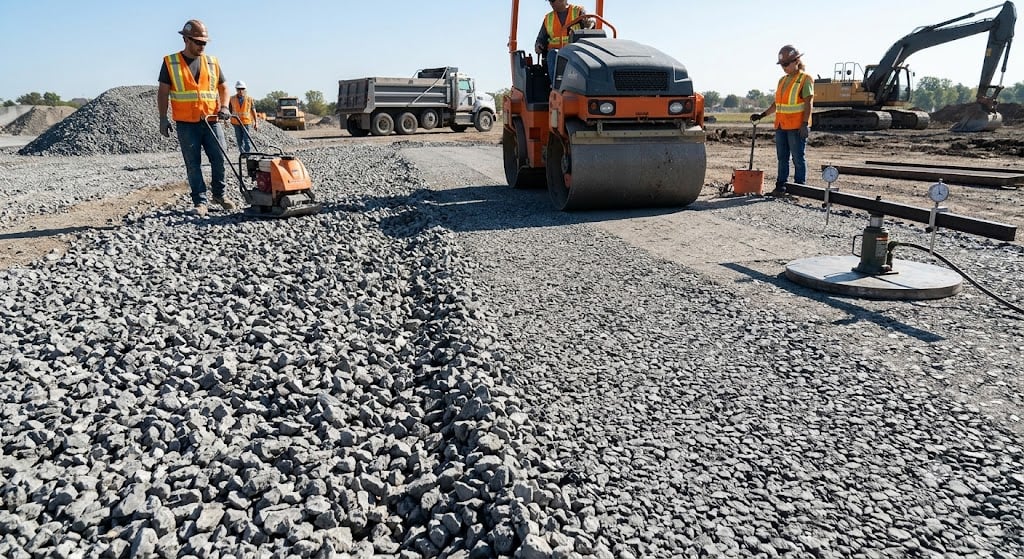
Have you ever walked across a gravel driveway and noticed soft spots or loose stones under your feet? Now imagine what happens when a truck, car, or heavy piece of equipment rolls over that same surface. Without a solid base, things can go wrong pretty quickly. When looking for crushed stone delivery near me in California, it helps to know how compaction affects the strength of the material and the weight it can support. Getting the right stone is important, but placing and compacting it properly matters just as much.
What Is Crushed Stone Compaction?
Crushed stone compaction is the process of pressing loose stone particles together to create a firm, stable layer. This is usually done with a plate compactor or a roller, depending on the size of the project.
When crushed stone arrives at your job site, the particles have small gaps between them. As the material is compacted, the stones settle into a tighter arrangement and many of those gaps become smaller. The result is a stronger base that is less likely to shift under pressure.
Think of it like packing a suitcase. If everything is tossed in loosely, there is plenty of wasted space. Pack it carefully, and everything fits more tightly. Crushed stone works in a similar way.
How Compaction Improves Load-Bearing Capacity
Load-bearing capacity refers to how much weight a surface can support without sinking, cracking, or becoming unstable. Proper compaction helps crushed stone handle that weight more effectively.
Here is how it makes a difference.
1. It Creates a Tighter Stone Structure
Loose stones can move when weight is placed on them. Compaction helps the particles settle against one another, creating a more stable layer.
This is especially useful for driveways, parking areas, construction access roads, and equipment pads. When the stones fit together well, the surface is better prepared to handle regular traffic.
2. It Reduces Settling and Surface Movement
Nobody wants to finish a driveway only to see dips and uneven patches appear a few weeks later. Poorly compacted stone can settle when vehicles pass over it or rainwater moves through the base.
Compacting the material in suitable layers helps reduce this problem. Each layer gets the attention it needs before the next one goes on. It takes a little more effort upfront, but it can save plenty of repair work later.
3. It Helps Spread Heavy Loads
A properly compacted crushed stone base helps distribute weight across a wider area instead of allowing pressure to concentrate in one small spot.
This matters when a surface needs to support delivery trucks, construction machinery, or parked vehicles. The base still needs the right thickness and suitable ground beneath it, though. Compaction alone cannot fix weak soil or an incorrectly designed base.
Why Moisture and Layer Thickness Matter
Here is something that can easily get overlooked: crushed stone needs the right conditions during compaction.
Too much moisture can create problems, especially if the material contains fine particles. Excess water may make the base unstable or prevent proper compaction. Very dry material may also be harder to compact effectively, depending on its gradation and composition.
Layer thickness matters, too. Spreading one very thick layer and compacting only the top may leave the material underneath loose. Placing the stone in manageable layers allows the compactor to work more effectively throughout the base.
The ideal moisture level, layer depth, and compaction method depend on the material and the project requirements.
Choosing the Right Crushed Stone for Your Project
Not every crushed stone product works the same way. Stone size, particle shape, and the amount of fine material all affect how the particles fit together.
For example, a well-graded crushed stone blend may compact into a firm base because it contains different particle sizes that fit together. Larger, more uniformly sized stones may be better suited to certain drainage applications, where leaving open spaces is useful.
Before ordering, consider what the finished surface needs to do. Will it support heavy trucks? Carry everyday vehicle traffic? Provide a stable foundation for a patio or walkway? Answering these questions makes it easier to choose the right material.
If you are searching for crushed stone delivery near me in California, Western Materials can help you find suitable aggregate materials for construction, landscaping, and other site projects. With more than 40 years of industry experience, Western Materials supplies crushed stone, sand, gravel, and specialty materials throughout California. Get a quote and discuss your project needs before placing your order.
Common Compaction Mistakes to Avoid
A few simple mistakes can weaken an otherwise good base.
- Skipping ground preparation: Soft soil, roots, and unsuitable material can affect the finished surface.
- Spreading overly thick layers: The bottom may remain loose even when the top looks firm.
- Using the wrong stone blend: Material that does not suit the application may fail to provide the needed support.
- Ignoring drainage: Water can weaken the underlying soil and contribute to movement.
- Stopping too early: A surface that looks level is not necessarily compacted enough.
Taking time to prepare the site and follow the required compaction method helps the base perform as intended.
Frequently Asked Questions
1. Does compacting crushed stone make it stronger?
Yes. Proper compaction brings the particles closer together and improves the stability of the stone layer. The actual load-bearing capacity also depends on stone gradation, base thickness, soil conditions, and drainage.
2. How thick should a compacted crushed stone base be?
There is no single thickness for every project. A residential walkway may need a thinner base than a driveway carrying heavy trucks. Ground conditions, expected loads, and local project requirements should guide the final depth.
3. Can crushed stone be compacted when it is wet?
It depends on the material and how wet it is. Some blends compact better with a suitable amount of moisture, but excessive water can cause instability. Follow the material specifications and project requirements.
4. Is all crushed stone suitable for load-bearing applications?
No. Different stone sizes and blends serve different purposes. A well-graded base material may suit driveways and foundations, while more open stone blends may be selected for drainage. Always match the aggregate to the job.
5. Where can I find crushed stone delivery in California?
Western Materials supplies crushed stone and other aggregate products for projects throughout California. Share your project type, estimated quantity, and delivery location to help determine the right material and delivery arrangement.