





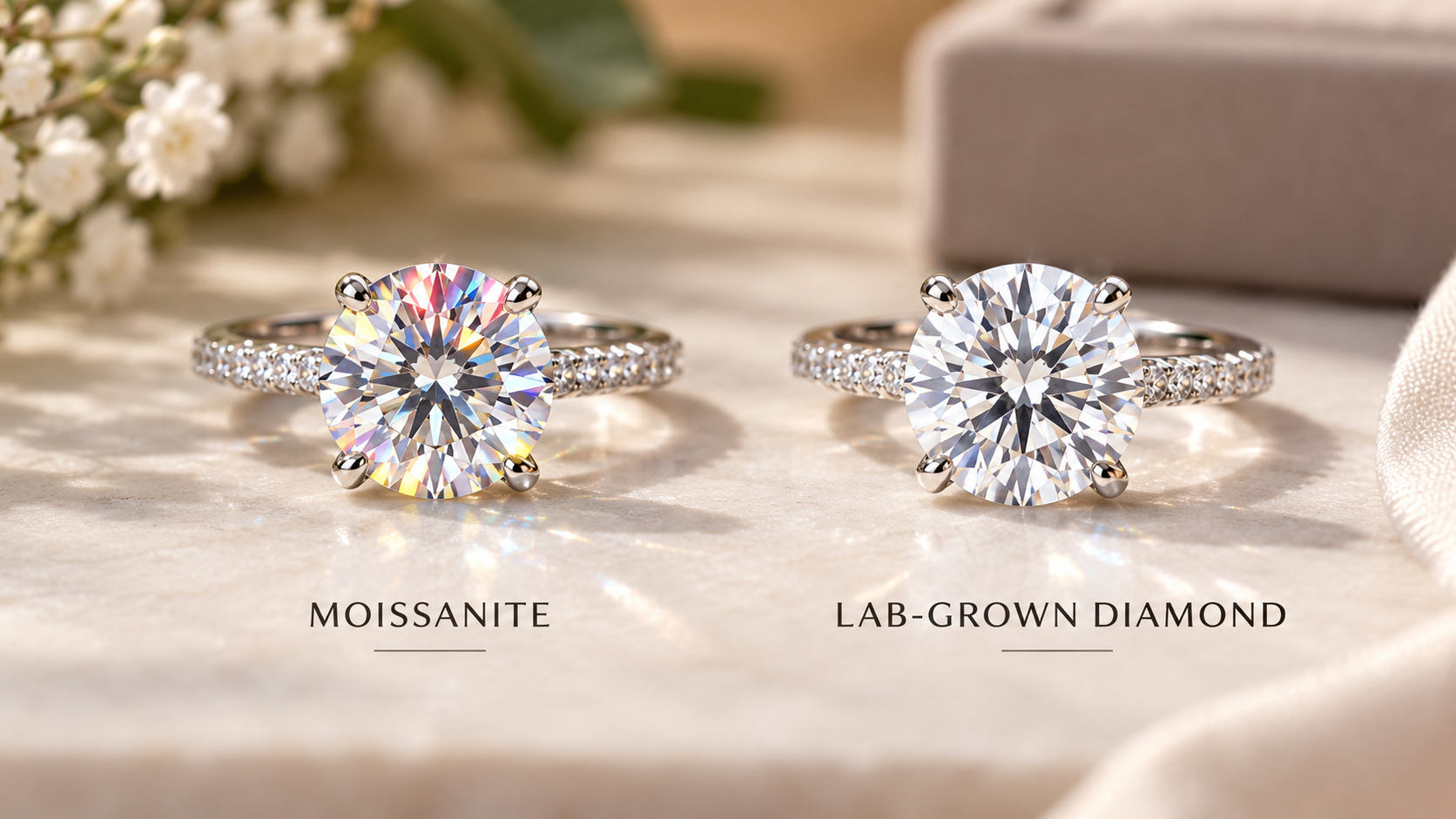
Is moissanite a lab-grown diamond? No. Moissanite is a separate gemstone made of silicon carbide, while a lab-grown diamond is made of carbon. Both can be created in a laboratory and can look alike in a ring, which is why they are often confused. The Gemological Institute of America (GIA) treats them as different materials: lab-grown diamonds are real diamonds, while moissanite is classed as a diamond simulant.
What Is Moissanite?
Moissanite is silicon carbide (SiC). It is named after French chemist Henri Moissan, who studied meteoric iron from Canyon Diablo, Arizona, and reported in 1904 that it contained silicon carbide. Natural moissanite is extremely rare, so the moissanite in jewelry is grown in a laboratory. GIA calls it synthetic moissanite.
It is known for its sparkle. According to GIA, moissanite has more than twice the fire of a diamond and slightly more brilliance. Fire is the rainbow-colored flash a gem produces when it splits white light. Moissanite is also doubly refractive, meaning light entering the stone splits into two rays, which can make the back facets look slightly doubled.
Jewelers use it in engagement rings, earrings, pendants, and bracelets, and GIA notes it has become a very popular engagement ring stone.
What Is a Lab-Grown Diamond?
A lab-grown diamond is a real diamond. Its composition is carbon, arranged in the same cubic crystal structure as a natural diamond. GIA explains that this gives lab-grown diamonds nearly the same chemical, optical, and physical properties as natural ones. Lab-grown diamond composition matches a natural diamond’s; the difference is origin. One forms in the earth over a very long time, the other is grown in a controlled setting.
How Lab-Grown Diamonds Are Made
There are two main methods:
- HPHT (High Pressure, High Temperature): A capsule holding a carbon source and a mix of metals is heated to roughly 1,300–1,600°C under very high pressure, mimicking conditions deep in the earth.
- CVD (Chemical Vapor Deposition): In a near-vacuum chamber, a carbon-containing gas is energized, usually with microwaves. Carbon then crystallizes layer by layer onto a diamond seed at about 700–1,200°C.
Both produce rough crystals that are cut and polished like any other diamond.
Is Moissanite a Lab-Grown Diamond? How Gemologists Classify It
GIA uses the word “simulant” for a material that looks like another gem but has a different chemical composition, crystal structure, and optical and physical properties. Moissanite is one. A lab-grown diamond is not: GIA says calling lab-grown diamonds imitations or simulants is incorrect, because their properties closely match natural diamonds.
“Simulant” describes chemistry, not quality. Moissanite is a genuine gemstone with its own character. It just isn’t a diamond, so the answer to “is moissanite a real diamond?” is no.
Moissanite vs. Lab-Grown Diamonds: Key Differences
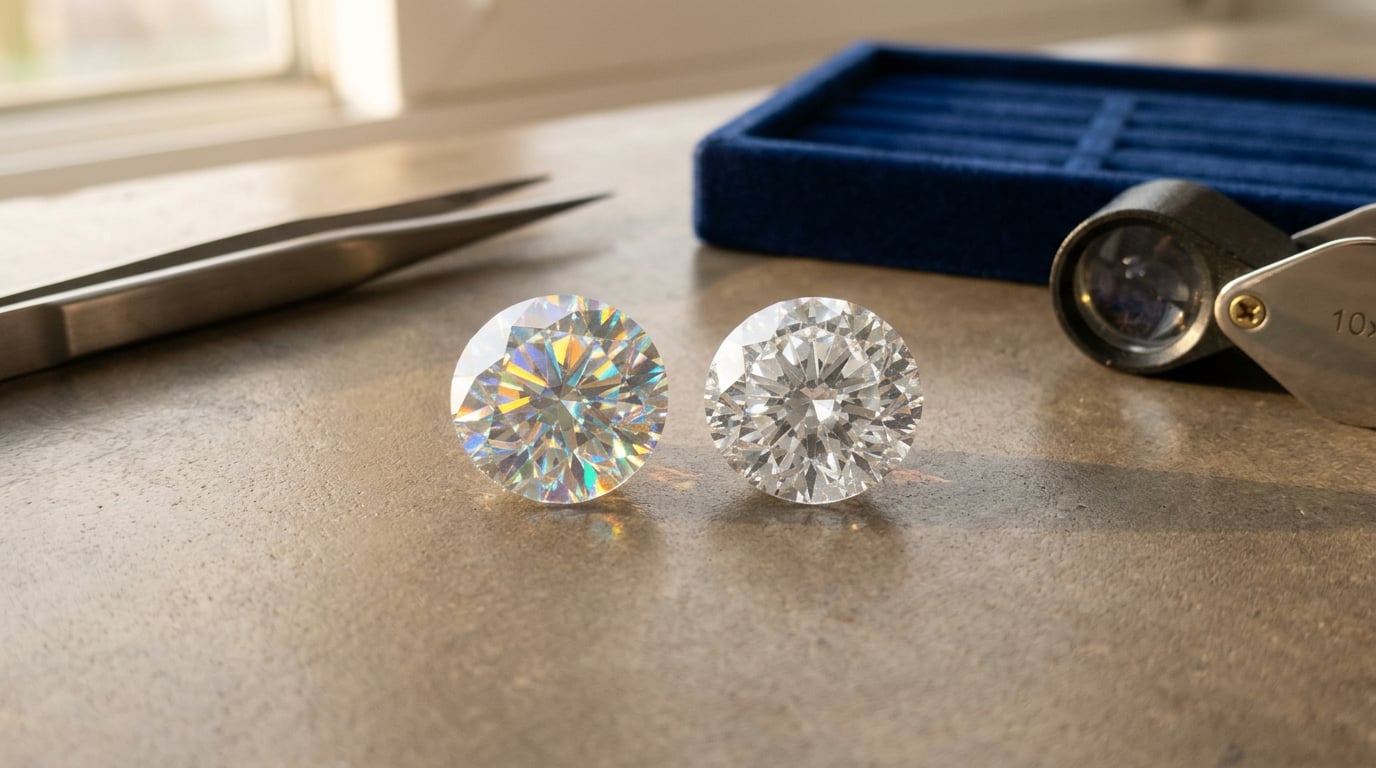
This table summarizes the main moissanite and diamond differences. Values are approximate and vary by stone.
| Feature | Moissanite | Lab-Grown Diamond |
|---|---|---|
| Chemical composition | Silicon carbide (SiC) | Carbon (C) |
| Crystal structure | Hexagonal (non-cubic) | Cubic |
| Brilliance and fire | Slightly more brilliance and over twice the fire of diamond | Classic diamond sparkle, with less fire than moissanite |
| Hardness (Mohs) | About 9.25 | 10 |
| Durability | Very hard; suitable for everyday wear | Harder than any simulant; suitable for everyday wear |
| Visual appearance | More rainbow flashes; doubled back facets can look slightly fuzzy | Classic diamond look; singly refractive |
| Typical price | Generally lower than a comparable lab-grown diamond | Generally higher than moissanite; varies |
| Resale and market | Terms vary by seller; don’t assume value holds | Values vary and aren’t guaranteed; ask about trade-in terms |
Can You Tell Moissanite and Diamonds Apart?
Sometimes, but not reliably by eye alone.
The biggest visible difference is how each stone handles light. Moissanite tends to show more rainbow flashes. GIA notes that in sizes of one carat or more, its intense fire may give it away as a non-diamond, and in very large stones it can create a “disco ball” effect. Its double refraction can also make the back facets look doubled.
Heat testers are not a safe shortcut. When moissanite reached the market, GIA researchers found that thermal probes reacted to it as if it were diamond, and that the doubling of facet junctions was the clearer separator. GIA also makes instruments that separate diamonds from simulants.
Cut quality, lighting, and viewing angle all change what you see. For certainty, ask a qualified gemologist to test the stone. GIA notes that a stone can be submitted to its laboratory if you’re unsure what it is.
Is Moissanite Cheaper Than a Lab-Grown Diamond?
Generally, yes, though exact prices vary. GIA notes people consider simulants because they are more affordable than diamonds of similar size, color, and clarity. Several factors shape the final price of either stone:
- Size: Larger stones cost more.
- Quality: For diamonds, color, clarity, and cut grades matter. For moissanite, GIA notes value often depends on how colorless it is.
- Cut: A well-cut stone returns more light and usually costs more.
- Seller and setting: Markups, documentation, and the metal and design of the ring all change what you pay.
Because of this, compare two specific stones rather than relying on a general price range.
Which Is Better for an Engagement Ring?
Neither is universally better. It depends on what you value.
Moissanite advantages:
- Usually costs less, which can free budget for a larger stone or a more detailed setting.
- GIA calls it the hardest of the diamond simulants.
- GIA lists it as safe for ultrasonic and steam cleaning, and less likely than diamond to attract grease.
Moissanite trade-offs:
- Its look differs from a diamond’s. Some people enjoy the extra fire; others find it less natural, especially in larger sizes.
- It is slightly softer than diamond, and double refraction can make it look a little fuzzy from some angles.
Lab-grown diamond advantages:
- It is a real diamond, with a diamond’s composition and crystal structure.
- It offers the classic diamond look and rates 10 on the Mohs scale.
Lab-grown diamond trade-offs:
- It generally costs more than a comparable moissanite.
- By eye, it can be indistinguishable from a natural diamond, so independent documentation matters.
How to Choose Between Moissanite and Lab-Grown Diamonds
A few questions can help you decide:
- What is your budget? If cost is the priority, moissanite may allow a larger or more detailed ring for the same spend.
- What look do you prefer? View both in person, in different lighting.
- Do you want a diamond specifically? If so, only a lab-grown or natural diamond qualifies.
- How will it be worn? Both suit daily wear, but diamond is the harder stone.
- What are your long-term expectations? If resale or trade-in matters, get the policy in writing rather than assuming value will hold.
Once you understand the differences between moissanite and lab-grown diamonds, comparing quality, pricing, and different places to buy lab-grown diamonds can help you make a more informed decision.
Whichever stone you choose, make sure the seller states clearly what it is. In the United States, the FTC has said that describing a simulated diamond such as cubic zirconia as a “laboratory-created diamond” without clear qualification would likely mislead shoppers. A moissanite listing should say moissanite. For diamonds, GIA advises buying with an independent laboratory report to be certain of the stone’s identity.
Frequently Asked Questions
Is moissanite a real diamond?
No. Moissanite is silicon carbide, while diamond is carbon. It is a real gemstone, but its crystal structure and optical properties differ from a diamond’s. A lab-grown diamond, by contrast, is a real diamond.
Is moissanite considered lab-grown?
Moissanite in jewelry is made in a laboratory because natural crystals are extremely rare, and GIA calls it synthetic moissanite. But it is not a lab-grown diamond. In the jewelry trade, that term means a diamond grown in a lab.
Does moissanite sparkle more than a diamond?
It sparkles differently. GIA says moissanite has more than twice the fire of a diamond and slightly more brilliance, so it tends to show more rainbow flashes. Whether that looks better is personal taste.
Which lasts longer, moissanite or a lab-grown diamond?
Both are durable enough for daily wear. Diamond is harder, 10 on the Mohs scale versus about 9.25 for moissanite, and GIA notes diamond is harder than any simulant. Setting design and care also matter.
Why is moissanite generally less expensive?
GIA notes simulants generally cost less than diamonds of similar size, color, and clarity. The exact reasons vary, so compare specific stones rather than relying on a general rule.
Conclusion
So, is moissanite a lab-grown diamond? No. Moissanite is silicon carbide, a distinct gemstone with its own look and properties, while a lab-grown diamond is a real diamond made of carbon. Moissanite generally costs less and shows more colorful fire. A lab-grown diamond offers the classic diamond appearance and higher hardness. Both can be durable choices for engagement rings and fine jewelry.
The right choice depends on your budget, your taste, and what you want from the stone over time. If possible, see both in person before deciding.
References
- GIA 4Cs, “Simulants, Moissanite and Lab-Grown Diamonds”
- GIA 4Cs, “What Are Simulated Diamonds?”
- GIA, “An Introduction to Simulants or Imitation Gem Materials”
- GIA, “HPHT and CVD Diamond Growth Processes” (Dr. James E. Shigley)
- Nassau, McClure, Elen and Shigley, “Synthetic Moissanite: A New Diamond Substitute”, Gems & Gemology, Winter 1997
- Federal Trade Commission, “The many facets of advertising diamonds with clarity”, Business Blog, May 2019
- G. F. Kunz, “Moissanite, a Natural Silicon Carbide” (1905), via RRUFF