


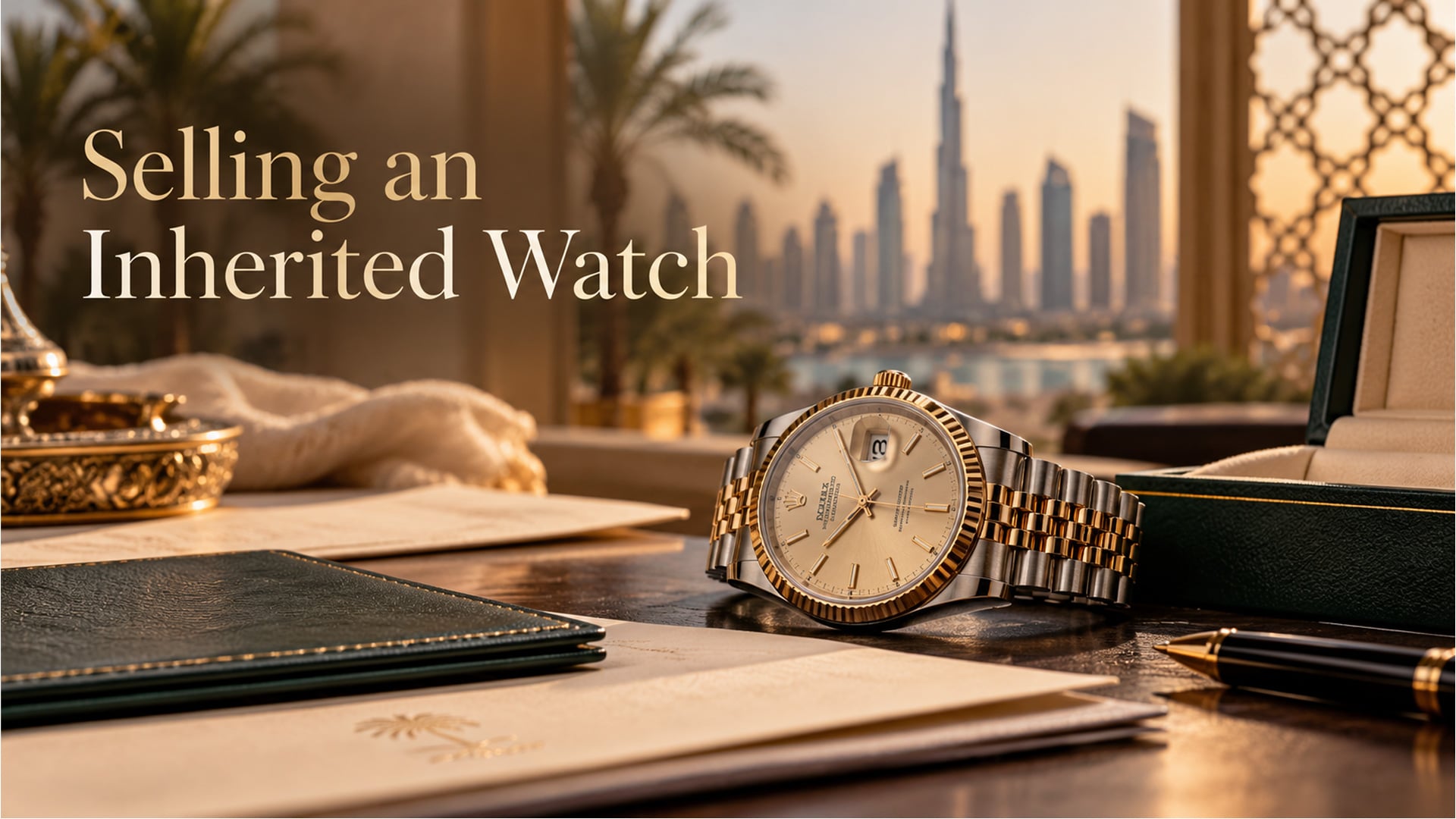
An Inherited Watch May Have Financial Value, but Establishing Its History and Your Authority to Sell Comes First
Finding a luxury watch among a family member’s belongings can raise more questions than expected. You may recognise the Rolex name on its dial or the distinctive shape of a Cartier case, but know very little about when the watch was purchased, whether it has been serviced or where the original documents were kept.
It can also be difficult to decide whether to keep such a personal item or sell it.
If you are considering selling an inherited luxury watch in the UAE, the process should begin with two separate matters: confirming your legal authority to dispose of the watch and understanding exactly what you own.
Neither should be skipped because the watch appears valuable.
First, Establish Who Has the Right to Sell
An item found among a deceased person’s possessions does not automatically become the property of whoever is holding it.
Depending on the circumstances, the watch may form part of an estate, be subject to inheritance procedures or involve more than one person with a legal interest.
Before arranging a sale, confirm that the relevant estate administration and ownership questions have been properly resolved.
The applicable process can depend on the circumstances of the deceased, the estate and the relevant jurisdiction. Where authority is uncertain, obtain advice from an appropriately qualified UAE legal professional.
A watch dealer’s assessment of the timepiece is not a substitute for determining who has the legal right to transfer ownership.
Identify the Watch Before Searching for Its Price
The brand name is only the beginning.
A Rolex Datejust may belong to a different production generation from another Datejust that looks similar in photographs. A Patek Philippe Calatrava could be a compact vintage hand-wound model or a much newer reference.
These differences can affect its materials, movement, condition assessment and market interest.
Look for genuine paperwork recording the reference number. If none is available, seek appropriate professional assistance with identification.
Avoid opening the case yourself or publishing complete serial numbers online.
What If the Original Box and Papers Are Missing?
Missing documents are common in situations where an item has passed between generations.
The original presentation box may have been discarded, or a warranty card may have been stored separately from the watch.
The absence of these items does not, by itself, prove that the watch is counterfeit.
However, a potential buyer may require additional authentication and ownership evidence.
Gather any genuine purchase receipts, historical correspondence, service records or estate documentation that can help explain the item’s history.
Do not create replacement documents or describe a watch as having a complete original package when it does not.
Understand the Difference Between Condition and Authenticity
A watch can be authentic and still be in poor condition. It can also appear well maintained while containing replacement or aftermarket components that were not disclosed.
For this reason, appearance and authenticity should be considered separately.
Inspect visible scratches, dents, bracelet wear and obvious signs of damage without attempting technical repairs.
For mechanical watches, explain whether the watch appears to operate normally, but avoid making guarantees about timekeeping or service history.
When dealing with an unfamiliar vintage watch, aggressive cleaning or polishing can alter original surfaces and potentially affect collector interest.
Do Not Service or Polish the Watch Automatically
It may seem sensible to make an inherited watch look new before selling it.
However, that approach can be counterproductive.
Polishing removes material and may change the case profile. Certain older watches attract specialist interest partly because of their original finishes and components.
Mechanical servicing can also be expensive, particularly for complicated references.
Before committing to either form of work, establish the watch’s identity and seek an assessment of its current condition.
What Determines the Price a Buyer Might Offer?
Original retail price is not the same as current resale value.
An inherited watch may have been purchased decades ago, and the original price may no longer be a meaningful benchmark.
A potential buyer may consider the reference, materials, condition, originality, documentation, market demand and expected servicing requirements.
A dealer’s acquisition offer may also differ from the asking price shown on a retail website.
Avoid assuming that a watch will appreciate simply because it is old, made from gold or associated with a prestigious manufacturer.
Preparing for a Selling Enquiry
Once ownership authority has been established, prepare an accurate description of the watch.
Record the brand, reference where known, condition, accompanying accessories and any available maintenance history.
Photograph the dial, case, case back, bracelet and visible wear in clear natural light.
If you do not know whether the watch has been serviced or modified, explain that the information is unavailable.
Owners exploring possible transaction routes can review a luxury watch selling and trading enquiry service to understand the type of reference, condition and documentation information a watch business may request. An enquiry is not a promise of acceptance or purchase.
Keep sensitive identity, inheritance and ownership records private unless disclosure is legitimately required.
Frequently Asked Questions
Can an inherited luxury watch be sold without its original warranty card?
It may be possible, but the seller must have legal authority to transfer the watch and meet the prospective buyer’s authentication and documentation requirements.
Does an inherited watch become more valuable with age?
Not automatically. Age alone does not guarantee appreciation. The exact reference, originality, condition and buyer demand matter.
Should family members agree before a watch is sold?
Where ownership or estate rights involve more than one party, those legal questions should be resolved before any sale. Seek qualified advice when the position is unclear.
A Careful Process Protects More Than the Watch’s Value
An inherited luxury watch can carry both emotional and financial significance.
Whether the decision is to preserve it or sell it, taking time to establish ownership authority, reference identity and condition is worthwhile.
For UAE families considering a sale in 2027, an informed process begins with reliable records and truthful descriptions, not an optimistic price found online.