






Ask five surgeons which thread they would use for a closure and you may hear five answers. The sizes they pick usually fall within a narrow band though, and the reasons behind the choice are consistent. This guide explains how USP sizes are labeled and what drives the choice. It lists the sizes commonly used in dogs and cats for each type of tissue. Careful suture sizing helps a closure hold without adding extra bulk to the wound. This is general educational information and the attending veterinarian makes the final decision for each patient.
The Quick Answer
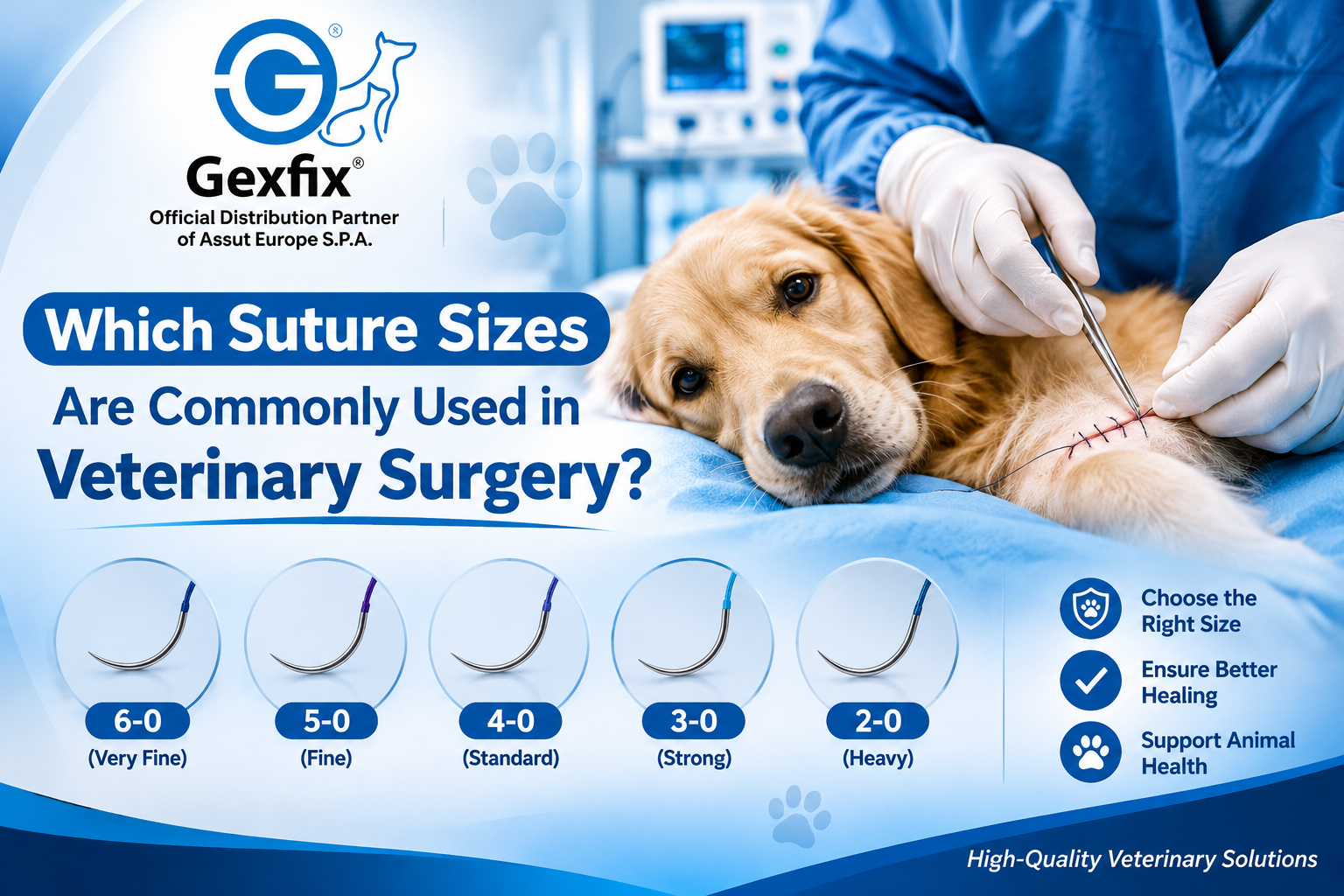
Most small animal closures use sizes from 4/0 to 0. Fine sizes such as 4/0 and 3/0 suit delicate tissue and small patients. Heavier sizes such as 2/0 and 0 suit load bearing layers like the abdominal wall in medium and large dogs. Very little data exists on the ideal size so 3-0 or 4-0 is generally considered appropriate for the gastrointestinal tract and the bladder. Beyond that the right size depends on how much load the tissue carries and how long it must hold.
How USP Sizes Are Labeled
The Zero Scale
The United States Pharmacopeia scale looks backward at first because it counts down through zeros. Plain numbers such as 1 and 2 describe heavy thread. Size 0 is finer than size 1 and each extra zero means a finer thread. So 2/0 is finer than 0 and 4/0 is finer than 3/0. Packages may print the same size as 3-0 or 000 and all of them mean the same thing.
Metric Equivalents
A metric number often appears beside the USP size. It gives the diameter in tenths of a millimeter. USP 0 matches metric 3.5 and 2/0 matches metric 3. USP 3/0 matches metric 2 and 4/0 matches metric 1.5. USP 5/0 matches metric 1. Veterinary papers sometimes quote the metric figure only so it helps to know both.
What Decides the Size
There is no one size fits all answer to the best suture. A short routine makes the choice consistent from case to case.
Tissue Load and Healing Time
Start with the question of how long the thread must hold. Tissue such as the bladder heals quickly while the linea alba takes months and regains about half its tensile strength in three months. A thread that fades too early leaves the repair unsupported. A thread that stays far longer than needed leaves extra material behind. The strength curve matters more than the absorption date printed on the package.
Patient Size
The same layer behaves differently in a kitten and in a large dog. Skin thickness and tissue volume rise with body size. Small patients need finer thread because tissue is thin and tears easily. Large dogs need heavier thread in load bearing layers. Activity matters too because a restless patient puts more stress on a closure than a calm one.
Material and Needle
Size cannot be chosen alone. Two threads of the same size can behave differently if they are made from different materials. A monofilament slides smoothly through tissue while a braided thread handles easily and ties securely. The needle decides how the thread enters the tissue. Taper needles suit soft tissue and hollow organs while cutting needles suit skin. A very fine thread on a large needle leaves a hole bigger than the thread needs. When you compare a vet suture for a given layer read the instructions for use. Material and size and needle are best picked together.
Common Sizes by Procedure in Dogs and Cats
The ranges below are general reference points used in teaching and everyday practice. Individual surgeons may choose differently based on the patient and the case.
Ligatures in Spay and Castration
Pedicle ligatures need secure knots because a slipped knot can cause serious bleeding. Cats and small dogs commonly receive 3/0. Medium dogs often need 2/0 and large dogs may need 0 or heavier depending on pedicle thickness. The spermatic cord in a castration is commonly ligated with 3/0 or 2/0 based on the size of the dog.
Abdominal Wall
The linea alba is the main load bearing layer in a midline closure. Cats and small dogs commonly receive 3/0 or 2/0 here. Medium to large dogs often receive 2/0 or 0. A prospective clinical study of linea alba closure used 2 metric thread (3/0) for cats and small dogs and 3 metric (2/0) for medium dogs and 3.5 metric (0) for large dogs with bites placed 3 to 5 mm from the edge. A cadaver study in cats found that a 5 mm bite and stitch interval gave the highest load at failure when closing feline linea alba with 3-0 polydioxanone. Bite spacing and size work together.
Hollow Organs
Intestine and bladder walls are thin and must seal without leaking. Sizes of 3/0 to 4/0 are common in small animals with the finer end used for cats and small dogs. A monofilament absorbable material on a taper needle is a frequent choice. Stomach tissue is thicker and often takes 2/0 to 3/0 in dogs.
Subcutaneous Layer
Closing dead space keeps fluid from collecting under the skin. Sizes of 3/0 to 4/0 are common in cats and small dogs and larger dogs may use 2/0 or 3/0. The goal is support without bulk.
Skin
Skin closure in cats and small dogs commonly uses 4/0 or 3/0. Medium to large dogs often use 3/0 or 2/0. Long straight incisions are sometimes finished with staples from a scalp stapler instead of thread. That device closes the skin only so the deeper layers still follow the sizes above. Tension changes the answer too. A wound over a joint may need a slightly heavier thread or a pattern that shares the load across wider tissue.
Orthopedic Soft Tissue
Joint capsule and fascia closures in dogs commonly use 2/0 to 0 depending on patient and joint. Tendon repairs need materials that keep strength for a long time and are usually planned with specialist guidance.
What Recent Research Suggests About Finer Sizes
Some research points toward finer thread than many clinics expect. A 2023 laboratory study tested USP 2-0 and 3-0 and 4-0 PGA on canine midline tissue from dogs weighing 5 to 15 kg. The 4-0 group had lower maximum tensile strength than the heavier groups but still provided at least 56.3 N for skin incisions and sufficient stability for abdominal skin and linea alba. The authors also reported that smaller sizes reduced the early inflammatory response in the tissue.
This was an ex vivo study on a narrow weight range so it does not settle the question for every patient. It does support the principle that the finest thread that holds the tissue is usually the best choice.
Handling and Knots
A well chosen size still fails when it is handled badly. Needle holders should grip the needle without crushing the thread. A holder that is too large can bend a fine needle and one that is too small may let a large needle rotate. Forceps should hold tissue gently and scissors should cut cleanly.
Knot technique changes with size. Fine monofilament can slip when too few throws are used so surgeons often add an extra throw. Heavy threads make bulky knots that should be trimmed neatly and buried away from the wound line. A knot tied too tight squeezes tissue and reduces blood flow.
When Adhesive Fits
Some wounds do not need thread at all on the surface. Tissue adhesive holds the edges of short shallow wounds that sit under little tension. Skin glue for dogs sets within seconds and wears away as the skin heals. It does not support deeper layers or wounds that move a lot. Some teams apply a thin layer over a finished closure as a surface barrier in patients that tend to lick. That protects a sound closure and never replaces one.
Mistakes to Avoid
The first mistake is choosing a thread far heavier than the tissue needs and causing extra trauma. The second is choosing a thread too fine for a load bearing layer so it breaks. The third is treating absorption time as if it were strength time.
Using one size for every patient regardless of weight is another common error. So is pairing a very fine thread with a needle that is too large. The last is leaning on surgical glue for dogs to hold a wound that is under real tension.
Questions to Ask Before You Order
Ask which USP sizes and needle types are available for each material. Ask for the strength and absorption data in the instructions for use so you can compare products on equal terms. Confirm the product is labeled for veterinary use and check the sterility statement and expiration date. A feline only practice may need just two or three sizes so match your stock to your caseload.
Final Thoughts
Good suture sizing comes from a simple routine applied to each tissue. Consider how much load the tissue carries and how long it needs support. Account for patient size and then pair the thread with a suitable material and needle. Typical ranges run from 4/0 for delicate tissue and small patients up to 0 for the body wall and orthopedic closures in large dogs. Staples and adhesive can take over in certain layers but thread remains the most adaptable way to match strength to tissue.
Gexfix International Corp. supplies absorbable and non absorbable veterinary sutures in a range of USP sizes and needle types in partnership with Assut Europe S.P.A.
Frequently Asked Questions
Q: What suture size is most common in dogs and cats?
A: Sizes 3/0 and 2/0 are very common for ligatures and the abdominal wall and 4/0 or 3/0 for skin and hollow organs. The surgeon chooses based on the tissue and the weight of the patient.
Q: How do I choose between 3/0 and 4/0 suture?
A: Choose 3/0 when the tissue carries more load or the patient is larger. Choose 4/0 for thin tissue or small patients. The aim is the finest thread that holds the tissue securely.
Q: Why does a smaller suture size matter?
A: A thicker thread leaves a larger channel and a bulkier knot and adds more foreign material. Research on canine abdominal closures reported lower early inflammation with finer sizes.
Q: Is absorption time the same as how long a suture stays strong?
A: No. An absorbable suture can take months to disappear while losing most of its strength much sooner. The instructions for use list both figures and the surgeon matches strength time to the healing needs of the tissue.
Q: Can the same size be used for every patient?
A: No. Tissue thickness and load change with body size. A kitten and a large dog usually need different sizes even for the same procedure.