



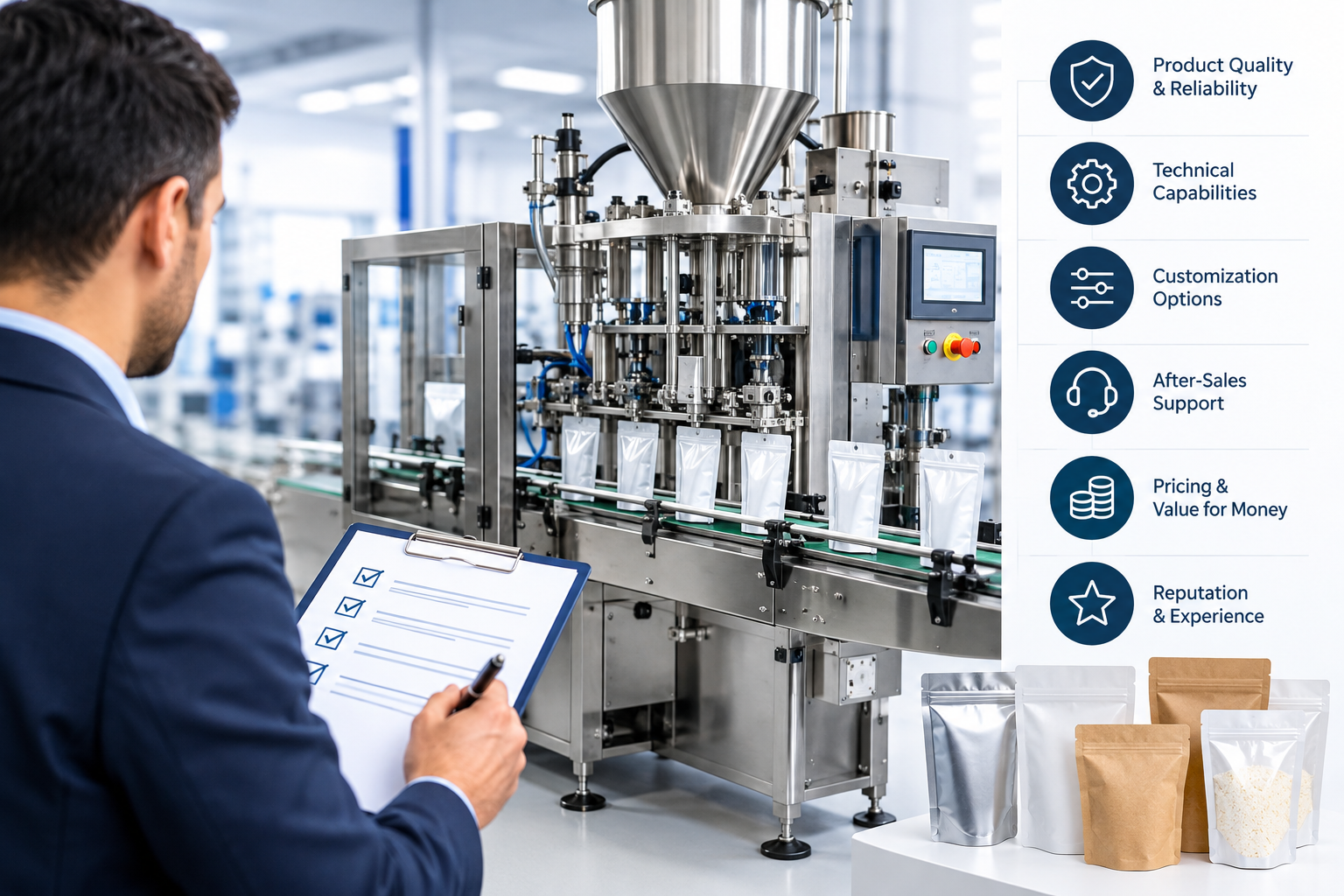
How to Evaluate Pouch Filling Machine Suppliers for Industrial Packaging
Buying packaging equipment is a long-term decision, especially when the machine will become part of your daily production process. A pouch filling machine can influence filling accuracy, production speed, product waste, labor requirements, and overall packaging efficiency. This is why choosing the right supplier is just as important as choosing the machine itself.
With so many packaging equipment manufacturers and suppliers available, it can be difficult to know which one offers genuine value. A supplier may have an attractive price, but that does not necessarily mean the machine will deliver reliable performance over several years. The better approach is to look at the complete package, including machine quality, technical expertise, customization, service, spare parts, and long-term support.
Start With Your Own Packaging Requirements
Before comparing suppliers, be clear about what you actually need from the machine. Suppliers can only recommend suitable equipment when they understand your product and production requirements.
Consider the type of product you want to fill, the required filling quantity, pouch dimensions, expected production volume, and the level of accuracy you need. A powder product, liquid, granule, or viscous product may require a completely different filling system.
Your current production requirements are important, but future plans should also be considered. If you expect production volumes to increase or plan to introduce additional pouch sizes, the machine should have enough flexibility to accommodate those changes.
Look at the Supplier’s Experience
Once your requirements are clear, start evaluating the suppliers themselves. Industry experience is a useful starting point because an experienced supplier is more likely to understand the practical challenges involved in pouch filling and packaging.
However, do not judge experience simply by the number of years a company has been operating. Look at whether the supplier has worked with products and applications similar to yours.
For example, ask whether they have supplied equipment for your industry and whether they can show examples of comparable installations. A supplier familiar with your type of product may be able to identify issues that a general machinery supplier could overlook.
It is also worth asking:
- How long have they been manufacturing packaging equipment?
- What industries do they normally serve?
- Have they handled similar products?
- Can they provide customer references?
- Do they manufacture the equipment themselves or mainly resell it?
These questions can help you understand the supplier’s actual level of expertise.
Don’t Judge a Machine by Appearance Alone
A modern stainless steel machine can look impressive in a showroom, but appearance tells you very little about how it will perform during continuous production.
Pay attention to the quality of the machine’s construction and the components used in critical areas. Ask the supplier about the filling system, sensors, motors, controls, sealing components, pneumatic systems, and product-contact parts.
Ease of maintenance is another important consideration. Operators and maintenance teams should be able to access components without unnecessary difficulty. Machines that are complicated to clean or maintain can create avoidable downtime.
A good supplier should be comfortable explaining why particular components have been selected and how they contribute to machine performance.
Check Real Filling Accuracy and Production Speed
Two specifications buyers often focus on are speed and accuracy. Both matter, but advertised figures should always be examined in context.
A machine may have a stated maximum speed, but actual output can depend on the product, pouch size, filling quantity, material, operator settings, and machine configuration.
The same applies to filling accuracy. Product characteristics can affect how consistently a filling system performs.
The best way to evaluate this is to request a product trial. Give the supplier your actual product and pouch specifications and ask them to demonstrate the equipment under realistic conditions.
During the trial, pay attention to:
- Filling consistency
- Actual production speed
- Product waste
- Pouch handling
- Sealing quality
- Changeover time
- Operator involvement
A practical demonstration can tell you far more than a brochure filled with specifications.
Consider How Flexible the Machine Is
Production requirements can change over time. You may introduce a new product, change pouch sizes, increase production, or modify your packaging format.
For this reason, flexibility should be part of your supplier evaluation.
Ask whether the machine can handle different pouch sizes and filling quantities. Find out what adjustments are required when changing products and how long a typical changeover takes.
Depending on the application, you may also need options such as multiple filling heads, automatic feeding, coding, inspection, or different sealing configurations.
The best supplier is not necessarily the one offering the most features. It is the one that can provide the right features for your application without adding unnecessary complexity.
Pay Close Attention to After-Sales Support
This is one area that is easy to overlook when purchasing a machine. During the buying process, most attention goes toward specifications and price. Once the machine is installed, however, technical support can become much more important.
Even reliable packaging equipment requires maintenance and occasional troubleshooting. Operators may need training, components may need replacement, and adjustments may be required as production changes.
Before placing an order, ask the supplier what happens after installation.
Find out whether they provide:
- Installation and commissioning
- Operator training
- Preventive maintenance guidance
- Remote technical support
- On-site service
- Warranty coverage
- Troubleshooting assistance
- Spare parts support
A supplier that disappears after delivering the machine can become a serious problem when production is interrupted.
Make Sure Spare Parts Are Easy to Obtain
Spare parts are closely connected to after-sales support. A machine can be well designed, but if a critical component takes weeks to replace, the resulting downtime can be costly.
Ask the supplier which components are considered critical and whether they recommend keeping certain parts in stock. You should also understand how quickly replacement parts can normally be supplied.
Pay particular attention to components such as sensors, valves, motors, pneumatic parts, sealing components, and electrical controls.
It is better to understand spare parts availability before buying than to discover a problem after production has already stopped.
Think About Automation and Future Expansion
Automation is becoming increasingly important for manufacturers looking to improve production consistency and reduce manual handling.
An automatic packaging machine can bring several processes together, depending on the production setup. Filling, pouch handling, sealing, coding, inspection, and conveying can potentially be integrated into a more streamlined packaging line.
Even if you do not need a fully automated system today, it is worth asking the supplier about future integration possibilities.
A machine that can be upgraded or connected with additional equipment may provide greater value as your production requirements increase.
Compare Total Value Instead of Just Price
Price is naturally an important part of the buying decision, but it should not be the only deciding factor.
A lower-priced machine may appear attractive initially but could become more expensive if it requires frequent maintenance, has limited support, uses expensive spare parts, or produces lower output.
Instead, consider the machine’s total cost over its expected operating life.
Look at:
- Initial purchase price
- Installation and training costs
- Energy consumption
- Maintenance requirements
- Spare parts costs
- Expected production capacity
- Potential downtime
- Warranty and technical support
This gives you a more realistic picture of the machine’s value.
Check the Supplier’s Reputation
Before making the final decision, spend some time researching the supplier.
Look for customer feedback, case studies, product demonstrations, and references from companies using similar equipment. If possible, speak directly with an existing customer.
Ask about their experience with machine reliability, technical support, response times, spare parts, and communication.
A supplier’s reputation often tells you how they treat customers after the sale, which is something a product brochure cannot show.
Create a Supplier Comparison Checklist
After evaluating several suppliers, put the information into a simple comparison. This makes it easier to avoid choosing based on one attractive feature or a lower price.
Your checklist can include:
| Evaluation Factor | What to Check |
|---|---|
| Machine quality | Construction, components, durability |
| Filling performance | Accuracy and consistency |
| Production capacity | Realistic output, not just maximum speed |
| Flexibility | Pouch sizes, products, changeovers |
| Automation | Integration and upgrade options |
| Technical support | Installation, training, troubleshooting |
| Spare parts | Availability and delivery time |
| Warranty | Coverage and terms |
| Supplier experience | Relevant projects and industries |
| Total cost | Purchase, maintenance, downtime, and operation |
This approach gives you a more balanced basis for making the final decision.
Final Thoughts
Choosing a pouch filling machine supplier is ultimately about finding the right balance between equipment performance, supplier expertise, service, and long-term value.
Do not rush the decision based on price or machine appearance alone. Test the equipment with your actual product, ask detailed questions, investigate the supplier’s previous work, and understand what support will be available after installation.
A reliable supplier should be able to grow with your business, support your production team, provide spare parts when needed, and help keep your equipment running efficiently. Taking the time to evaluate these factors before purchasing can help you avoid costly problems later and build a more dependable packaging operation.
Frequently Asked Questions
1. How do I choose a reliable pouch filling machine supplier?
Start by checking the supplier’s industry experience, machine quality, customer references, technical support, spare parts availability, and ability to meet your specific production requirements. A product trial can also help you verify machine performance before purchasing.
2. Should I choose the cheapest pouch filling machine supplier?
Not necessarily. The lowest purchase price may not provide the lowest overall cost. Maintenance, downtime, spare parts, energy consumption, machine life, and after-sales support should all be considered before making a decision.
3. Why should I test my product before buying a filling machine?
Different products behave differently during filling. Testing your actual product allows you to evaluate filling accuracy, production speed, product waste, pouch handling, and overall machine performance under realistic conditions.
4. What should I ask about after-sales service?
Ask about installation, operator training, warranty coverage, troubleshooting, preventive maintenance, spare parts, remote assistance, and on-site technical support. Clear information about these services can help prevent unexpected production problems.
5. Can a pouch filling machine be integrated into an automated packaging line?
Yes. Depending on the machine configuration, pouch filling equipment can be integrated with feeding, sealing, coding, inspection, conveying, and other packaging equipment. Discussing future automation requirements with the supplier can help ensure the system remains flexible as production grows.