



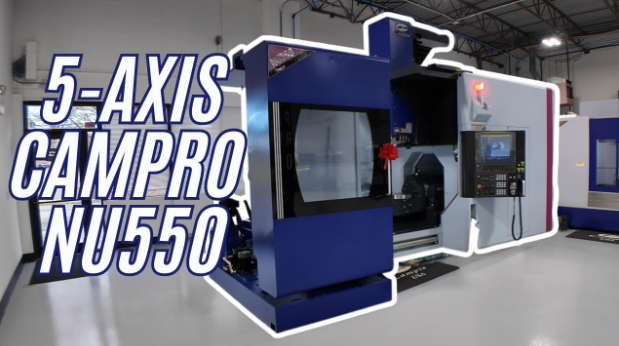
Modern manufacturing often involves components with complex surfaces, angled features, deep cavities, and tight dimensional requirements. A 5-axis vertical machining center can address these requirements by allowing the cutting tool and workpiece to be positioned along multiple axes during machining. This reduces the need to repeatedly reposition certain parts and can make it possible to reach surfaces that are difficult to machine with conventional three-axis equipment.
Understanding how five-axis machining works, where it is useful, and what factors affect machine performance can help manufacturers evaluate whether this technology matches their production requirements.
What Is a 5-Axis Vertical Machining Center?
A 5-axis vertical machining center generally moves the cutting tool along the X, Y, and Z linear axes. Five-axis equipment adds two rotational axes, allowing the workpiece or cutting tool to change orientation during machining.
This additional movement is particularly useful when a component contains multiple surfaces or complex geometries. Instead of completing every feature from a separate orientation, the machine can reposition the workpiece or tool to access different surfaces while maintaining a controlled machining process.
The vertical configuration refers to the orientation of the machining spindle and work area. Vertical machining centers are commonly used for milling operations because the setup provides direct access to the workpiece and tooling area.
How Five-Axis Movement Changes Machining
The primary difference between a 5-axis vertical machining center is the number of directions available for positioning. Additional rotational movement gives the cutting tool greater access to angled surfaces and complex features.
This can be especially useful when machining parts that contain curved contours, undercuts, inclined surfaces, or multiple faces. The ability to approach a surface from an appropriate angle can also allow shorter cutting tools to be used in some applications.
Shorter tools can be beneficial because excessive tool length can contribute to deflection and vibration during cutting. Tool selection still depends on the material, geometry, cutting conditions, and specific operation, but five-axis positioning can provide greater flexibility in determining how a feature is approached.
Reducing Multiple Setups
One significant consideration in complex machining is the number of times a workpiece must be removed, repositioned, and secured.
Every additional setup introduces another opportunity for alignment errors or inconsistencies. A five-axis machine can access multiple sides or angled features during fewer setups when the part and machine configuration permit it.
Reducing setups can also streamline production. Operators spend less time preparing the workpiece between operations, while machining programs can be designed around a more continuous sequence of operations.
However, the exact number of setups required depends on part geometry, workholding, machine configuration, tooling, and production requirements. Five-axis capability does not automatically eliminate every secondary setup.
Precision Depends on More Than Axis Count
Having five axes does not by itself guarantee a specific level of machining accuracy. Machine rigidity, spindle characteristics, thermal stability, calibration, tooling, workholding, programming, and maintenance all influence the final result.
Machine construction is particularly important during demanding cutting operations. A rigid structure can help control vibration and maintain positional stability under cutting loads. Campro’s vertical machining center range includes both box-way and linear-guideway configurations, with structural features designed around different machining requirements.
The quality of the cutting tool and tool holder also matters. Secure tool holding helps minimize unwanted movement and vibration, while appropriate cutting parameters can reduce excessive tool wear and maintain consistent machining conditions.
Where Five-Axis Machining Is Commonly Used
Five-axis machining can be useful across industries where components have intricate geometries or require machining from multiple orientations.
Aerospace Components
Aerospace manufacturing frequently involves components with complex contours and demanding dimensional requirements. Five-axis equipment can help machine features such as blades, brackets, and structural components from different orientations.
Automotive Manufacturing
Automotive applications include molds, engine-related components, and other precision-machined parts. The ability to access multiple surfaces can support efficient machining of complex components.
Medical Components
Medical manufacturing may require small, detailed components with carefully controlled dimensions. Five-axis machining can provide additional positioning flexibility for intricate parts and specialized tooling.
Tool and Die Work
Molds and dies often contain curved surfaces, cavities, and angled features that can be challenging to produce efficiently using only three linear axes. Multi-axis positioning can simplify access to these geometries.
Choosing Between Different Vertical Machine Configurations
Not every manufacturing operation requires five-axis capability. A standard vertical machining center may be appropriate for parts that primarily require three-axis milling and straightforward workholding.
When comparing equipment, manufacturers should consider the actual geometry of their parts, production volume, material requirements, available floor space, spindle specifications, tool capacity, and workpiece dimensions.
CNC machines in the USA include box-way models such as the CPV series and linear-guideway models such as the CNV series. The listed machines vary in work envelope and configuration, providing different options for production requirements.
Evaluating Machine Performance Before Purchase
A machine should be assessed according to the applications it will perform rather than simply its number of axes. Important factors include spindle speed and power, axis travel, rotary-axis range, table capacity, tool-changing capability, machine rigidity, control system, coolant management, and chip removal.
The workpiece itself should also guide the evaluation. Manufacturers can review representative parts and determine which operations would benefit from additional axis movement. Testing actual components can provide more useful information than relying solely on general specifications.
Maintenance requirements should also be considered. Regular inspection, proper lubrication, tool-holder checks, calibration, and appropriate cutting-tool management contribute to consistent machining performance over the machine’s service life.
Understanding the Role of CNC Technology
Computer numerical control allows machining operations to follow programmed toolpaths with controlled movements. In multi-axis machining, programming becomes particularly important because the tool orientation changes as the machine moves through different sections of a component.
CAM software is commonly used to generate complex multi-axis toolpaths. The programmer must account for tool geometry, machine kinematics, workholding, cutting conditions, and potential collisions. Proper simulation and verification can help identify programming issues before a machining cycle begins.
For manufacturers comparing a CNC vertical machining center, the appropriate choice depends on the part geometry, production objectives, required tolerances, materials, and available machining processes.
Conclusion
Five-axis vertical machining combines vertical milling with additional rotational movement to provide greater access to complex component surfaces. Its ability to reduce certain setups, improve tool orientation, and machine intricate geometries makes it relevant to aerospace, automotive, medical, tooling, and other precision manufacturing applications. For organizations researching equipment options, Campro USA provides vertical machining centers in box-way and linear-guideway configurations, as well as dedicated five-axis models for applications requiring additional machining flexibility.