



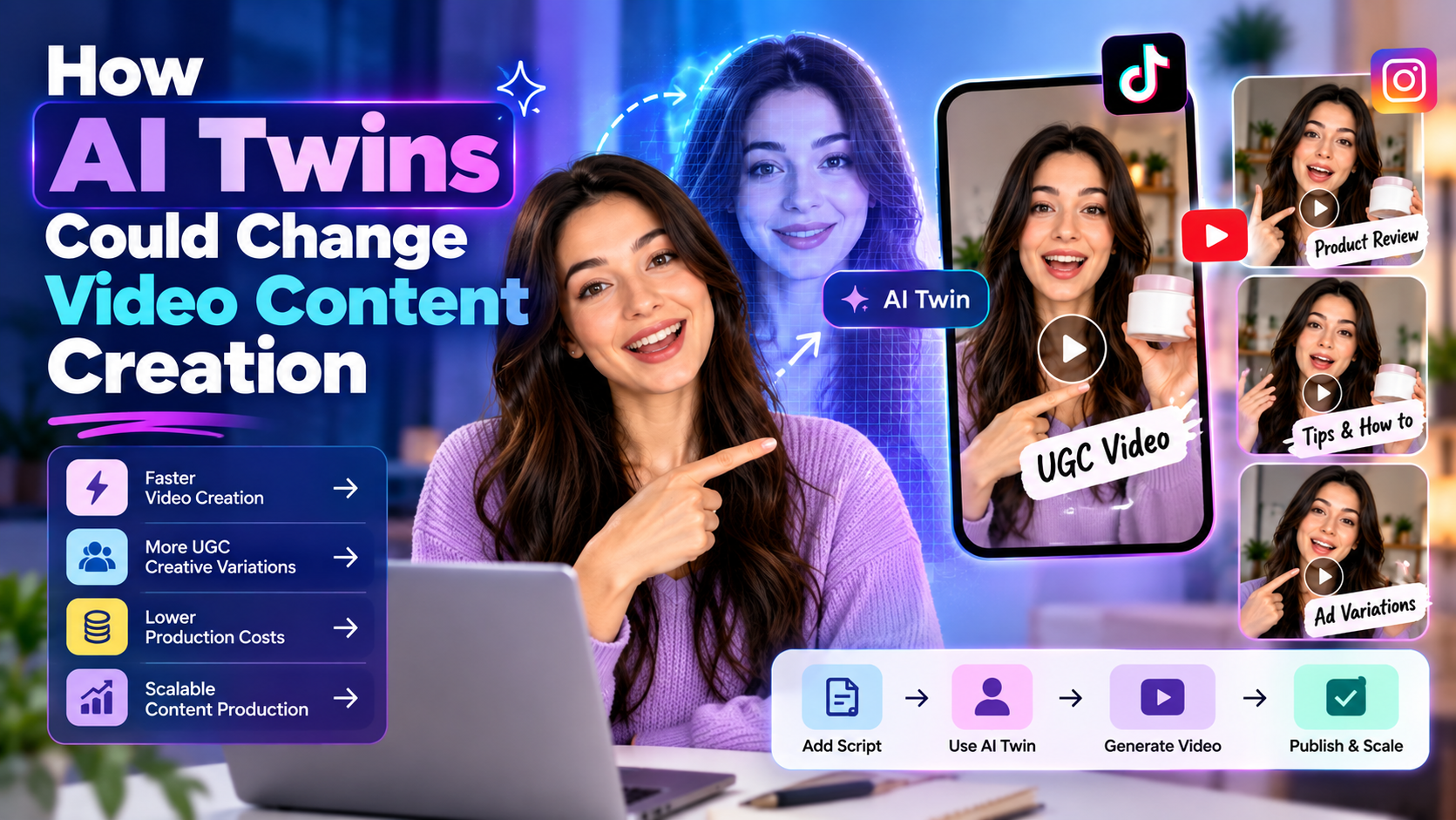
Video content has become one of the most important formats for digital marketing, social media, ecommerce, and brand communication. From short-form videos on TikTok and Instagram to product demonstrations, paid advertisements, and educational content, businesses and creators are producing more videos than ever.
But producing high-quality video content at scale can be challenging. Traditional video production requires cameras, locations, lighting, actors or creators, scripts, editing, and multiple rounds of revisions. Even a short social media video can take hours or days to produce.
This is where AI Twins could make a major difference.
An AI Twin is a digital representation of a real person that can be used to create videos from scripts without requiring the person to record every video manually. As AI video generation becomes more realistic, AI Twins could change how creators, marketers, and brands approach video production.
One particularly interesting application is an AI twin for UGC video. Brands can use AI Twins to create creator-style videos, product demonstrations, testimonials, and advertising variations while reducing the time and resources required for traditional production.
In this article, we’ll explore how AI Twins work, how they could change video content creation, their benefits and limitations, and what the future could look like for AI-powered video production.
What Is an AI Twin?
An AI Twin is an AI-generated digital version of a real person. Depending on the technology, it can replicate elements such as a person’s appearance, voice, facial expressions, and speaking style.
The purpose is to create a digital representation that can deliver new scripts or messages without requiring the person to physically record each video.
For example, imagine a content creator who regularly works with ecommerce brands. Instead of recording every product advertisement individually, the creator could build an AI Twin.
The creator could then prepare an approved script, and the AI Twin could deliver that script in a video.
This creates a new way to scale personal content.
AI Twins can potentially be used for:
- UGC videos
- Product advertisements
- Social media content
- Product demonstrations
- Educational videos
- Personal branding
- Promotional campaigns
- Brand partnerships
- Customer onboarding
- Multilingual videos
The technology is particularly interesting because it combines personalization with automation.
What Is an AI Twin for UGC Video?
An AI twin for UGC video is a digital version of a creator, founder, spokesperson, or other real person that is used to produce user-generated-content-style videos.
Traditional UGC usually involves a real creator recording a video about a product or service. The content might look casual, conversational, and authentic rather than like a traditional polished commercial.
AI Twins can recreate this style while making the production process more scalable.
For example, a creator could use an AI Twin to generate several versions of a product video:
- “Here’s why I started using this product.”
- “Three things I noticed after trying it.”
- “If you’re struggling with this problem, watch this.”
- “I wish I discovered this product earlier.”
- “Here’s how I use this product every day.”
Instead of recording five separate videos, the creator may be able to generate them using the same digital identity.
This could be especially valuable for paid social advertising, where brands often need many creative variations to test.
Why Video Content Creation Needs to Scale
The demand for video content continues to grow across nearly every digital channel.
Brands need videos for:
- Instagram Reels
- TikTok
- YouTube Shorts
- Meta advertising
- Product pages
- Landing pages
- Email marketing
- Ecommerce marketplaces
- Educational platforms
The challenge is that traditional video production does not always scale efficiently.
If a company needs 50 different advertising concepts, it may need multiple creators, production sessions, editors, and revisions.
This creates a bottleneck.
AI Twins could remove part of that bottleneck by allowing businesses to create more variations from the same digital presenter.
The result could be a more flexible video production workflow.
How AI Twins Could Change Video Production
1. Faster Video Creation
One of the biggest potential advantages of AI Twins is speed.
Traditional recording requires a person to prepare, set up equipment, record the content, review the footage, and potentially repeat the process.
With an AI Twin, much of the physical production process can be replaced by digital generation.
A marketer could write a script, select an AI Twin, add product visuals, and generate a video.
This doesn’t eliminate creative work. Instead, it shifts the focus from recording to scripting, creative direction, editing, and testing.
For brands producing large amounts of short-form content, this could significantly improve production efficiency.
2. More UGC Creative Variations
Paid advertising increasingly depends on creative testing.
A single advertisement may perform well for one audience but poorly for another. A different hook, opening scene, CTA, or product benefit can produce a completely different result.
This means advertisers need a steady supply of creative variations.
An AI twin for UGC video can make this process easier.
A brand could use the same AI Twin to create multiple versions of an advertisement.
For example:
Hook A: “I didn’t expect this product to work this well.”
Hook B: “If you have this problem, you need to see this.”
Hook C: “Here’s what changed after I started using this.”
Hook D: “Three reasons this product is now part of my routine.”
The core product remains the same, but the creative angle changes.
This gives advertisers more opportunities to discover winning concepts.
3. Lower Production Costs
Video production can become expensive when every variation requires a new recording.
Creators need to be compensated, products may need to be shipped, production teams may need to be involved, and editing resources are required.
AI Twins can reduce some of these recurring production requirements.
Once a digital twin has been created, new content can potentially be generated without repeating the entire recording process.
However, AI Twins don’t necessarily eliminate production costs completely.
Brands still need creative strategy, scripting, editing, quality control, AI generation tools, and potentially creator licensing agreements.
The bigger advantage is production efficiency rather than simply eliminating costs.
4. More Consistent Personal Branding
Consistency is important for creators and businesses.
When multiple people create content for a brand, differences in voice, appearance, messaging, and presentation can make the content feel inconsistent.
An AI Twin can provide a consistent digital identity.
For example, a founder could use their AI Twin to create:
- Product announcements
- Educational videos
- Social media posts
- Customer onboarding videos
- Product tutorials
The same visual identity can appear across multiple pieces of content.
This can help maintain a recognizable brand presence.
5. Scaling Creator Content
Creators are limited by time.
Even successful creators cannot physically record hundreds of videos every week.
AI Twins could help creators separate content creation from physical recording.
A creator might record the source material required to build their AI Twin and then use it to generate selected content in the future.
This could allow creators to spend more time on:
- Content strategy
- Community engagement
- Brand relationships
- Creative concepts
- Business development
- Audience growth
The AI Twin becomes an extension of the creator rather than a replacement for the creator.
6. Personalized Video at Scale
Personalization is another area where AI Twins could have a major impact.
Imagine a company selling software to different industries.
Instead of creating one generic video, the company could create multiple versions targeting:
- Ecommerce businesses
- SaaS companies
- Agencies
- Marketing teams
- Small businesses
Each version could have different messaging while using the same AI Twin.
This creates a more personalized experience without requiring a separate filming session for every audience.
AI Twins and Social Media Content
Short-form social media is particularly suited to AI-powered video creation.
Platforms such as TikTok, Instagram, and YouTube Shorts reward content that can capture attention quickly.
Creators need to publish consistently and experiment with different formats.
AI Twins could support this workflow by helping creators generate additional content without recording every piece manually.
For example, a creator could use their AI Twin for:
Educational content: Explain a marketing concept.
Product content: Introduce a new product.
Comment responses: Answer common audience questions.
Tips: Share quick recommendations.
Promotional content: Support brand partnerships.
However, creators should avoid making every piece of content feel automated. Human creativity and genuine audience interaction remain important.
AI Twins Could Transform UGC Advertising
UGC advertising is one of the strongest potential applications of AI Twin technology.
Traditional UGC ads often depend on creators recording authentic-looking videos for brands.
AI Twins could make this workflow more flexible.
A creator could establish a digital version of themselves and agree to specific usage terms with a brand.
The brand could then create approved UGC-style advertisements using the AI Twin.
This could provide several benefits.
More Creative Testing
Brands can generate multiple scripts and hooks.
Faster Revisions
If messaging changes, a new video can potentially be generated without scheduling another recording.
Consistent Appearance
The creator’s digital identity remains consistent across different advertisements.
More Campaign Variations
Brands can create different versions for audiences, products, markets, and platforms.
This could make creator partnerships more scalable.
AI Twins Could Create New Opportunities for Creators
AI Twins aren’t only useful for brands.
They could also create new business models for creators.
Creators could potentially license their digital identity for approved campaigns.
For example, a creator might agree to let a brand use their AI Twin for a specific campaign for three months.
The agreement could define:
- Where the AI Twin can appear
- What products it can promote
- How long it can be used
- Which countries it can appear in
- What types of content are permitted
- Whether the creator must approve scripts
- How much the creator is paid
This could become another potential revenue stream within the creator economy.
Instead of charging only for individual videos, creators could potentially monetize access to their digital likeness under controlled licensing agreements.
AI Twin vs Traditional Video Production
AI Twins don’t necessarily replace traditional production.
Instead, the two approaches can work together.
Traditional production is still valuable for:
- Major brand campaigns
- High-production commercials
- Emotional storytelling
- Events
- Live content
- Important product launches
AI Twins may be more useful for:
- Creative testing
- Short-form content
- UGC advertisements
- Product variations
- Educational videos
- Social media content
- Repetitive content formats
The future may therefore involve a hybrid production model.
Brands can use traditional production for flagship campaigns and AI-powered production for high-volume content.
How to Create Better AI Twin Videos
Using an AI Twin does not automatically guarantee a successful video.
The creative strategy still matters.
Start With a Strong Hook
The first few seconds should give viewers a reason to continue watching.
Instead of starting with a generic introduction, lead with a problem, curiosity gap, result, or strong statement.
Keep the Script Conversational
UGC content works best when it sounds natural.
Avoid overly formal language and long sentences.
Write the way people actually speak.
Focus on One Message
Don’t try to explain every product benefit in one video.
Choose one key message and build the video around it.
Use Product Visuals
Combine the AI Twin with product shots, demonstrations, screenshots, animations, or other relevant visuals.
A talking-head video can become more engaging when visual elements support the message.
Create Multiple Versions
Don’t rely on one creative.
Test different hooks, CTAs, lengths, messages, and product angles.
AI Twins and Multilingual Video Content
Another major opportunity is multilingual content.
Global brands often need to create video campaigns for different markets.
Traditionally, this can mean hiring different creators or recording multiple versions.
AI-powered video technology could make localization more efficient.
A single creator identity could potentially be adapted for different languages and markets, depending on the capabilities of the platform.
This could help brands expand campaigns internationally while maintaining a consistent digital identity.
However, translation alone isn’t enough.
Localized content should also consider cultural differences, local expressions, audience preferences, and advertising requirements.
Challenges and Limitations of AI Twins
Although AI Twins offer significant opportunities, they also create challenges.
Authenticity
The biggest concern is whether audiences will consider AI-generated creator content authentic.
Creators and brands should be transparent when appropriate and avoid misleading viewers.
Consent
A person’s likeness and voice should not be replicated without permission.
Creators should have control over how their digital identity is used.
Security
Digital identities need to be protected from unauthorized use.
Quality
Poor AI generation can produce unnatural expressions, voice issues, or visual inconsistencies.
Audience Trust
If audiences feel deceived, AI-generated content could damage a creator’s reputation.
For this reason, responsible use is essential.
Why Human Creativity Still Matters
AI Twins can automate parts of video production, but they cannot replace creative strategy.
A tool can generate a video from a script, but someone still needs to decide:
- What should the video say?
- Who is the audience?
- What problem should it solve?
- What hook should be used?
- What emotion should it create?
- What CTA should the viewer follow?
- How should the product be positioned?
The best AI-powered videos will likely come from teams that combine technology with strong creative thinking.
AI handles production efficiency.
Humans handle strategy, storytelling, judgment, and originality.
The Future of AI Twin Video Creation
AI Twins are still an emerging technology, but their potential is significant.
As AI video generation improves, digital representations may become more realistic, expressive, and flexible.
Creators could potentially operate digital versions of themselves across multiple channels.
Brands could build long-term partnerships with creators through AI Twin licensing.
Marketing teams could generate hundreds of creative variations from a single campaign concept.
Video localization could become faster.
UGC production could become more scalable.
And small businesses could gain access to video production capabilities that previously required large teams.
The most important change may not be that AI Twins make videos automatically.
It may be that they change the economics of video production.
When the cost and time required to create another video decrease, businesses can experiment more.
They can test more ideas, learn from audiences faster, and improve their creative strategy.
How Marketers Can Prepare for AI Twin Content
Marketers who want to take advantage of AI Twins should start by building a strong creative process.
First, identify the types of content that can benefit from AI.
Then create reusable scripts, hooks, messaging frameworks, and visual templates.
Next, experiment with AI Twin content alongside traditional creative.
Measure performance using metrics such as:
- Click-through rate
- Cost per click
- Conversion rate
- Cost per acquisition
- Return on ad spend
- Video completion rate
- Engagement rate
The objective should not be to create AI videos simply because the technology exists.
The objective should be to determine whether AI-powered creative improves the marketing workflow and campaign performance.
Final Thoughts
AI Twins could fundamentally change video content creation by making personalized, creator-style video production faster and more scalable.
For brands, an AI twin for UGC video could provide a new way to create advertising variations, test creative concepts, and produce social media content without requiring a new recording session for every idea.
For creators, AI Twins could become an extension of their personal brand and potentially create new monetization opportunities through digital identity licensing.
But the technology is not a replacement for creativity.
The strongest video strategies will combine AI-powered production with human storytelling, strategic thinking, and authentic communication.
As AI video tools continue to evolve, the biggest advantage may belong to creators and marketers who learn how to use AI Twins as part of a broader creative system rather than treating them as a simple video-generation tool.
The future of video content creation may not be entirely human or entirely AI. It could be a combination of both—where humans create the ideas and AI helps turn those ideas into more content, more quickly, and at a much larger scale.