




Car dealerships handle a constant flow of inquiries from website visitors, social media, phone calls, messaging platforms, and walk-in customers. Without a structured system, sales leads can be missed, follow-ups can be delayed, and customer information may become scattered across different channels. A dealership CRM brings these interactions into one organized platform and helps sales teams manage prospects throughout the buying journey. It can also connect customer information with vehicle inventory, quotations, appointments, and sales activities.
For modern automotive businesses Car Dealership CRM Software provides a practical way to improve lead management, sales coordination, and customer engagement.
What Is Car Dealership CRM Software?
Car dealership CRM software is a customer relationship management system designed specifically for automotive businesses. Unlike a general CRM, an automotive CRM can connect customer activities with vehicle inventory and dealership sales processes.
The system can store customer profiles, inquiries, preferred vehicles, communication history, follow-up activities, quotations, appointments, and sales information in one place.
This gives sales teams a centralized view of each prospect and helps them understand where that customer is in the buying journey.
Why Lead Management Matters for Car Dealerships
Every dealership lead represents a potential sales opportunity. However, receiving a lead is only the first step. Sales teams need to respond quickly, understand customer requirements, recommend suitable vehicles, and continue follow-ups until the opportunity is converted or closed.
Manual lead tracking can make this process difficult, particularly when a dealership receives inquiries from multiple sources.
A CRM helps organize these opportunities so sales representatives can prioritize leads and maintain consistent communication.
How CRM Software Improves Lead Management
Centralized Lead Capture
A dealership may receive leads from its website, online listings, social media, phone calls, email, and other platforms. A CRM can bring these inquiries into a centralized lead database.
Instead of checking multiple systems, sales representatives can access customer information from one location.
Faster Lead Assignment
When a new inquiry arrives, it can be assigned to the appropriate sales representative based on branch, team, vehicle type, or other business rules.
This reduces confusion over lead ownership and helps ensure that new opportunities are handled by the right person.
Lead Qualification
Not every inquiry has the same level of buying intent. CRM software can help sales teams organize prospects based on factors such as preferred vehicle, budget, purchase timeline, financing requirements, or customer interest.
This allows sales representatives to focus their time on opportunities that require immediate attention.
Automated Follow-Up Reminders
One of the biggest challenges in dealership sales is remembering when to contact a prospect again. CRM software can provide reminders for calls, messages, appointments, quotations, and other follow-up activities.
This reduces the risk of leads being forgotten after the initial inquiry.
How Car Dealership CRM Software Improves Sales
Effective CRM is not only about storing customer information. It should help sales teams move prospects through the complete sales process.
Better Customer Profiles
A CRM can maintain detailed customer records, including contact information, vehicle preferences, previous interactions, quotations, appointments, and sales history.
When a salesperson contacts a customer, they can quickly understand the customer’s previous conversations and requirements.
Vehicle-Based Customer Matching
Automotive CRM software can work alongside vehicle inventory management. When a customer is interested in a particular make, model, price range, or vehicle category, sales teams can identify suitable vehicles from available stock.
This can make product recommendations more relevant and reduce the time spent searching for inventory.
Organized Sales Pipelines
A sales pipeline provides a visual representation of where each opportunity stands. For example, a lead may move through stages such as:
- New inquiry
- Contacted
- Qualified
- Vehicle shortlisted
- Test drive
- Quotation
- Negotiation
- Booking
- Sold
This gives sales managers a clearer view of active opportunities and potential revenue.
Improved Quotation Management
Dealerships can create and manage customer quotations while keeping relevant vehicle and pricing information connected to the customer record.
This helps sales teams maintain better consistency and reduces unnecessary manual data entry.
Key Features of Automotive CRM Software
A dealership CRM should provide features that support both customer relationships and automotive sales operations.
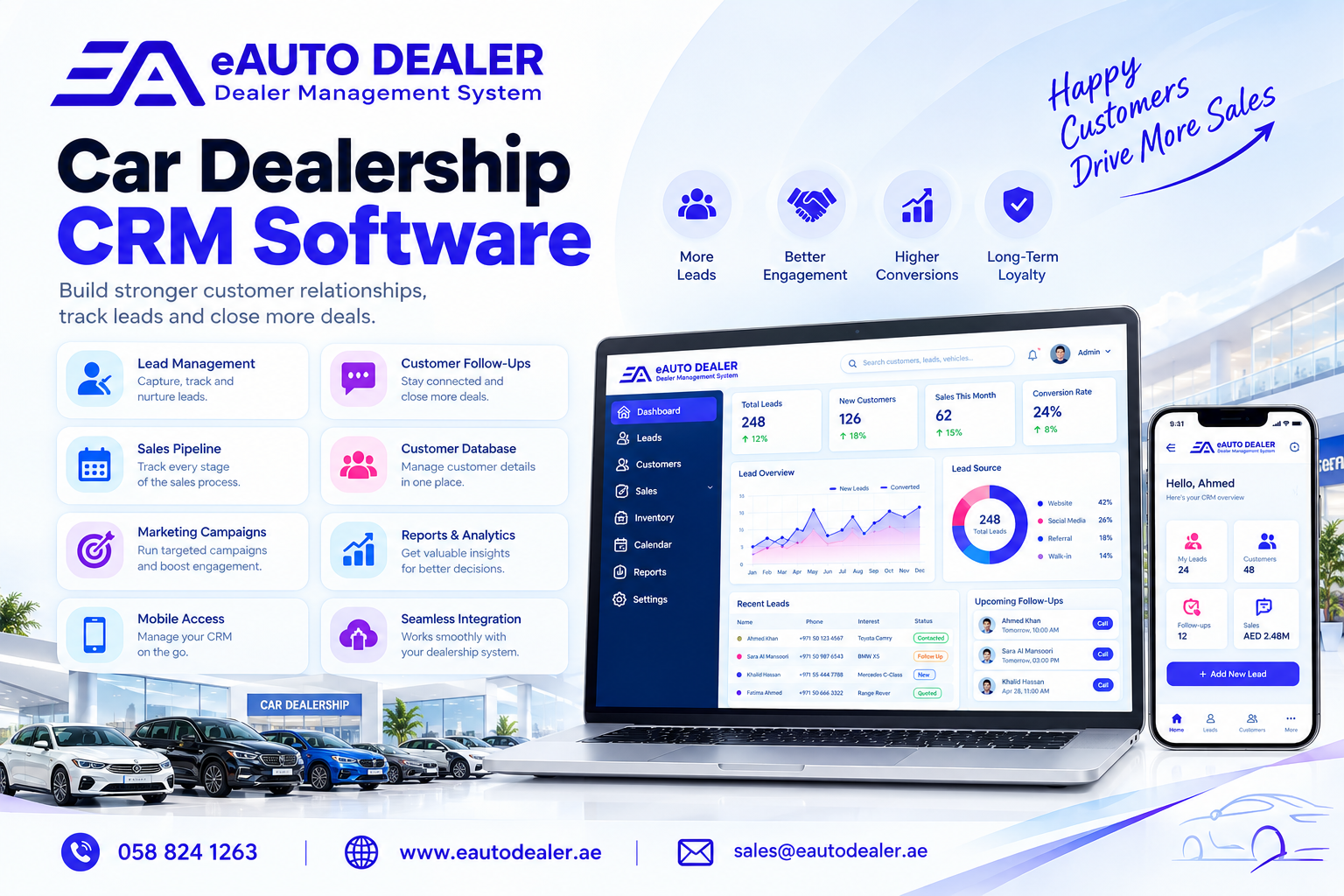
Lead and Contact Management
Store customer information, inquiries, preferences, communication history, and lead sources in one centralized database.
Follow-Up Management
Create reminders and activities for calls, emails, messages, appointments, and other customer interactions.
Sales Pipeline Management
Track opportunities from the first inquiry through qualification, negotiation, booking, and final sale.
Test Drive Management
Record test-drive appointments and connect them with customer and vehicle information.
Salesperson Performance Tracking
Managers can monitor lead assignments, follow-ups, conversions, sales activity, and individual salesperson performance.
Reporting and Dashboards
CRM dashboards can provide information about new leads, active opportunities, conversions, pending follow-ups, sales performance, and lead sources.
Benefits of CRM Software for Car Dealerships
A properly implemented CRM can improve several areas of dealership operations:
- Faster lead response: Sales teams can identify and handle new inquiries more efficiently.
- Better follow-ups: Automated reminders reduce missed customer interactions.
- Higher lead visibility: Managers can see active opportunities across the sales team.
- Improved customer experience: Sales representatives have access to relevant customer information.
- Better sales organization: Pipelines make it easier to manage opportunities.
- Improved reporting: Management can measure lead sources and sales performance.
- Reduced manual work: Centralized customer records reduce repetitive data entry.
- Stronger customer retention: Dealerships can continue engaging customers after a sale.
CRM Software and Omnichannel Lead Management
Modern customers may interact with dealerships through several channels before purchasing a vehicle. A prospect might first discover a vehicle online, contact the dealership through a messaging platform, call the showroom, and later visit for a test drive.
An automotive CRM helps create a connected customer history across these interactions. This means sales representatives can continue the conversation without starting from the beginning every time the customer changes communication channels.
How CRM Helps Improve Sales Conversion
A CRM does not automatically guarantee more sales. Its value comes from helping dealerships create a more organized sales process.
When leads are captured correctly, assigned quickly, followed up consistently, and moved through a defined pipeline, managers can identify where opportunities are being lost.
For example, if many customers request quotations but few schedule test drives, management can investigate that stage of the sales process. Similarly, if follow-ups are frequently delayed, CRM activity reports can highlight the issue.
This creates a data-driven approach to improving dealership sales performance.
CRM Software for UAE Car Dealerships
UAE dealerships operate in a competitive automotive market where customers may compare vehicles, prices, financing options, and dealerships before making a purchase. Fast communication and organized follow-up can therefore be important parts of the customer experience.
For dealerships operating in Dubai, Abu Dhabi, Sharjah, and other UAE locations, CRM software can also support multi-branch sales management. Managers can monitor leads, customer activity, sales opportunities, and salesperson performance across different showrooms.
When CRM is integrated with inventory and accounting systems, sales teams can work with more complete dealership information.
Choosing the Right Car Dealership CRM Software
Before selecting a CRM, dealerships should evaluate whether it supports their actual sales workflow.
Consider these factors:
Lead Sources
Check whether the system can organize leads from websites, phone inquiries, social media, online listings, and other sources.
Automotive Integration
The CRM should work with vehicle inventory so sales teams can quickly identify suitable vehicles for customers.
Follow-Up Automation
Look for reminders, scheduled activities, notifications, and workflow automation that help sales teams maintain consistent communication.
Reporting
Managers should be able to measure lead volume, conversion rates, salesperson activity, sales pipeline performance, and lead sources.
Multi-Branch Support
For dealership groups, branch-level lead management and centralized reporting can make operations easier to control.
Emirates Auto Dealer Management System for Better CRM Operations
Emirates Auto Dealer brings CRM and dealership operations together through a centralized automotive ERP platform. Its connected approach can help businesses manage leads, customers, sales, inventory, purchasing, accounting, garage operations, and reporting within one environment.
The Emirates Auto Dealer is designed for UAE dealerships that need cloud-based CRM, vehicle inventory management, multi-branch control, sales workflows, role-based access, and real-time business dashboards. Connecting customer information with vehicle and dealership data can give sales teams a more complete view of each opportunity.
Final Thoughts
Car dealership CRM software can transform lead management from a manual process into a structured and measurable sales workflow. By centralizing customer information, automating follow-ups, connecting leads with vehicle inventory, and providing clear sales pipelines, CRM technology helps dealerships manage opportunities more effectively. For modern automotive businesses, an integrated CRM can also connect sales with inventory, accounting, branch management, and other dealership operations, creating a stronger foundation for efficient customer management and sustainable sales growth.
Frequently Asked Questions
What is CRM software for car dealerships?
CRM software for car dealerships is a specialized customer management system that helps dealers capture leads, manage customer information, track follow-ups, organize sales opportunities, and improve customer engagement.
How does CRM improve dealership lead management?
It centralizes leads, assigns opportunities to sales representatives, provides follow-up reminders, tracks customer interactions, and helps managers monitor the sales pipeline.
Can dealership CRM software manage vehicle inventory?
Yes. Automotive CRM platforms can integrate with vehicle inventory systems, allowing sales teams to view available vehicles and match customer requirements with current stock.
Does CRM software help increase car sales?
CRM software can support better sales performance by improving lead response, follow-up consistency, pipeline visibility, and customer management. Actual sales results depend on the dealership’s processes and sales team.
Can CRM software manage multiple dealership branches?
Yes. Multi-branch CRM systems can allow businesses to manage leads and sales activities at individual locations while providing management with centralized reporting.