

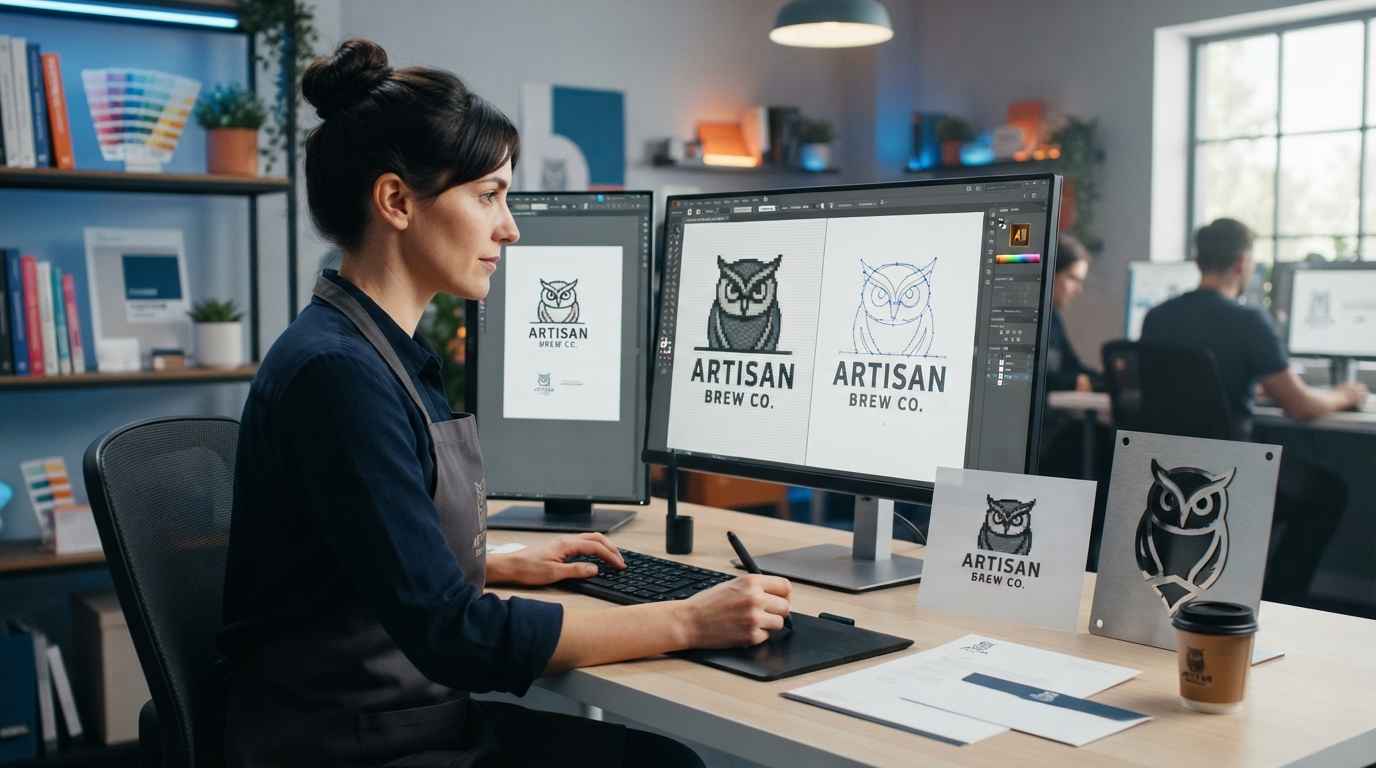
Many logos, signs, and printed graphics begin as raster images such as JPG, PNG, or scanned files. These formats can work well for websites and basic digital use, but they often become blurry when enlarged.
Professional raster to vector conversion provides a practical way to recreate these graphics as scalable vector artwork. Instead of relying on pixels, vector files use paths, curves, shapes, and fills that can be resized while maintaining clean edges.
This process is especially useful for businesses that need the same logo or artwork across different applications, from business cards and packaging to storefront signs and large-format printing.
However, quality depends on more than simply tracing an image. The artwork needs accurate shapes, clean paths, correct colors, and proper preparation for its final use.
What Is Raster to Vector Conversion?
Raster to vector conversion is the process of recreating a pixel-based image as vector artwork.
Raster files are made from individual pixels. Common examples include:
- JPG
- PNG
- BMP
- TIFF
- GIF
Vector files are built using mathematical paths and shapes. Common formats include:
- SVG
- EPS
- AI
The main advantage of vector artwork is scalability. A properly created vector logo can be used at a small size on a business card or enlarged for a building sign without the same pixelation found in a raster image.
Why Logos Often Need Vector Conversion
A company logo may be created years ago and only exist as a small JPG or PNG. While the file may look acceptable on a website, it may not be suitable for professional printing.
For example, enlarging a small raster logo can result in:
- Blurry edges
- Pixelation
- Rough curves
- Loss of small details
- Poor print quality
Recreating the logo as vector artwork gives the business a more flexible master file.
The vector version can then be resized and adapted for different marketing and production requirements.
Benefits of Vector Artwork for Logos
Better Scalability
Vector logos can be resized for different applications while maintaining clean shapes and edges.
Easier Editing
Individual elements can be modified when the artwork is properly constructed and organized.
Better Printing Flexibility
Printers often require vector artwork for certain professional applications, especially when precise shapes and scalable graphics are needed.
Consistent Branding
A clean master vector file can be used to create different logo versions while maintaining consistent proportions and design elements.
Multiple File Options
Once artwork has been professionally recreated, it can often be exported into several formats according to different requirements.
Raster to Vector Conversion for Business Signs
Signs often require artwork that can be enlarged significantly.
A logo that looks clear on a computer screen may not perform well when printed across a storefront, vehicle graphic, banner, or large sign.
Vector artwork helps solve this issue because paths can be scaled without depending on a fixed pixel resolution.
For sign projects, accurate vector artwork is particularly important for:
- Large storefront signs
- Outdoor business signs
- Vehicle graphics
- Banners
- Wall graphics
- Trade show displays
- Directional signs
The larger the final design, the more visible poor tracing and rough edges can become.
Why Sign Artwork Needs Clean Paths
Sign production may involve printing, cutting, engraving, or other manufacturing processes. In these situations, poorly created paths can cause technical problems.
A professional vector file should be checked for:
- Open paths
- Duplicate shapes
- Unnecessary anchor points
- Incorrect outlines
- Overlapping objects
- Missing elements
- Unwanted background objects
Clean paths make the artwork easier to edit and prepare for different production methods.
Raster to Vector Conversion for Print Design
Print design is another common reason to convert raster artwork into vector format.
Businesses may need the same graphic for:
- Business cards
- Brochures
- Flyers
- Posters
- Packaging
- Product labels
- Menus
- Promotional materials
A vector version gives designers more flexibility when changing dimensions or preparing artwork for different print products.
For example, a logo may need to appear on a small business card and later be used on a large promotional banner. A properly created vector file can support both applications.
Maintaining Accurate Logo Proportions
Accuracy is critical when recreating logos.
A professional conversion should preserve the original relationships between shapes, text, symbols, and other elements.
Important details include:
- Width and height
- Letter spacing
- Shape proportions
- Border thickness
- Alignment
- Object placement
- Internal spacing
Changing these elements can make the converted logo look noticeably different from the original.
Recreating Text Correctly
Text is often one of the most important parts of a business logo.
If the original font is available, it may be possible to recreate the lettering accurately. In other situations, letters may need to be converted into vector outlines.
The goal is to preserve:
- Letter shape
- Spacing
- Weight
- Alignment
- Proportions
A small difference in typography can change the appearance of an established brand identity.
Accurate Color Conversion
Color handling is also important when preparing vector artwork.
A raster image may contain colors that need to be recreated for the intended application. Digital artwork may use RGB colors, while professional printing may require CMYK or specific spot colors.
The correct color setup depends on the production process.
Before conversion begins, it is useful to provide brand color information if exact colors are important.
This can help reduce color differences between the source artwork and the final vector file.
Removing Backgrounds and Unwanted Elements
Low-resolution raster files can contain backgrounds, compression artifacts, shadows, and other elements that are not needed in the final artwork.
Professional conversion should identify which parts belong to the actual design.
For example, a business logo placed on a white JPG background may need the background removed so the logo can be placed on different materials.
Cleaning the artwork makes it more flexible for future design work.
Manual vs Automatic Raster to Vector Conversion
Many design applications include automatic tracing tools. These can be useful, especially for simple artwork.
However, automatic tracing may create excessive anchor points or inaccurate shapes.
Common problems include:
- Complicated paths
- Uneven curves
- Unwanted objects
- Incorrect colors
- Excessive detail
- Difficult editing
Automatic tracing can provide a starting point, but professional artwork often requires manual refinement.
Manual editing allows the designer to simplify paths, correct curves, rebuild important shapes, and remove unnecessary elements.
Choosing the Right Vector Format
The required file format depends on how the artwork will be used.
SVG
SVG is commonly used for websites, digital graphics, and certain cutting applications.
EPS
EPS is widely used for professional graphic design and printing workflows.
AI
AI is useful when the artwork needs continued editing in Adobe Illustrator.
PDF can contain vector elements and is commonly used for sharing and print production.
A professional provider should understand which format is appropriate for the project rather than supplying the same file type for every situation.
What Makes a High-Quality Vector Logo?
A quality vector logo should have clean paths, accurate proportions, and a structure that allows future editing.
Before accepting the final artwork, check:
- Are all curves smooth?
- Does the design match the original?
- Are the colors correct?
- Is the text accurate?
- Are unnecessary objects removed?
- Are the paths properly created?
- Is the artwork scalable?
- Is the file organized?
- Is the selected format suitable for production?
These checks are especially important when the artwork will become part of a company’s long-term branding system.
Preparing Artwork for Large Signs
Large-format artwork requires additional attention because imperfections become easier to see when the design is enlarged.
Before converting artwork for a large sign, provide:
- The highest-quality source image available
- Final sign dimensions
- Brand color information
- Any available original artwork
- Required file format
- Information about printing or cutting
- Details about the material being used
If the source image is extremely small or blurry, additional design reconstruction may be necessary.
Preparing Raster Artwork for Professional Printing
Before sending artwork to a print provider, confirm the production requirements.
Different printers may request different file formats, color settings, dimensions, or bleed specifications.
A professional vector conversion should therefore consider the final printing process.
For example, packaging artwork may require different preparation than a simple business card logo.
Providing the printer’s specifications before conversion can help ensure that the final file is suitable for production.
Common Problems With Poor Raster to Vector Conversion
Jagged Edges
Poor tracing can produce uneven lines and curves.
Excessive Anchor Points
Automatic tracing may create too many points, making the artwork difficult to edit.
Incorrect Proportions
Poor reconstruction can change the size or shape relationships within a logo.
Color Mismatch
The converted artwork may not accurately reproduce the original brand colors.
Unwanted Backgrounds
Background pixels can accidentally become part of the vector artwork.
Duplicate Objects
Poorly organized files may contain overlapping or duplicate shapes.
Incorrect Typography
Text may have altered letter shapes, spacing, or proportions.
These issues can create additional work when the artwork reaches the printing or production stage.
How to Choose a Professional Raster to Vector Service
When selecting a conversion provider, focus on the quality of the finished artwork rather than only the price.
Look for a provider that:
- Has experience with logos and commercial graphics
- Shows relevant portfolio examples
- Reviews the source artwork before conversion
- Understands different production requirements
- Provides appropriate file formats
- Offers revisions when needed
- Communicates clearly about project requirements
A good provider should also be able to explain how difficult or low-quality artwork will be handled.
Questions to Ask Before Ordering
Before sending your artwork, ask:
Will the artwork be manually refined after tracing?
This helps determine whether the final file will receive detailed cleanup.
Which formats will I receive?
Confirm that the provider can supply the file types needed for printing, editing, or production.
Can you preserve the original colors and proportions?
This is particularly important for established business logos.
Can you handle low-resolution images?
Ask how unclear or damaged source files will be reconstructed.
Are revisions included?
Knowing the revision policy can prevent misunderstandings later.
How to Check the Final Vector File
Before approving the finished artwork, inspect it at different sizes.
Look closely at curves, corners, lettering, and small details.
Also check whether the file contains unnecessary objects or hidden elements.
A useful final checklist includes:
- Accurate shapes
- Smooth curves
- Correct colors
- Clean typography
- Proper proportions
- Organized objects
- Clean paths
- No unwanted background
- Suitable vector format
- Good scalability
The file should also be tested according to its intended use whenever possible.
When Is Raster to Vector Conversion Worth It?
Professional conversion can be worthwhile when an important graphic only exists as a raster file.
Common situations include:
- An old company logo needs to be recreated
- A small logo must be enlarged for signage
- A scanned design needs to become editable
- A printer requests vector artwork
- Packaging artwork needs resizing
- A business needs consistent branding files
- Artwork must be prepared for cutting or manufacturing
For frequently used logos and graphics, having a clean vector master file can save time on future projects.
Final Thoughts
Professional raster to vector conversion gives businesses a practical way to turn pixel-based logos and graphics into scalable artwork for branding, signs, and print design. The quality of the result depends on accurate tracing, clean paths, correct colors, proper typography, and careful technical preparation.
Before choosing a conversion provider, review their experience, portfolio, file formats, revision process, and approach to complex artwork. A professionally prepared vector file should not only look accurate on screen but also be ready for its intended production purpose.
When these factors are handled correctly, iDigitize can help turn existing raster artwork into clean, scalable vector files suitable for different business and production needs.
FAQs
Q1. Why should I convert a logo from raster to vector?
Converting a raster logo to vector makes it easier to resize, edit, and prepare for different printing and branding applications without the same pixelation issues.
Q2. Can a JPG logo be converted into an editable vector?
Yes. A JPG logo can be recreated as vector artwork. The level of editing possible depends on how the vector file is constructed and organized.
Q3. What is the best vector format for printing?
EPS, AI, SVG, and PDF can all be useful for printing. The best choice depends on the printer’s requirements and the type of project.
Q4. Can vector artwork be used for large signs?
Yes. Vector artwork is well suited to large signs because it can be scaled while maintaining clean paths and edges.
Q5. Is automatic tracing good enough for a business logo?
Automatic tracing may work for simple graphics, but important logos often need manual refinement to achieve accurate shapes, curves, colors, and typography.
Q6. What should I provide for raster to vector conversion?
Provide the highest-quality source image available along with final dimensions, brand colors, required file format, and information about how the artwork will be used.