





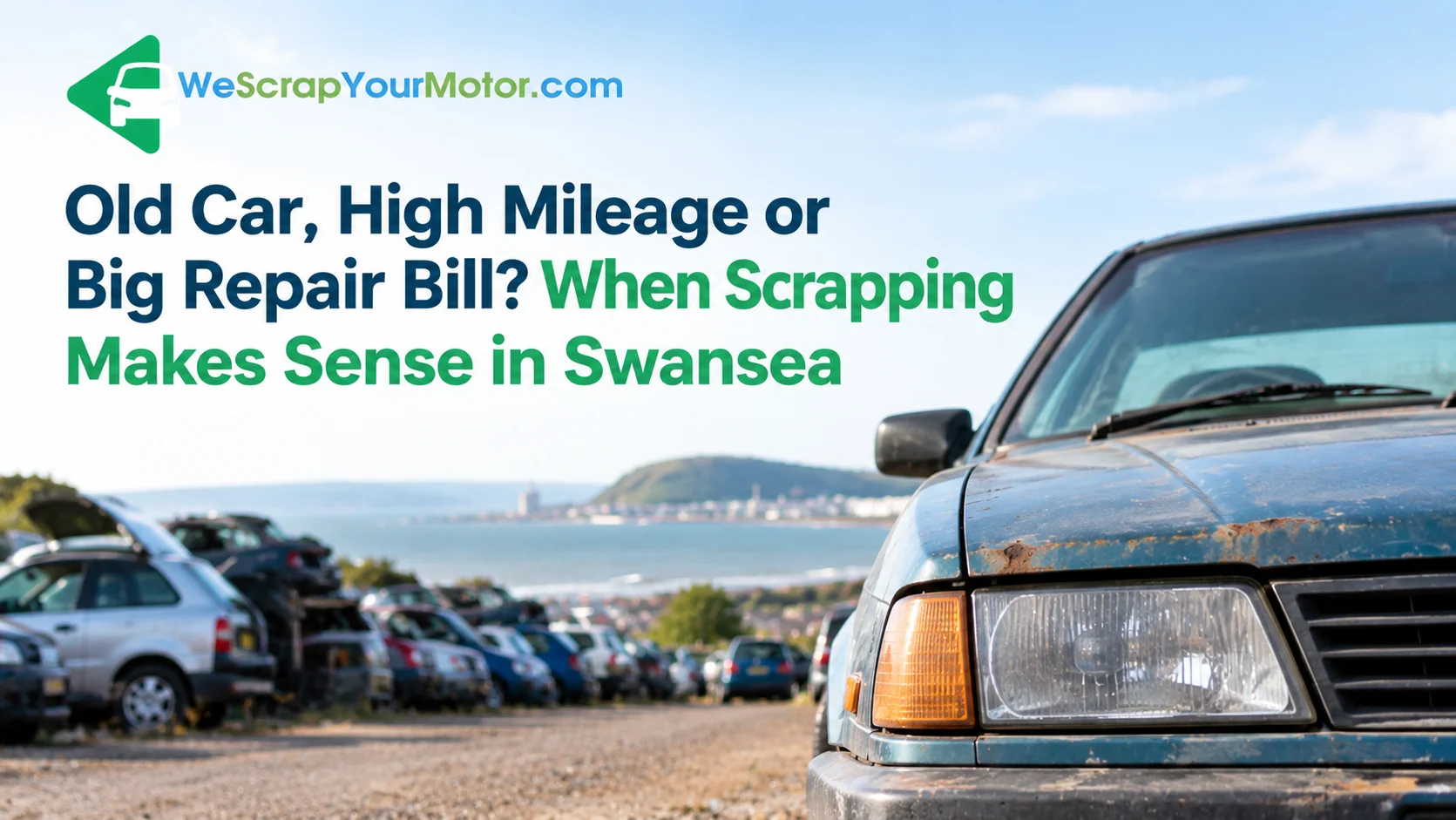
Many motorists searching scrap my car Swansea are not dealing with a vehicle that suddenly became worthless overnight.
Usually, the decision develops gradually.
The car gets older.
Mileage increases.
A few MOT advisories appear.
Repairs become more frequent.
Eventually, the owner has to decide whether another garage bill will genuinely extend the car’s useful life or simply postpone a larger expense.
There is no specific age or mileage at which every car should be scrapped.
The right time depends on condition, reliability, repair costs, market value and what you would need to spend to replace the vehicle.
High Mileage Does Not Automatically Mean Scrap
A six-figure mileage reading can look alarming, but mileage alone is a poor reason to dispose of a vehicle.
A well-maintained 130,000-mile car can sometimes be more dependable than a neglected car with half that mileage.
Instead of focusing only on the odometer, consider:
- Service history
- Oil-change intervals
- Engine condition
- Gearbox condition
- Corrosion
- Suspension
- MOT history
- Breakdown frequency
A high-mileage car that starts reliably, passes its MOT and has been properly maintained may still provide useful transport.
Age Can Matter Even With Low Mileage
Low mileage does not guarantee good condition either.
Cars deteriorate through age as well as use.
Older vehicles can experience problems with:
- Rubber seals
- Hoses
- Electrical connections
- Suspension bushes
- Corrosion
- Batteries
- Braking components
- Plastics and trim
A vehicle that has covered relatively few miles but spent many years exposed to weather can still require substantial maintenance.
Age and mileage should therefore be considered together.
The Repair Bill Is Only the Beginning
Suppose your vehicle is worth around £2,000 in good working order and your garage recommends an £800 repair.
Should you approve it?
Perhaps.
But first ask what else the vehicle is likely to need.
If that £800 repair is followed by tyres, brakes, suspension work and another MOT repair, your actual twelve-month expenditure could be much higher.
List known upcoming costs before deciding.
This can include:
- Current repair
- MOT work
- Servicing
- Tyres
- Brakes
- Timing belt
- Clutch
- Suspension
- Known warning lights
The question is not simply whether you can afford today’s repair.
It is whether the vehicle justifies the total investment.
Look for a Pattern of Failures
One breakdown does not necessarily make a vehicle uneconomical.
Repeated breakdowns are more concerning.
For example, imagine that during the past year a vehicle has required:
- Alternator replacement
- Cooling-system repairs
- Suspension work
- Electrical diagnosis
- MOT repairs
Now the gearbox is beginning to fail.
The newest fault should not be assessed in isolation.
The pattern suggests several systems are ageing simultaneously.
At that stage, obtaining a disposal valuation can be sensible before authorising another large repair.
Check the MOT History
MOT records can reveal how the vehicle is ageing.
Pay attention to recurring advisories relating to:
- Corrosion
- Suspension
- Steering
- Brakes
- Tyres
- Emissions
One advisory may simply need monitoring.
A growing list of recurring defects can indicate that future maintenance costs are increasing.
Motorists should consider the complete financial picture around an upcoming MOT rather than automatically scrapping a vehicle simply because another test is due.
Serious Corrosion Changes the Calculation
Corrosion deserves particular attention because structural deterioration can become expensive and safety-critical.
Ask a qualified garage to assess the extent of any serious rust.
Do not rely only on what is visible from outside.
Some corrosion can be repaired economically.
Extensive structural corrosion on a low-value older vehicle may be much harder to justify financially.
This is one area where professional assessment is more valuable than guesswork.
What If the Engine or Gearbox Fails?
Engine and gearbox problems can quickly change the economics of an older car.
However, even a major fault does not automatically mean scrapping is the only option.
Compare:
- The vehicle’s working value
- The cost of repair or replacement component
- The vehicle’s current faulty value
- Its scrap or salvage value
- Its overall condition
A valuable car with one repairable mechanical problem may still justify the work.
An older vehicle with engine failure, serious corrosion and several MOT problems presents a very different case.
Non-Running Cars Can Still Have Value
A vehicle does not need to drive to retain value.
A non-runner may still contain usable:
- Body panels
- Wheels
- Lights
- Interior components
- Electronics
- Gearbox
- Starter motor
- Alternator
- Other reusable parts
It also contains recyclable materials.
For that reason, do not assume a car that will not start has no value.
Describe its condition accurately and obtain a proper quotation.
Scrap or Salvage?
These terms are sometimes used as though they mean exactly the same thing, but the value can differ.
A genuine end-of-life vehicle may be destined for permanent recycling.
A salvage vehicle may still contain enough reusable or repairable value to justify a different route.
For example, an accident-damaged newer vehicle could have substantial parts value even if repairing the complete car is uneconomical.
Repairable faults, reusable parts and market demand can make some damaged vehicles more valuable than their raw material content alone.
Getting a Local Quote in Swansea
Once repair no longer appears economical, obtain a current valuation before spending more money on the vehicle.
Drivers looking to scrap my car in Swansea can use We Scrap Your Motor to request a quote for unwanted, damaged and non-running vehicles.
Providing accurate details about registration, location, condition and missing parts can help produce a more realistic quotation and allow the correct collection arrangements to be made.
Mention if:
- The vehicle does not start
- Wheels are missing or locked
- Steering is damaged
- Parts have been removed
- There are access restrictions
- The vehicle is heavily accident damaged
Good information helps avoid misunderstandings later.
What Happens to an End-of-Life Vehicle?
If the vehicle is being permanently scrapped, it should enter the regulated end-of-life vehicle system.
UK guidance says cars that have reached the end of their useful life must be taken to an Authorised Treatment Facility.
Qualifying cars and light vans that are completely destroyed can receive a Certificate of Destruction.
This provides formal evidence that the vehicle has entered the destruction process.
Make sure DVLA is also correctly informed of the disposal.
How Should You Be Paid in Wales?
This point is particularly important for Swansea drivers.
When a vehicle is genuinely being purchased as scrap in England or Wales, physical cash payment is not permitted.
Payment should be made using a permitted traceable method such as bank transfer or cheque.
A company offering lawful, traceable payment is therefore preferable to someone offering a suspicious cash-only collection for an end-of-life car.
Signs That Scrapping May Now Make Sense
There is no universal formula, but the case becomes stronger when several of these conditions apply:
- Repair costs are greater than realistic vehicle value
- The vehicle has serious structural corrosion
- Breakdown frequency is increasing
- Engine or gearbox repairs are required
- Several MOT defects exist
- Maintenance costs are becoming unpredictable
- The vehicle is no longer dependable
- A suitable replacement is financially realistic
One factor alone may not settle the decision.
Several appearing together usually deserve closer attention.
Signs That Repairing May Still Be Better
Do not dispose of the car too quickly if:
- The current problem is isolated
- Repair cost is predictable
- The rest of the vehicle is healthy
- Maintenance history is strong
- The car remains reliable
- Replacement would be significantly more expensive
A £500 repair on a low-value car can still make financial sense if it buys another two years of reliable transport.
Vehicle value is only part of the equation.
Frequently Asked Questions
Is a 100,000-mile car ready for scrap?
Not necessarily. Maintenance, condition, MOT history and reliability matter more than a specific mileage figure.
Can I scrap a car that no longer starts?
Yes. Non-running vehicles can be collected using appropriate recovery equipment.
Should I repair an old car before selling or scrapping it?
Only if the increase in vehicle value is likely to justify the repair cost. Do the calculation before spending money.
Can a failed MOT car still have value?
Yes. Depending on the vehicle and faults, it may have repair, salvage, parts or scrap value.
What should I do before collection?
Confirm the quotation, prepare any required documents, remove personal belongings, discuss access conditions and understand the DVLA process.
Final Thoughts
Searching scrap my car UK does not necessarily mean your car belongs in a scrapyard today.
Start with the numbers.
Estimate the car’s realistic working value.
Get a proper repair estimate.
Add the maintenance likely to be needed over the next year.
Check what the vehicle is worth in its current condition.
Then compare those figures with the cost of replacing it.
Keep repairing when the money buys useful and dependable future motoring.
Consider selling, salvaging or scrapping when each new repair only delays another expensive problem.
That is a far better way to decide than relying on age, mileage or one failed MOT alone.