






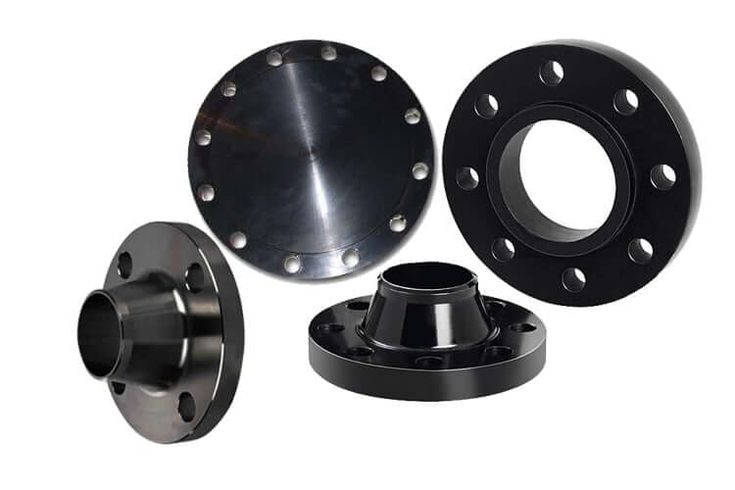
Carbon Steel Flanges connect pipes, valves, pumps and vessels into sealed, bolted assemblies that engineers can open for inspection. Weld neck, slip-on, blind, socket weld, threaded and lap joint remain the six types specified most often. Carbon steel delivers high tensile strength at moderate cost, and it performs across a wide band of pressures and temperatures. Oil and gas, power generation, chemical processing, water treatment and manufacturing all depend on these joints for routine piping connections.
What Are Carbon Steel Flanges
A flange forms a flat collar at the pipe end, bolted to a matching face with a gasket compressed between them. CS Flanges come mainly from forged grades: ASTM A105 for ambient and elevated service, A350 LF2 for low-temperature duty, and A694 for pipeline work. Dimensions, facings and bolt circles follow ASME B16.5 for NPS ½ to 24, and ASME B16.47 above that size. Pressure classes run from 150 to 2500. Bolted joints open without cutting the line, so inspection and part replacement don’t interrupt the wider system.
Common Types of Carbon Steel Flanges
Weld Neck Flanges
Weld neck flanges carry a tapered hub butt-welded to the pipe, which transfers stress gradually and suits cyclic, high-pressure, and elevated-temperature service.
Slip-On Flanges
The pipe slides inside a slip-on flange, and then two fillet welds secure it. Fabrication costs less, and the design fits low to moderate pressure lines.
Blind Flanges
A blind flange is a solid disc that closes a pipe end, valve port or vessel opening, allowing isolation, pressure testing and later expansion.
Socket Weld Flanges
Socket weld flanges take the pipe into a counterbored socket secured by a fillet weld. Specifications restrict them to NPS 2 and smaller.
Threaded Flanges
Threaded flanges screw onto matching male pipe threads, avoiding any welding. Low-pressure utility lines and sites barred from hot work suit them best.
Lap Joint Flanges
Lap joint flanges sit loose over a stub end and rotate freely, which speeds bolt hole alignment on lines dismantled often for cleaning.
Correct selection follows from piping design, pressure class, operating temperature, material compatibility and the governing code, with published carbon steel flange dimension charts settling the final geometry.
Industrial Uses of Carbon Steel Flanges
Carbon steel flanges appear wherever process piping needs bolted connections that site teams can break open for maintenance and repair.
Oil and Gas
Upstream and refinery piping uses weld neck and blind types on wellhead manifolds, separators and transfer lines. Class 900 to 2500 ratings handle sour service pressures where specified materials permit.
Power Generation
Steam headers, feedwater lines and condenser cooling circuits rely on forged carbon steel joints. ASTM A105 flanges serve saturated and superheated steam duties within the stated temperature limits of the grade.
Chemical Processing
Process lines carrying non-corrosive hydrocarbons, solvents and utility media use carbon steel joints. Where acids or chlorides contact the wetted surface, lined or alloy alternatives replace them at the design stage.
Water Treatment
Raw water intakes, clarifier headers and distribution mains join through slip-on and blind flanges. Galvanising, epoxy coating or cathodic protection controls corrosion on long buried and submerged pipe runs.
Manufacturing
Compressed air, cooling water, thermal oil and steam utility headers run on bolted carbon steel connections. Plant teams break these joints during shutdowns to clean strainers and swap valves.
Flange choice depends on the fluid handled, operating pressure and temperature, corrosion risk, and the specification governing the plant, which usually also lists compatible carbon steel pipe fittings for the same line.
Benefits of High Strength Carbon Steel Flanges
High Strength Carbon Steel Flanges deliver measurable gains in strength, service life, availability and maintenance access when the specification matches the duty.
- Forged grades such as A694 F60 and F65 carry higher yield strength than A105, which supports thinner walls at the same pressure class.
- Service life improves when the grade, wall thickness and protective coating match the operating environment rather than the lowest acceptable specification.
- Six flange types, nominal sizes from ½ inch to 60 inches, and pressure classes from 150 to 2500 cover most piping layouts.
- Bolted construction lets maintenance crews isolate a section, replace a gasket and reinstate the joint without cutting or rewelding pipe.
- Carbon steel costs less than stainless or nickel alloys, though lifecycle corrosion allowance and coating upkeep belong in any honest comparison.
How to Choose the Right Carbon Steel Flange
Six checks decide whether a flange fits the line, and skipping any of them shows up later as leakage.
- Confirm the design pressure and temperature against the rating table for the chosen material group, since ratings fall as temperature rises.
- Match the flange type to the piping layout, available space, welding access and the frequency of planned dismantling.
- Select a material grade compatible with the fluid, the service temperature and the corrosion allowance stated in the line specification.
- Verify nominal pipe size, outside diameter, thickness, facing type such as raised face or ring joint, and bolt hole pattern.
- Check the governing dimensional standard, with ASME B16.5 flanges covering NPS ½ to 24 and ASME B16.47 applying beyond that size.
- Ask the supplier for mill test certificates, heat numbers and dimensional reports before accepting Carbon Steel Flange Fittings into stores.
Gasket material, bolt grade, a controlled tightening sequence and post-installation inspection carry equal weight in a leak-free joint.
Conclusion
Weld neck, slip-on, blind, socket weld, threaded and lap joint designs each answer a different connection requirement in process piping. Pressure, temperature, material grade, layout, and the governing code together decide which one belongs on a given line. Engineers should verify technical specifications before ordering Carbon Steel Flanges and matching fittings for the intended service.