



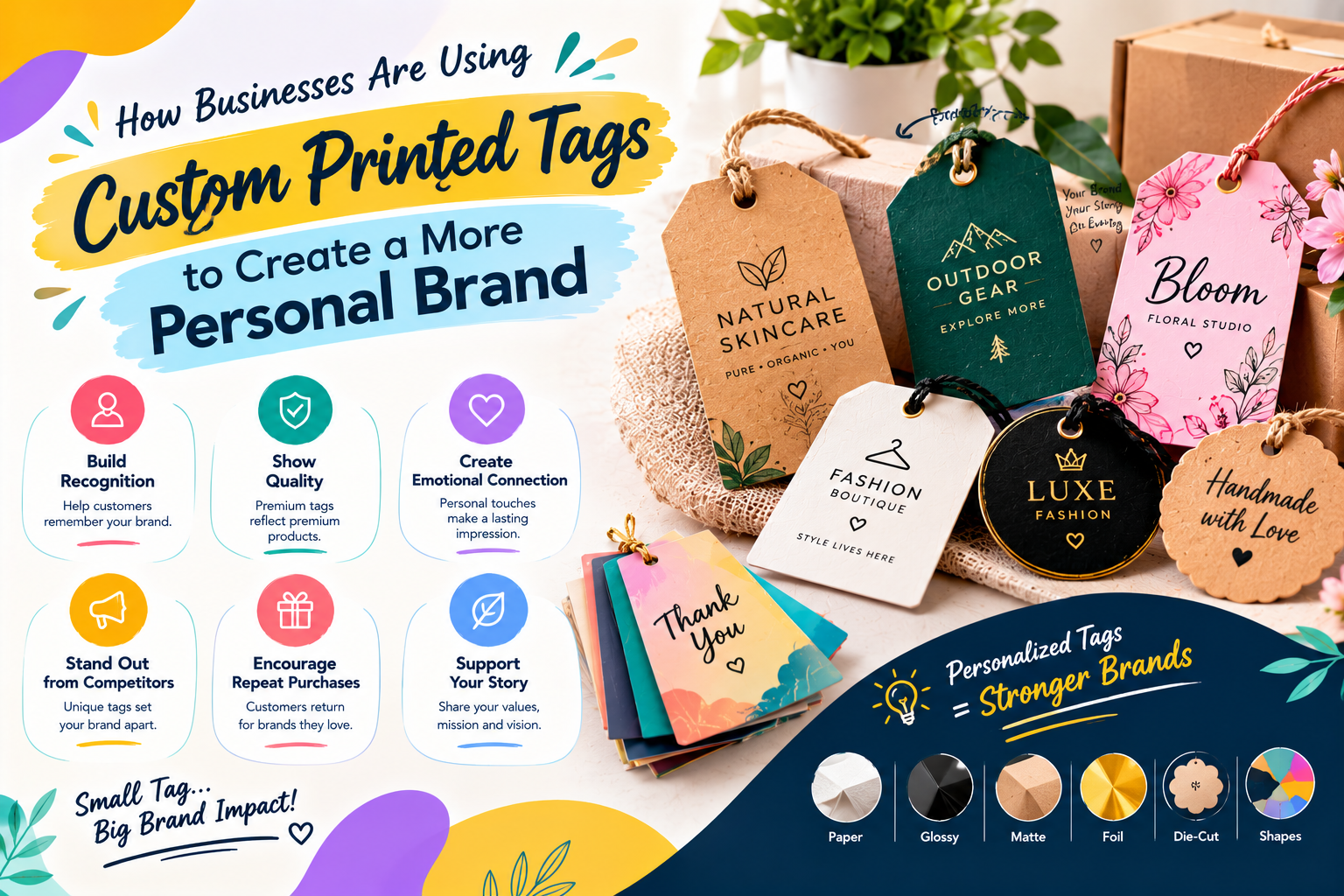
A brand can have a beautiful logo, a polished website, carefully designed packaging, and an active social media presence, yet still feel distant.
Why?
Because branding is not only about how a business looks. It is also about how it makes people feel.
Customers increasingly notice the small details that make an interaction feel thoughtful rather than purely transactional. A handwritten note, a carefully selected package, a memorable product detail, or a simple message can change the way someone experiences a purchase.
This is where custom printed tags can play an unexpectedly important role.
Tags are often associated with product names, prices, sizes, or basic information. But businesses are finding more creative ways to use them as small pieces of brand communication. A thoughtfully designed tag can introduce the people behind a business, explain a product, share a message, create a sense of occasion, or simply make customers feel appreciated.
The physical size of a tag may be small, but its role does not have to be.
When used intentionally, custom printed tags can help transform a business from something customers simply buy from into a brand they feel more connected to.
Personal Branding Starts With the Small Details
People rarely experience a brand through one single interaction.
They encounter it through dozens of small details.
They may see a logo on social media, visit a website, receive an order, open the packaging, touch the product, read an instruction, contact customer support, and eventually decide whether they want to purchase again.
Every one of these moments contributes to their impression of the business.
A custom printed tag can become part of that physical experience.
Instead of simply displaying information, it can communicate personality.
A playful brand might use humor. A handmade business might emphasize craftsmanship. A premium brand might choose understated wording and an elegant design. A family-owned company might use a warm and conversational message.
The tag becomes another opportunity to sound like the brand.
And when those small interactions feel consistent, the business can begin to feel more human.
A Tag Can Introduce the Person Behind the Product
One of the simplest ways to make a brand feel personal is to show that real people are behind it.
Customers do not necessarily need a complete biography. Sometimes, a short sentence is enough.
A handmade product could include a tag that introduces the maker. A small clothing label might explain who designed the collection. A local food business could mention the inspiration behind a recipe or product.
This kind of information gives context to the purchase.
Instead of seeing an anonymous item, the customer gets a glimpse of the person or idea behind it.
That distinction matters because products are often easier to connect with when there is a story attached to them.
A tag gives businesses a physical place to tell a very small part of that story.
Replace Generic Messages With Something That Sounds Real
One of the easiest ways to make a brand feel impersonal is to rely on language that could belong to almost any company.
“Thank you for your purchase” is perfectly acceptable, but it does not necessarily tell the customer anything about the business.
Custom printed tags allow brands to make these messages more distinctive.
A business can use wording that reflects its personality instead of relying on standard corporate phrases.
A cheerful brand might use an enthusiastic message. A minimalist business may prefer something simple and understated. A creative company could use a playful line that reflects its identity.
The goal is not to sound clever for the sake of being clever.
The goal is to sound like a real person speaking to another person.
That difference can make a small message much more memorable.
Give Customers a Reason to Pause
Most physical marketing materials compete for attention.
A tag has an advantage because it is attached to something the customer already chose to purchase.
That means the customer has a natural reason to look at it.
Businesses can use this moment to communicate something unexpected.
Instead of another sales message, a tag might include:
- A short story about the product
- A useful care tip
- A question for the customer
- A product recommendation
- A behind-the-scenes detail
- A small piece of brand history
- A creative message related to the product
The content does not need to be lengthy.
In fact, shorter messages often work better because they respect the limited space and the customer’s attention.
A good tag should make the customer think, “That’s a nice detail.”
That reaction is often more valuable than trying to squeeze another promotion into the design.
Turn Product Stories Into Physical Experiences
Every product has a story, even if the story is simple.
Maybe a particular color was inspired by a place. Maybe the product was created after customers repeatedly asked for it. Maybe a particular material was selected because it suited the purpose better.
These details can make a product more interesting.
A custom printed tag gives businesses a simple way to share them.
For example, a small jewelry company could explain the inspiration behind a collection. A candle brand could introduce the idea behind a fragrance. A clothing business could explain the concept behind a seasonal design.
Customers may not remember every detail, but one memorable sentence can change how they perceive the product.
The product is no longer just an object.
It has context.
Make Different Customers Feel Like the Message Was Meant for Them
Personalization does not always require printing a customer’s name.
Businesses can create a sense of personal relevance simply by changing the message according to the product, collection, occasion, or customer journey.
For example, a gift business could use different tags for birthdays, weddings, holidays, or general gifting.
A fashion brand might create separate messages for new collections.
A food company could use different tags for first-time purchases and returning customers.
This approach makes the interaction feel more intentional without requiring complicated technology.
The customer sees a message that makes sense for the situation they are in.
That is a simple but effective form of personalization.
Let the Design Speak Before the Words Do
Personal branding is not only about copy.
The appearance of the tag also communicates something.
A tag with soft colors, handwritten typography, and natural textures can create a completely different impression from one featuring bold colors, sharp typography, and a modern layout.
Neither approach is automatically better.
The right choice depends on the personality the business wants to communicate.
For example:
- A handmade business may benefit from a warm, tactile appearance.
- A modern technology brand may prefer a clean and minimal design.
- A children’s brand can use playful illustrations and bright colors.
- A premium business might choose restrained colors and refined typography.
An environmentally focused company may choose visual elements that support its natural aesthetic.
The important thing is consistency.
If the tag looks completely different from the website, packaging, and other branded materials, it can weaken the overall identity.
When the visual language is consistent, even a small tag can reinforce recognition.
Use Tags to Make Handmade Products Feel Even More Human
Handmade and artisan businesses have a natural advantage when it comes to personal branding.
The human element is already part of the product.
Custom printed tags can bring that element closer to the customer.
A tag could mention who made the item, where it was created, what inspired it, or what makes the production process distinctive.
It does not need to reveal every detail.
One genuine insight can be enough.
For example, a customer buying a handmade item may appreciate knowing that each piece is finished individually rather than produced as a mass-market product.
The tag helps communicate that difference at exactly the moment the customer is interacting with the physical item.
Create Tags That Feel Like Part of the Product
A common mistake is treating the tag as something added at the very end.
Instead, businesses can design the tag as part of the overall product experience.
Its shape can complement the product.
Its colors can match the packaging.
Its typography can reflect the brand.
Also, message can reinforce the purpose of the item.
Even the choice of material can contribute to the experience.
When all of these elements work together, the tag stops looking like an extra piece of paper attached to a product.
It feels intentional.
And intentional details often make a product feel more carefully considered.
Use the Back of the Tag as Valuable Brand Space
Businesses sometimes focus entirely on the front of a tag and leave the back empty.
That is a missed opportunity.
The reverse side can contain information that supports the customer experience without overcrowding the primary design.
For example, the front could feature the brand and a short message, while the back provides:
- Product care instructions
- A short brand story
- A QR code
- Social media information
- A thank-you note
- A product-use suggestion
- A small illustration
- A customer prompt
This creates two layers of communication.
The first side catches attention.
The second side provides additional value.
Of course, leaving some blank space can also be a deliberate design decision. The goal is not to fill every available inch but to use the space intelligently.
Connect Physical Branding With Digital Conversations
A personal brand should not stop at the physical product.
Custom printed tags can connect customers with the digital side of a business.
A QR code can lead customers to a product demonstration, behind-the-scenes video, care instructions, a collection page, or another useful destination.
But the important part is the reason behind the scan.
A customer is more likely to interact when they understand what they will receive.
Instead of simply placing a QR code on the tag, businesses can frame it with a clear message.
For example:
- “See how we made it.”
- “Discover the story behind this collection.”
- “Need help caring for your product?”
These messages make the digital interaction feel useful rather than promotional.
The tag becomes a bridge between the physical and digital brand experience.
Use Seasonal Tags to Keep the Brand Feeling Fresh
A consistent brand identity does not mean everything has to look identical forever.
Seasonal tags can give businesses an opportunity to introduce variety while maintaining recognizable brand elements.
A holiday collection might use a special message.
A summer launch could feature a brighter visual treatment.
A business anniversary might include a short note about the milestone.
A limited collection could receive its own tag design.
This creates a feeling of movement around the brand.
Customers can recognize the business while also noticing that something is different.
For brands that release products throughout the year, this can be an especially useful way to keep physical branding from becoming repetitive.
Make Customers Feel Appreciated Without Constantly Selling
There is a major difference between communication and promotion.
If every tag is trying to sell something, the customer experience can quickly feel commercial.
Personal branding works better when businesses occasionally communicate simply because they want to create a better experience.
A thank-you message does not always need a discount attached.
A product story does not need a sales pitch at the end.
A care tip does not need a promotion.
Sometimes, useful or thoughtful information is enough.
This restraint can actually make later promotional messages feel more credible because the customer is not being sold to every time they interact with the brand.
Create a Familiar Signature Customers Can Recognize
Some businesses develop a recognizable style through repeated physical details.
The tag can become one of those details.
Maybe the business always uses a particular color combination. Perhaps every tag contains a short handwritten-style phrase. Another brand might use a recurring illustration or distinctive shape.
Over time, these details can become associated with the company.
A customer might see the tag and recognize the brand before reading the business name.
That is a sign that the visual identity is doing its job.
The goal is not to create something complicated.
It is to create something consistent enough to become familiar.
Use Tags to Celebrate the Customer’s Purchase
A purchase can be more than a transaction.
For certain products, it represents a milestone, gift, personal treat, achievement, or special occasion.
Businesses can acknowledge that feeling through their tags.
A fitness-related brand could celebrate progress.
A gift business could make the moment feel more special.
A luxury product could use a tag that emphasizes the experience of receiving something carefully selected.
The exact message depends on the business, but the underlying idea is simple:
Recognize what the purchase means to the customer.
When a brand shows that it understands the emotional side of buying, it can feel more personal.
Don’t Confuse Personal With Overly Familiar
There is an important balance to maintain.
A personal brand should feel warm and human, but it should still respect the customer’s boundaries.
Not every business needs to use overly casual language.
Not every customer wants jokes, excessive enthusiasm, or a message that feels too familiar.
The right tone depends on the audience.
A professional business may choose thoughtful and polished wording. A youthful lifestyle brand might be more conversational. A luxury business may communicate through simplicity rather than friendliness.
Personalization works best when it feels appropriate.
The objective is to create connection, not to force familiarity.
The Physical Quality of the Tag Matters Too
Words and design are important, but the physical feel of the tag can influence perception.
A flimsy tag attached to a premium product may feel inconsistent.
A thoughtfully selected material can reinforce the personality of the business.
Businesses can consider factors such as:
- Thickness
- Texture
- Shape
- Color
- Printing quality
- Finish
- Attachment style
These choices should support the brand rather than distract from it.
For a premium product, a refined physical presentation may reinforce quality.
For a handmade business, a more natural or tactile appearance may feel appropriate.
The tag should feel like it belongs there.
Personal Branding Does Not Require a Huge Budget
One of the appealing things about custom printed tags is their scalability.
A business does not necessarily need an elaborate packaging system or expensive promotional campaign to introduce more personality into its customer experience.
A small printed tag can carry a thoughtful message and reinforce the brand without taking over the entire presentation.
This makes tags particularly useful for growing businesses that want to improve their physical branding gradually.
Start with one purpose.
Test a message.
See how customers respond.
Then refine the design as the business develops.
Personal branding is built through many small decisions, not one massive investment.
What Makes a Custom Tag Feel Personal?
The answer is rarely a single design trick.
A personal tag usually combines several elements:
- Language that sounds natural
- A clear connection to the brand
- Useful or interesting information
- Thoughtful design
- Appropriate personalization
- A message that fits the product
- Consistency with the wider customer experience
Most importantly, it should have a reason for existing.
If the only purpose is to display a logo, the tag may not contribute much beyond basic identification.
But if it helps the customer understand, appreciate, use, or remember the product, it becomes far more valuable.
Final Thoughts
Building a personal brand is not only about creating a memorable logo or choosing the perfect brand colors.
It is about creating moments that feel intentional.
Custom printed tags give businesses one more opportunity to create those moments.
They can introduce the person behind a product, share a story, offer useful advice, recognize a special occasion, connect customers with digital content, or simply say something that feels genuine.
The best part is that the approach does not require every business to become overly informal or complicated.
- Personal branding can be quiet.
- It can be elegant.
- It can be playful.
- It can be practical.
What matters is that the customer can sense that some thought went into the experience.
A small tag cannot build a brand on its own.
But when it becomes part of a consistent, thoughtful customer experience, it can help transform a product from something people simply purchase into something they remember.
And that is ultimately what a personal brand is trying to achieve: not just recognition, but connection.
Frequently Asked Questions
What are custom printed tags?
Custom printed tags are branded or informational tags designed specifically for a business, product, collection, event, or campaign. They can include logos, messages, product information, care instructions, stories more human and thoughtful way. A tag can share a thank-you message, introduce the maker, explain a product story, or provide useful information that makes the customer experience feel, QR codes, or other relevant content.
How can custom printed tags make a brand feel more personal?
They give businesses a physical space to communicate in a more human and thoughtful way. A tag can share a thank-you message, introduce the maker, explain a product story, or provide useful information that makes the customer experience feel more intentional.
Can small businesses benefit from personalized tags?
Yes. Custom tags can be particularly useful for small businesses because they provide an affordable way to add personality to physical products without requiring a large-scale branding campaign.
What should a business put on a custom printed tag?
The content depends on the purpose. Businesses can include a short thank-you message, brand story, product information, care instructions, a QR code, collection details, or another piece of information that adds value to the customer experience.
Are custom printed tags useful for online businesses?
Yes. E-commerce businesses can use tags inside shipped products to create a stronger physical connection with customers. They can also connect buyers to digital content through QR codes or other calls to action.
Should a custom printed tag always include a logo?
Not necessarily, but the tag should usually contain enough visual or written branding for customers to associate it with the business. The logo can be included subtly if a more natural design is preferred.
How can businesses avoid making personalized tags feel too promotional?
Focus on adding value rather than constantly selling. A useful tip, genuine thank-you, interesting story, or thoughtful message can often create a stronger personal impression than a tag filled with discounts and sales language.
Source Link: https://ibexpackaging.com/custom-tags/