





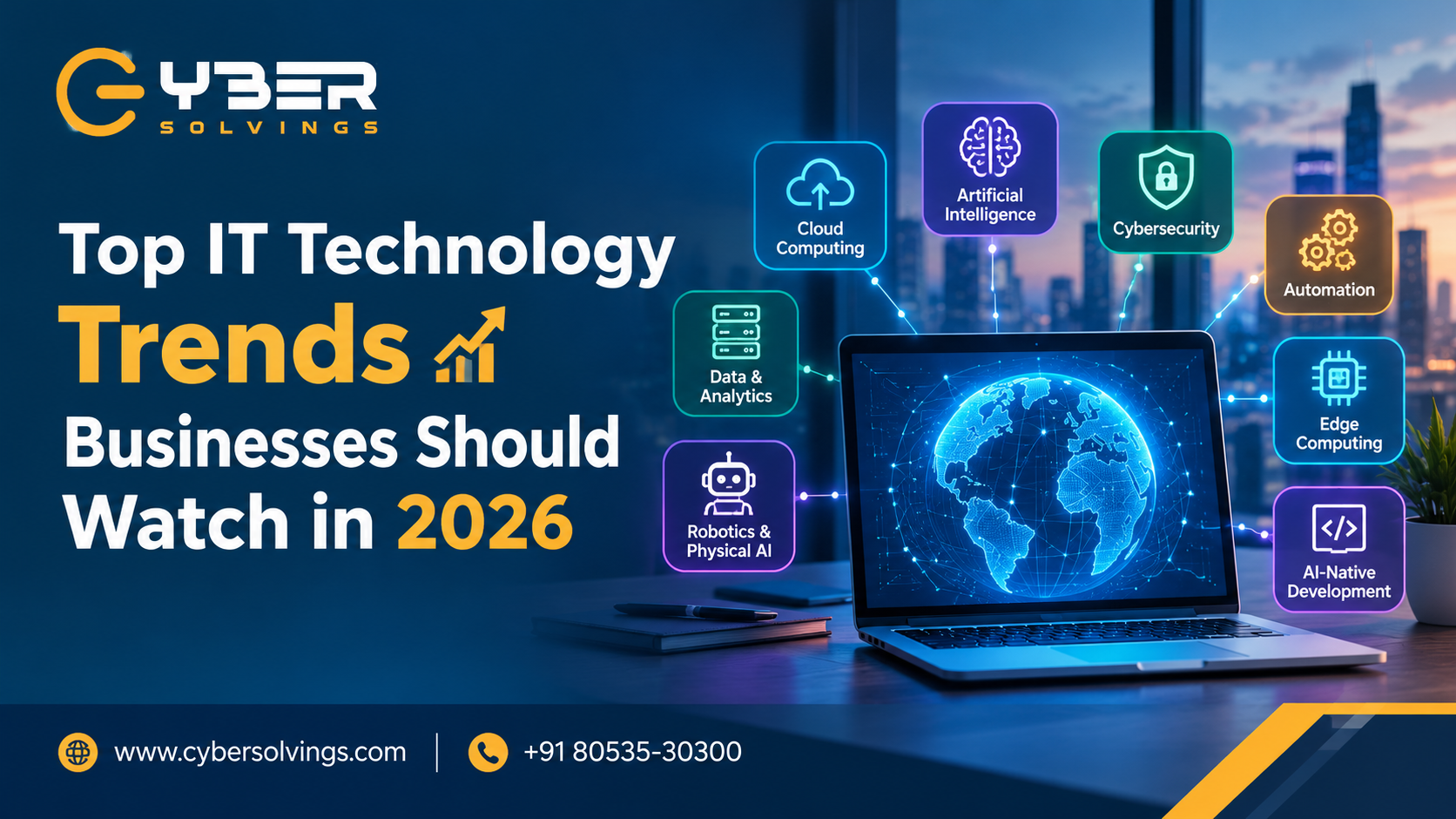
Technology continues to transform the way businesses operate, communicate, serve customers, and compete. In 2026, companies are moving beyond simply adopting new software and are focusing on intelligent, secure, scalable, and business-focused technology solutions. Artificial intelligence, cloud computing, cybersecurity, automation, edge computing, and intelligent infrastructure are becoming increasingly important for organizations of all sizes.
For businesses, keeping up with the latest IT technology trends in 2026 is no longer just about innovation. It is about improving efficiency, reducing operational costs, protecting valuable data, and creating better customer experiences.
Recent technology research shows that organizations are increasingly moving AI from experimentation into practical business operations. Gartner’s 2026 strategic technology trends highlight areas including AI-native development, AI supercomputing, multiagent systems, confidential computing, physical AI, preemptive cybersecurity, and AI security platforms.
In this article, we explore the top IT technology trends businesses should watch in 2026 and how they can influence future business growth.
1. Artificial Intelligence Becomes a Core Business Technology
Artificial Intelligence (AI) remains one of the most important technology trends in 2026. However, businesses are increasingly moving beyond basic AI experiments and using AI for practical business processes.
AI can help organizations automate repetitive tasks, analyze large amounts of data, improve customer support, identify patterns, and support decision-making.
Generative AI is also becoming integrated into everyday business applications. Employees can use AI assistants for creating content, summarizing documents, analyzing information, writing code, and supporting internal operations.
The next stage is AI-powered business operations, where AI becomes part of workflows rather than functioning as a separate tool.
Businesses should focus on identifying specific problems that AI can solve instead of adopting AI simply because it is popular. A well-planned AI strategy should consider data quality, security, employee training, costs, and measurable business outcomes.
2. Agentic AI and Multi-Agent Systems
One of the emerging technology trends for businesses in 2026 is the rise of agentic AI.
Traditional AI systems usually respond to a specific request. Agentic AI can take a series of actions to achieve a defined objective. For example, an AI agent could analyze a customer request, retrieve relevant information, create a response, update a business system, and notify an employee.
Multi-agent systems take this concept further by allowing multiple specialized AI agents to collaborate on complex tasks. Gartner lists multiagent systems among its major strategic technology trends for 2026.
Businesses may eventually use AI agents for areas such as:
- Customer service
- IT support
- Software development
- Sales operations
- Data analysis
- Business administration
- Cybersecurity monitoring
- Workflow automation
However, greater autonomy also creates greater security and governance requirements. Businesses should establish clear permissions, monitoring, human oversight, and access controls before allowing AI agents to interact with sensitive systems.
3. AI-Powered Cybersecurity
As businesses adopt more AI, cybersecurity becomes even more important.
Cybercriminals can also use AI to automate attacks, create convincing phishing campaigns, identify vulnerabilities, and increase the speed of malicious activity. This means traditional security approaches may not be enough for modern digital environments.
In 2026, businesses are increasingly focusing on AI-powered cybersecurity, including automated threat detection, behavioral analysis, security monitoring, and faster incident response.
Gartner’s 2026 cybersecurity research highlights the growing need for security oversight around agentic AI and the changing role of AI-enabled security operations.
Businesses should strengthen security through:
- Multi-factor authentication
- Zero-trust security
- Endpoint protection
- Continuous monitoring
- Regular security assessments
- Employee cybersecurity training
- Data encryption
- Backup and disaster recovery
- AI security policies
Cybersecurity should not be treated as an optional IT expense. It is an essential part of business continuity and customer trust.
4. AI Security and Responsible AI Management
As organizations use more AI applications, they also need to secure the AI itself.
AI systems may have access to sensitive company information, customer data, internal documents, or business applications. Poorly controlled AI usage can create risks such as data leakage, unauthorized access, prompt injection, and inappropriate automated actions.
AI security platforms are therefore becoming increasingly relevant. Gartner identifies AI security platforms as one of its strategic technology trends for 2026, with the goal of providing centralized visibility, controls, and protection for AI applications.
Businesses should develop an AI governance framework that defines:
- Which AI tools employees can use
- What information can be shared with AI
- Who can access AI systems
- How AI decisions are monitored
- How sensitive data is protected
- When human approval is required
Responsible AI management can help organizations gain the benefits of AI while reducing unnecessary risks.
5. Cloud Computing and Hybrid Cloud
Cloud computing remains a major part of modern business IT infrastructure.
However, in 2026, many organizations are taking a more strategic approach to cloud adoption. Instead of moving everything to a single public cloud environment, businesses may combine public cloud, private cloud, on-premises infrastructure, and edge computing.
This approach is commonly known as hybrid cloud.
Hybrid cloud can provide businesses with greater flexibility. Sensitive workloads may remain in controlled environments while other applications use public cloud infrastructure for scalability.
Modern IT operations research also identifies hybrid cloud management as an important 2026 trend, particularly as businesses seek better resilience, security, cost management, and flexibility.
For businesses, the goal should not simply be “move to the cloud.” Instead, organizations should determine which workloads belong in which environment.
6. Edge Computing and Intelligent Infrastructure
As applications require faster response times, businesses are increasingly looking beyond centralized cloud infrastructure.
Edge computing processes data closer to where it is generated. This can be useful for manufacturing, healthcare, retail, logistics, smart buildings, IoT devices, and other environments where low latency is important.
For example, a manufacturing facility can process information from machines locally instead of sending every piece of data to a distant cloud data center.
Edge computing is becoming increasingly connected with AI. AI workloads can run closer to devices and users, helping organizations reduce latency and improve real-time decision-making.
This makes edge computing and AI infrastructure important areas for businesses to monitor in 2026.
7. AI-Native Software Development
Software development is also changing rapidly because of AI.
AI-native development platforms can help developers write code, test applications, identify bugs, document projects, and automate parts of the development lifecycle.
This does not mean developers are becoming unnecessary. Instead, developers can use AI as a productivity partner while spending more time on architecture, problem-solving, security, and business requirements.
Gartner expects AI-native development platforms to become increasingly important as organizations look for ways to create software with smaller, more productive teams.
Businesses should establish development guidelines around AI-generated code, including code review, testing, security validation, intellectual property considerations, and data protection.
8. Confidential Computing and Data Protection
Data privacy is becoming increasingly important as organizations process more sensitive information through cloud and AI systems.
Confidential computing is an emerging approach designed to protect data while it is being processed. Gartner identifies confidential computing as a major strategic technology trend for 2026, particularly for organizations handling sensitive workloads and operating across complex regulatory environments.
For businesses, this technology can become particularly relevant in industries such as:
- Banking and finance
- Healthcare
- Government
- Insurance
- Legal services
- Technology
As data becomes more valuable, protecting it throughout its lifecycle will become increasingly important.
9. Automation and AIOps
Business automation is not new, but it is becoming more intelligent.
AI-powered automation can help organizations monitor systems, identify potential problems, automate routine IT operations, and respond to incidents.
This is where AIOps, or Artificial Intelligence for IT Operations, becomes valuable.
Instead of waiting for an employee to discover that a server, application, or network is experiencing problems, intelligent monitoring systems can identify unusual behavior and potentially take corrective action.
For IT teams, this can mean:
- Faster issue detection
- Reduced downtime
- Predictive maintenance
- Automated troubleshooting
- Better infrastructure visibility
- More efficient IT teams
AIOps can be particularly valuable for organizations managing large or complex IT environments.
10. Zero-Trust Cybersecurity
The traditional idea of securing a business by protecting the network perimeter is becoming less effective.
Employees may work remotely, applications may run in multiple cloud environments, and business data may be accessed from different devices and locations.
This has increased the importance of Zero Trust security.
The basic principle is simple: organizations should not automatically trust a user or device simply because it is inside the corporate network.
Businesses can strengthen Zero Trust through:
- Strong identity verification
- Multi-factor authentication
- Least-privilege access
- Device security
- Network segmentation
- Continuous monitoring
- Application-level access controls
Zero Trust is becoming a foundational security strategy for businesses operating in cloud and hybrid environments.
11. Domain-Specific AI Models
General-purpose AI models are powerful, but businesses often need technology that understands their specific industry and processes.
This is driving interest in domain-specific language models.
A domain-specific model can be trained or adapted around specialized information, terminology, workflows, and requirements.
For example, a healthcare organization may need an AI system that understands medical terminology, while a financial organization may require AI that understands financial regulations and industry-specific processes.
Gartner identifies domain-specific language models as a key 2026 trend because specialized models can potentially provide better accuracy, context, and compliance for targeted business applications.
12. Physical AI and Smart Automation
AI is no longer limited to software.
Physical AI combines artificial intelligence with physical machines, robots, devices, and equipment. Gartner identifies physical AI as one of its top strategic technology trends for 2026.
Businesses in manufacturing, logistics, warehouses, agriculture, healthcare, and other industries can benefit from intelligent machines that can sense their surroundings and respond to changing conditions.
Robotics combined with AI could improve productivity, automate repetitive work, and support safer operations.
This trend is still developing, but businesses with physical operations should monitor it closely.
13. Digital Provenance and Technology Trust
With the growing use of AI-generated content, third-party software, open-source components, and digital services, businesses need better ways to understand where digital assets come from.
This is where digital provenance becomes important.
Digital provenance involves verifying the origin, ownership, integrity, or history of digital information and assets.
For businesses, this can help improve trust in:
- Software components
- AI-generated content
- Business data
- Digital documents
- Third-party applications
- Supply-chain technology
Gartner has included digital provenance among its 2026 strategic technology trends, reflecting the growing importance of trust and transparency in digital environments.
How Businesses Can Prepare for IT Trends in 2026
Businesses do not need to adopt every new technology immediately. The better approach is to prioritize technologies based on business requirements.
Start by identifying your organization’s biggest challenges.
Ask questions such as:
- Where are we losing productivity?
- Which processes are repetitive?
- Where could automation reduce costs?
- Is our cybersecurity strong enough?
- How secure is our business data?
- Can our IT infrastructure scale?
- Which cloud strategy fits our business?
- Are employees properly trained?
- How can technology improve customer experience?
After identifying priorities, businesses can create a technology roadmap.
It is also important to invest in employees. New technology requires new skills, and organizations need teams that understand AI, cybersecurity, cloud computing, automation, data, and modern IT infrastructure.
Recent 2026 research shows that organizations are increasingly focusing on infrastructure, security, and strategic technology partnerships as they move AI from experimentation into production.
Why IT Support Matters in the Age of New Technology
Adopting new technology without proper planning can create additional complexity.
Businesses may need help with cloud migration, cybersecurity, network management, software deployment, data backup, system monitoring, troubleshooting, and employee support.
This is where professional IT support services can make a significant difference.
A reliable IT partner can help businesses evaluate technology, implement appropriate solutions, monitor systems, reduce downtime, and improve security.
For organizations looking to modernize their technology infrastructure, Cybersolvings can be part of that journey by helping businesses understand their IT requirements and adopt technology with a practical, business-focused approach.
Conclusion
The top IT technology trends businesses should watch in 2026 are centered around one major shift: technology is becoming more intelligent, automated, connected, and security-focused.
Artificial intelligence and agentic AI are changing business processes. Cloud and edge computing are transforming infrastructure. AI-powered cybersecurity and Zero Trust are strengthening digital protection. Confidential computing and digital provenance are helping organizations build greater trust. Meanwhile, AI-native development, physical AI, automation, and domain-specific models are opening new opportunities for productivity and innovation.
The key is not to adopt technology simply because it is trending. Businesses should focus on technologies that solve real problems, improve efficiency, protect valuable information, and create measurable business value.
For companies planning their next stage of digital transformation, staying informed about these trends can provide a competitive advantage.
Cybersolvings helps businesses stay focused on practical IT solutions while preparing for an increasingly digital and technology-driven future.
Visit www.cybersolvings.com to learn more about IT solutions and services for modern businesses.