






Running a growing business can feel simple at first. A few employees, some spreadsheets, emails, separate software tools, and daily meetings may be enough. But as the company expands, these systems can become difficult to manage. Information gets scattered, teams lose time, and small operational problems start creating bigger ones.
This is where an enterprise solution can make a real difference. It brings important business processes, data, applications, and workflows into a more connected environment. Instead of managing everything separately, organizations can build a structured system that supports better decisions and smoother operations.
What Is an Enterprise Solution?
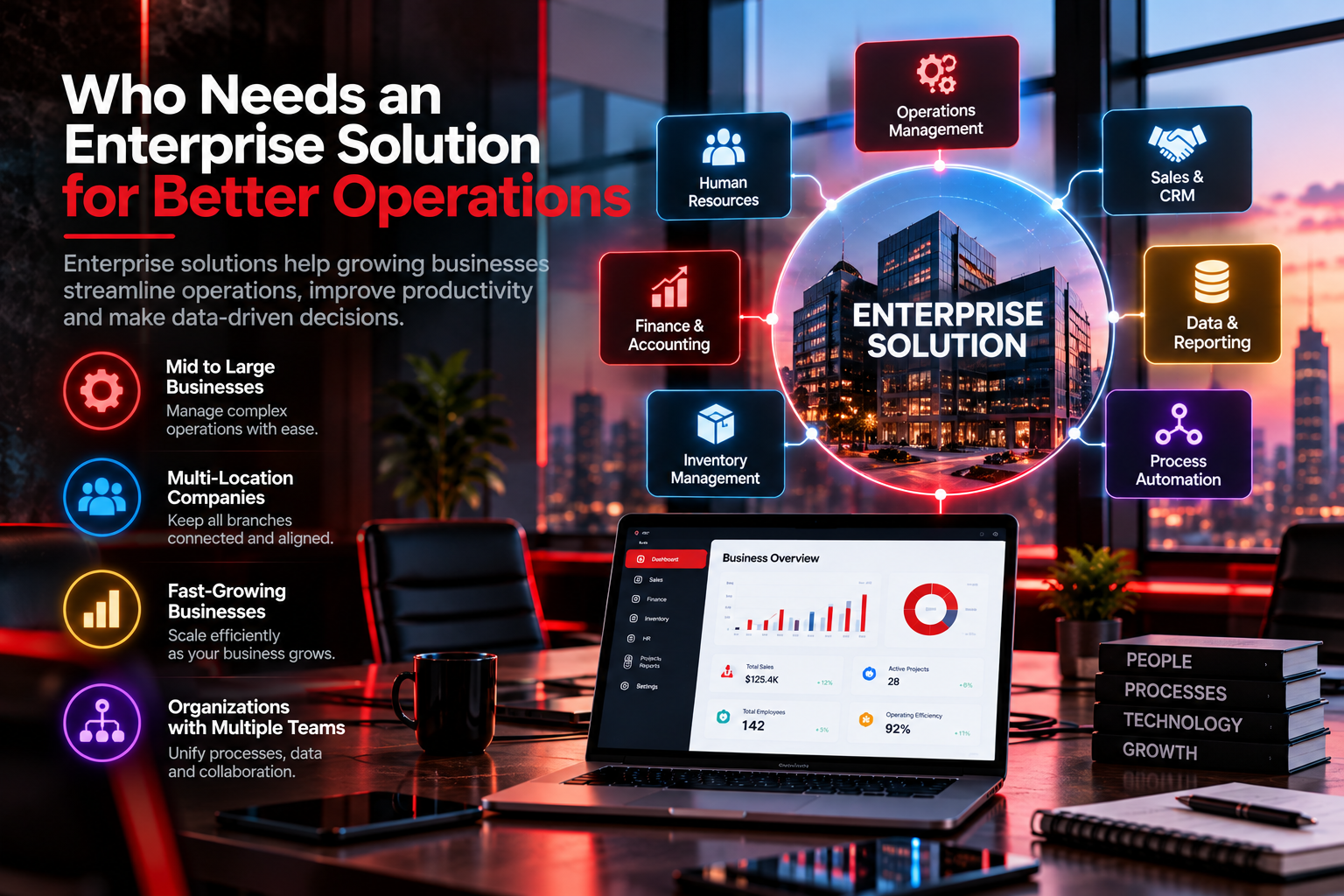
An enterprise solution is a technology system designed to help organizations manage complex business operations at scale. It can connect departments such as finance, sales, human resources, customer service, supply chain, and IT.
Unlike basic business software, enterprise platforms are generally built around the needs of larger or fast-growing organizations. They can support multiple users, large amounts of data, automation, reporting, security, and integration with existing applications.
The goal is not simply to add another piece of software. It is to create a more connected digital environment where employees can access the information they need and complete their work efficiently.
Which Businesses Need Enterprise Technology?
Not every small business immediately needs an enterprise-level system. However, the situation changes when operations become more complicated.
A company with multiple departments, locations, employees, products, or customer groups may start experiencing information gaps. For example, the sales team might have customer information in one system while finance uses another. Employees then spend valuable time moving data between platforms.
An enterprise solution can help bring these processes together. This is especially useful for organizations experiencing rapid growth, increasing customer demand, or complex internal workflows.
Manufacturing companies, financial organizations, healthcare providers, retailers, technology companies, logistics businesses, and professional service providers can all benefit when their operations reach a certain level of complexity.
Growing Companies Can Benefit Too
Enterprise technology is not only for huge corporations. A medium-sized company preparing for rapid expansion may also need stronger infrastructure.
Imagine a company that has grown from 30 employees to 200 in a few years. The tools that worked at the beginning may now feel slow and disconnected. Employee records, customer data, project information, and financial reporting may all exist in different places.
This is often the point where businesses begin looking for enterprise IT solutions that can scale with their operations.
Planning early can be useful. Otherwise, companies may eventually spend more money replacing outdated systems and fixing integration problems.
How Enterprise Solutions Improve Operations
One major advantage is better information management. When business data is organized and connected, employees can spend less time searching for information.
Automation is another important benefit. Repetitive tasks such as reporting, approvals, data entry, notifications, and workflow management can often be automated. This reduces manual work and allows employees to focus on more valuable responsibilities.
Better visibility also supports management teams. Decision-makers can use dashboards, reports, business intelligence, and analytics to understand what is happening across the organization.
For organizations working with data and advanced analytics in Pakistan, connected enterprise systems can provide a stronger foundation for collecting, organizing, and analyzing business information.
Companies With Complex IT Environments
Some businesses already use many software applications. The problem is that these applications may not communicate effectively.
A company might use one platform for customer relationship management, another for accounting, another for inventory, and several additional tools for communication and project management. Each system may work well individually, but managing them together can become difficult.
Enterprise integration can reduce this complexity. An appropriately designed system can connect applications and create smoother information flow between departments.
That means fewer duplicate records, less manual data transfer, and better consistency.
Organizations That Need Stronger Security
As companies collect more customer, employee, financial, and operational information, security becomes increasingly important.
Enterprise systems can provide structured access controls, authentication, monitoring, backup strategies, and other security measures. These features help organizations control who can access specific information.
Security requirements vary by industry, so businesses should evaluate their compliance obligations before selecting a technology platform. A system should support the organization’s operational needs without creating unnecessary security risks.
Businesses Planning Digital Transformation
Digital transformation is more than moving documents from paper to computers. It involves changing how an organization operates through technology.
For a company beginning a larger digital transformation project, an secure your website can provide a central foundation for modernizing workflows and connecting different business functions.
Cloud services, automation, analytics, artificial intelligence, customer platforms, and integrated databases can work together when the underlying architecture is properly planned.
This can make future technology upgrades easier as well.
What Should Businesses Consider Before Choosing One?
The right system depends on the company’s size, industry, existing infrastructure, budget, and future goals. Businesses should first identify their actual operational problems rather than choosing technology simply because it has many features.
Scalability is important too. A solution should be capable of supporting additional users, locations, data, and business processes as the company grows.
Integration should also be considered. If the new system cannot work with important existing applications, implementation may become unnecessarily expensive and complicated.
Employee experience matters. Even a powerful platform can fail if employees find it confusing or difficult to use. Training and change management are therefore an important part of implementation.
Why the Right Technology Partner Matters
Implementing enterprise technology is not simply a matter of installing software. It requires planning, configuration, integration, testing, security considerations, and ongoing support.
An experienced technology partner can help an organization understand its requirements and develop a solution around actual business workflows.
For companies in Pakistan, working with a provider familiar with local business environments can also make communication and implementation easier. The right partner should focus on measurable business improvements rather than selling unnecessary features.
Conclusion
An enterprise solution can be valuable for organizations dealing with complex operations, rapid growth, disconnected applications, large amounts of data, or increasing security requirements. It helps bring technology and business processes closer together while giving teams better visibility and control.
The key is choosing a system that matches the company’s present requirements and future direction. A well-planned implementation can improve productivity, automation, data management, integration, and decision-making.
For businesses exploring modern enterprise IT solutions, Chromeis can help organizations move toward more connected and efficient digital operations. The right technology is not about making business more complicated. It is about making complicated business easier to manage.
Frequently Asked Questions
1. What is an enterprise solution used for?
An enterprise solution is used to manage and connect complex business processes. It can support areas such as finance, sales, customer management, human resources, analytics, inventory, and IT operations.
2. Does a small business need an enterprise solution?
Not always. Small businesses may not need enterprise-level technology initially. However, a growing company with complex workflows, multiple departments, or increasing data requirements may benefit from adopting scalable enterprise technology.
3. What are enterprise IT solutions?
Enterprise IT solutions are technology services and systems designed to support the infrastructure, applications, data, security, integration, and operational requirements of organizations.
4. How can enterprise technology improve productivity?
It can reduce repetitive manual tasks, connect business applications, improve access to information, automate workflows, and provide better reporting. This allows employees to spend more time on important business activities.
5. How should a company choose an enterprise solution?
A company should evaluate its business goals, existing technology, scalability requirements, security needs, integration requirements, budget, and employee experience before selecting a solution. Professional implementation support can also help reduce risks.