




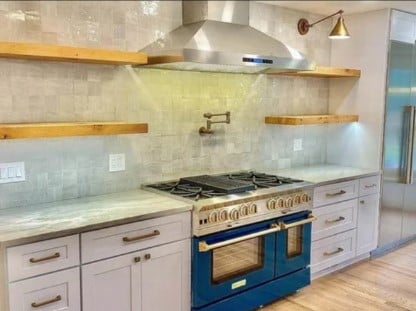
Large cooking surfaces create different ventilation requirements than compact residential cooktops. When multiple burners, griddles, or other appliances operate at the same time, cooking can generate more heat, grease, moisture, smoke, and airborne particles. Choosing an appropriately sized hood helps capture these byproducts before they spread throughout the kitchen.
For homeowners with expansive cooking areas, 54-inch range hoods can provide broad coverage across wider cooktops and professional-style ranges. However, physical width is only one part of selecting effective ventilation. Airflow, hood placement, ductwork, cooking habits, and installation all influence how well a system performs.
Why Hood Size Matters for Large Cooking Surfaces
A range hood needs to be positioned so that its capture area adequately covers the cooking surface below it. A hood that is too narrow may leave portions of the cooktop outside the most effective capture zone, particularly when steam or smoke rises away from the center.
Wider hoods like 54-inch range hoods provide greater horizontal coverage, making them particularly relevant for large ranges and cooktops. The goal is not simply to select the largest available hood but to match its dimensions and ventilation capacity to the cooking equipment.
What Does a 54-Inch Hood Offer?
A 54-inch hood is designed for applications where a broader ventilation footprint is useful. It can be appropriate for wide cooking equipment where a smaller hood would provide less coverage.
However, a larger hood does not automatically mean better ventilation. The blower’s airflow capacity, duct size, duct length, number of elbows, and termination all influence actual performance.
For this reason, 54-inch range hoods should be evaluated as part of a complete ventilation system. The hood needs to work with the cooking appliance and the home’s ductwork rather than being selected according to width alone.
Helps Control Smoke and Cooking Odors
Frying, searing, grilling, and high-temperature cooking can produce noticeable smoke and odors. Once these emissions spread beyond the immediate cooking area, they can settle on nearby surfaces and travel into other rooms.
A properly installed hood helps capture these emissions closer to their source. Outdoor-vented systems are particularly useful because they remove captured air from the building instead of simply filtering and returning it to the kitchen.
Supports Cleaner Kitchen Surfaces
Grease particles can travel through the kitchen when cooking without effective ventilation. Over time, these particles may settle on cabinets, walls, ceilings, and appliances.
Using 54-inch range hoods consistently can reduce the amount of cooking-related residue that escapes into the surrounding space. Regular cleaning of the hood and its grease filters remains important because accumulated grease can reduce effective operation and create additional maintenance concerns.
The EPA specifically recommends routinely cleaning kitchen surfaces, cooking appliances, and range hood grease filters as part of reducing cooking-related indoor pollution.
Works With Different Kitchen Layouts
Wide hoods can be used in different kitchen configurations, depending on the available space and ventilation design. Wall-mounted installations are common, while island applications require careful consideration of surrounding airflow because the hood is exposed on multiple sides.
Cabinet dimensions, ceiling height, duct routing, and the location of the cooking appliance should all be considered before installation. Selecting 54-inch range hoods can make sense when a kitchen includes a wide cooking surface that requires broader ventilation coverage.
A wider hood may require additional planning for structural support and duct routing, particularly when the kitchen is being remodeled or when an existing ventilation system needs modification.
Conclusion
The benefits depend on more than hood width, however. Proper airflow, installation height, ductwork, outdoor venting, filter maintenance, and appropriate use all contribute to effective kitchen ventilation. For homeowners researching the broader benefits of kitchen ventilation, 9 Reasons You Should Invest in a Range Hood offers an additional resource for understanding why range hood installation can be an important part of a well-ventilated kitchen. A properly selected and maintained system can help manage cooking moisture, odors, grease, smoke, and airborne particles while making large-scale cooking more comfortable.