





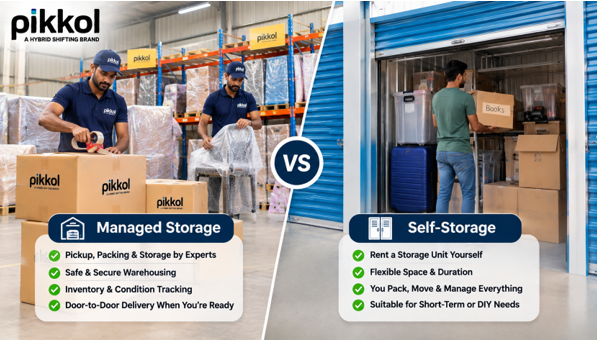
For most household moves in India, managed storage is the better fit, and self-storage suits people who want to visit and handle their own goods. In managed storage, the provider picks up, packs, stores and returns your goods. In self-storage, you rent a space, bring your goods yourself and keep control of access. If you’re between homes, renovating, or going abroad, and you want someone else to do the heavy lifting, choose managed. If you need to get in often or store business stock or hobby items, choose self-storage.
In one line each:
- Managed storage: you hand over your goods, and the provider handles pickup, packing, storage and return.
- Self-storage: you rent a unit, move your goods in and out yourself and usually hold the access.
Want a managed storage quote? Get a free quote from Pikkol or message us on WhatsApp.
What is managed storage?
Managed storage means the provider does the work. A typical service includes:
- Pickup from your home
- Packing, with materials
- Transport to the warehouse
- Storage in the provider’s facility
- Return and delivery to your address when you’re ready
Your goods are usually stored with other customers’ goods in the provider’s warehouse, and you don’t have your own key. It’s the natural choice when storage is part of a move. Pikkol’s storage page describes pickup, packing, storage and return of household goods. See how household storage works.
What is self-storage?
Self-storage means you rent a space, such as a unit or locker, and use it as you wish. A typical setup includes:
- A private unit in a range of sizes
- Access controls, such as a key, code or biometric entry
- You doing the work: packing, transport, loading and unloading
- Access hours set by the facility
You control when you visit and what goes in or out. It’s popular for business inventory, hobby gear, documents and items you need to reach often.
How do they compare?
Who does the work?
Managed storage: the provider. Self-storage: you. If you’re already juggling a move, a job change or a baby, this is the biggest difference.
Pickup and packing
Managed storage usually includes both, or offers them as add-ons. In self-storage, you arrange transport, buy packing materials and load the unit. Moving goods from a flat to a unit can mean hiring a mover anyway.
Access
Self-storage usually wins here. You can visit your unit within the facility’s hours. In managed storage, goods are normally retrieved by the provider on request, so you ask for items back rather than walking in. Ask whether visits are allowed and how they work.
Cost
Both can look cheap on a rate card, and the real total depends on what’s included. Self-storage can look cheaper per month, but you add the cost of transport, packing and your time. Managed storage can look more expensive per month, but it includes pickup, packing and return. Compare the total cost for your plan, not the monthly headline. See our guide to GST and hidden charges for what to check on any invoice.
Safety and handling
In self-storage, you handle your goods, so you know how they were packed, but you also carry the risk of damage while moving them. In managed storage, trained crews pack and handle your goods, but you rely on the provider’s care and records. Ask each provider about security, pest and damp protection, and how stored goods are recorded.
Insurance
Terms vary widely. Ask what is covered, on what value, whether cover is included or optional, and how to claim. Don’t assume your home insurance covers goods in storage.
Flexibility
Self-storage often lets you change unit size or stop with notice. Managed storage may price by volume and have a minimum period. Ask about the minimum term and the notice to end.
Space efficiency
In managed storage, you usually pay for the volume your goods take. In self-storage, you rent a fixed unit, and any space you don’t use is still paid for.
When is managed storage better?
- You’re between homes, with your move-out and move-in dates not matching
- Your new home isn’t ready, because of delayed possession or interiors
- You’re renovating, and want your goods out of the way and protected
- You’re moving abroad and want to store the rest in India
- You don’t have the time, vehicle or help to move your goods yourself
- You want one company for packing, storage and delivery to the new home
- You have a large load, such as a 2BHK or 3BHK
See Pikkol’s guides on storage vs paying an extra month’s rent and delivery from storage to your new home.
When is self-storage better?
- You need to visit often, to add or remove things
- You’re storing business stock, samples or documents
- You have hobby or sports gear, or tools you use regularly
- You’re decluttering a room, not clearing a home
- You want to control how your goods are packed and stacked
- You can handle the transport yourself
Can you combine them?
Sometimes the best answer is both: managed storage for the big, one-time move of furniture and boxes, and a small self-storage unit or a spare room at home for the things you’ll need to reach. If you’re moving abroad, you might ship essentials, store bulky goods in managed storage and carry the rest. Pikkol’s store, ship or sell guide can help you decide.
Which is cheaper?
It depends on what you need to do. As a rough guide:
- Short stay, large load, no vehicle: managed storage often costs less overall, because pickup and packing are included.
- Long stay, small load you can move yourself: self-storage can cost less per month.
- Frequent access: self-storage wins, because managed retrieval can add handling charges.
Pikkol doesn’t publish a standard storage rate card, so ask for a written quote for your home size and dates, and add the cost of any transport, packing and time you’d spend on self-storage.
What should you ask before you choose?
For any provider, ask for the answers in writing:
- What does the price include: pickup, packing, storage, return?
- What is the minimum period, and what happens if I end early?
- Can I visit or get items back, and what does it cost?
- How is my stuff recorded and kept safe from theft, damp, pests and fire?
- What cover applies, on what value, and how do I claim?
- What can’t be stored?
- Where is the facility, and which areas does the provider pick up from?
- How do I end the contract, and how fast can I get my goods back?
Pikkol’s FAQs and payment policy explain its booking terms. For how to vet any provider, see our guide on finding genuine packers and movers.
What does managed storage look like with Pikkol?
According to Pikkol’s storage page, the service covers pickup, packing, storage and return of household goods. Pikkol is also a packers and movers company, so storage can be part of a move. See packers and movers and house shifting. Pikkol’s Bengaluru storage page mentions a 48-hour return and no minimum contracts, so confirm the minimum period and return time in writing for your city and dates.
Storage pages by city:
If you’re moving abroad, see storage in Singapore, storage in the UAE and international relocations. To store a car or bike, see vehicle shifting.
Pikkol has completed more than 1,00,000 moves since 2015 and is headquartered in Bengaluru. Learn more about Pikkol or contact us.
Ready to compare? Get a free storage quote or chat on WhatsApp. Tell us your city, home size and how long you need storage.
Frequently asked questions
What is the difference between managed storage and self-storage?
In managed storage, the provider picks up, packs, stores and returns your goods. In self-storage, you rent a unit and do the packing, moving and access yourself.
Which is better for a house move?
Managed storage, usually, because pickup, packing and delivery are included and one company can handle the whole move.
Which is better if I need to visit my things often?
Self-storage, because you control access. Ask any managed provider whether visits are allowed.
Which is cheaper?
It depends. Self-storage can cost less per month, but you add transport, packing and your time. Managed storage can cost less overall for a one-time move. Compare total costs.
Is my stuff safer in managed storage?
Not automatically. Safety depends on the facility, the handling and the insurance. Ask about security, damp and pest protection, records and cover in writing.
Can I store furniture in self-storage?
Yes, if you can move it, and the unit is large enough. Many people hire a mover to transport it.
Does Pikkol offer managed storage?
Pikkol’s storage page describes pickup, packing, storage and return of household goods. See Pikkol storage.
Is there a minimum storage period?
Ask in writing. Pikkol’s Bengaluru page mentions no minimum contracts, but other material describes longer packages, so confirm for your dates.
Can I use both?
Yes. Some people put bulky goods in managed storage and keep a small unit for things they need often.
Does my home insurance cover stored goods?
Don’t assume so. Ask your insurer and the storage provider what is covered and on what value.