



Even a well-prepared student can also get frosen with a blank page. You may know the meaning of the topic, have ideas in your head, yet it can feel strangely difficult to turn those ideas into five clear paragraphs. The good news is that a strong essay is not only about using complicated words.
It is about having a clear argument, choosing useful evidence and giving every paragraph a job. That approach is crucial for Australian students because academic writing is increasingly rewarding clarity, reasoning and evidence instead of empty length. In this blog, you will walk through the step-by-step guide to writing a 5-paragraph essay.
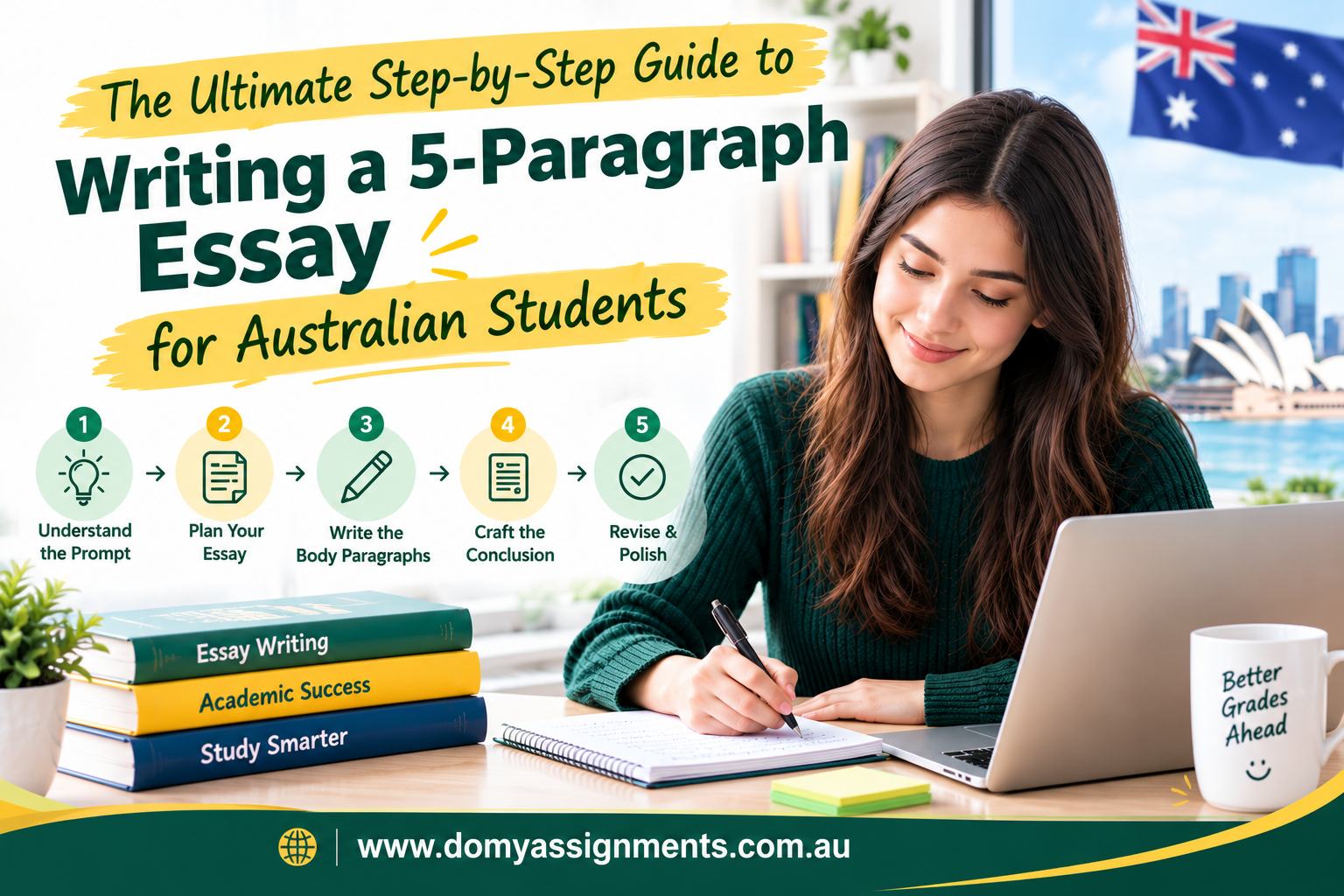
Step-By-Step Guide To Writing A 5-Paragraph Essay
Once you organise your ideas, drafting becomes much less intimidating. You should treat each paragraph as a small task instead of trying to write my essay for me Australia all at once.
1. Decode The Question
You should write the question at the top of your page. Now identify the topic, instruction word and limits of the task. This simple habit can keep you from wandering into interesting but irrelevant material.
2. Choose Three Strong Points
It is ideal to pick three arguments that directly answer the question. Quality is more important than quantity. Three well-developed ideas will usually create a stronger short essay than six rushed ones.
3. Draft Your Thesis
You should combine your answer with your three main reasons. Your thesis can become a quick test throughout the writing process: if a paragraph is not supporting it, you should reconsider the paragraph.
4. Research Selectively
Now you need to look for reliable sources instead of collecting dosens of links. Government publications, books, reputable academic sources and university resources are usually more useful than considering anonymous websites. You can record where each fact came from as you research, so do not make referencing a last-minute headache.
5. Draft The Three Body Paragraphs
In this step, you should write the body before you worry too much about perfect wording. Now start each paragraph with its main point, add relevant evidence, explain the evidence and connect the discussion back to the thesis.
6. Write And Polish The Introduction
Now that you know what your essay actually says, it will become easier to write the introduction. You should give the reader context, your thesis and a short roadmap.
7. Write The Conclusion And Edit
Must end by answering the question clearly and then read the entire essay slowly. Check whether every paragraph is contributing something useful, whether evidence is explained, and whether grammar, spelling, referencing and word count meet the assessment requirements.
Common Mistakes Australian Students Should Avoid
A strong structure can still fall apart when small problems accumulate. You should watch for these issues before you submit your essay.
- If you are using sophisticated vocabulary for its own sake, it can make your argument harder to understand. Writing an essay is not a competition to find the longest word in the dictionary.
- Another common mistake is often confusing description with analysis. It is descriptive to say what happened, and analysis is to explain why it matters and how it supports your argument.
- Some students also depend heavily on memorised templates. A framework for your essay should not replace it, but guide your thinking. It may seem tempting to search for essay writing when deadlines become stressful, but learning to construct the argument yourself can give you a skill that you can reuse across subjects.
- You should never leave proofreading until the final minute. Read for meaning first, then go for grammar and spelling and check references separately. A fresh read can help you reveal missing words, repeated ideas and weak connections to you that are almost invisible during drafting.
Final Checklist Before Submission
Before you click on submit, you should ask yourself five quick questions:
➢ Have I answered the exact question?
➢ Is my thesis clear?
➢ Does each body paragraph contain one main idea?
➢ Have I explained my evidence?
➢ Does the conclusion actually reflect the argument?
You must also check the requirements of your teacher for formatting, referencing, word count and submission. Academic expectations can differentiate between schools, subjects and assessment types. If you are tempted to search for “do my assignment for me,” take a pause and return to your plan first. A clear outline often helps you to make a difficult assignment feel much more manageable.
Frequently Asked Questions
1. How long should I write a five-paragraph essay?
There is no fixed word count because requirements depend on the level of the year, subject and assessment instructions. As a general learning exercise, you should focus less on reaching an arbitrary number and more on developing each paragraph fully. You must always follow the word limit that is supplied by your teacher or assessment rubric.
2. How many sources should I include in a short essay?
The number of sources you need to add in a short essay depends on the assignment and year level. A short classroom essay may need only a few appropriate sources, but a research-based task could expect considerably more references. The most important point is that sources must genuinely support your argument. Reliable evidence is more valuable than a long list of weak references.
3. What should I do if I cannot think of a thesis?
You should return to the essay question and answer it in one ordinary sentence, without worrying about academic language. Then you must ask yourself why you believe that answer. Your three strongest reasons can become your body paragraphs. Once those ideas are clear to you, refine the sentence into a concise thesis that previews your argument.
Conclusion
A good five-paragraph essay is not about to fill five sections with words. It is about to build one clear answer from beginning to end. The step-by-step guide to writing a 5-paragraph essay can give you a practical route: understand the question, plan three ideas, develop evidence, analyse what it means, then edit with care. Australian students already have access to strong reading and writing resources, so the next step is just to put those skills into a repeatable process. You should start with your question today and see how much easier the blank page feels.